书单
百科
这个词条暂时没有中文维基百科条目,下面是英文维基百科的内容(英文原文):
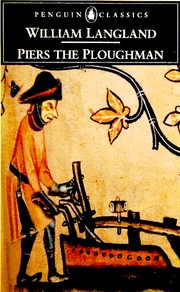
Piers Plowman (written c. 1370–86; possibly c. 1377) or Visio Willelmi de Petro Ploughman (William's Vision of Piers Plowman) is a Middle English allegorical narrative poem by William Langland. It is written in unrhymed, alliterative verse divided into sections called passus (Latin for "step").
Like the Pearl Poet's Sir Gawain and the Green Knight, Piers Plowman is considered by many critics to be one of the greatest works of English literature of the Middle Ages, preceding and even influencing Chaucer's Canterbury Tales. Piers Plowman contains the first known reference to a literary tradition of Robin Hood tales.
Three distinct versions of the poem exist, which scholars refer to as the A-, B-, and C-texts. The B-text is the most widely edited and translated version; it revises and extends the A-text by over 4000 lines.
Also, a Z-text of Piers Plowman, discovered in the 1980s, is composed of elements from the A and C versions. The Z-text is not distinctly authorial (critics have suggested it may be of scribal production), thus its authorship is greatly contested.
Summary
The poem, a mix of theological allegory and social satire, concerns the narrator/dreamer's quest for the true Christian life in the context of medieval Catholicism. This journey takes place within a series of dream visions; the dreamer seeks, among other things, the allegorical characters Dowel ("Do-Well"), Dobet ("Do-Better"), and Dobest ("Do-Best"). The poem is divided into passus ('steps'), the divisions between which vary by version.
The following summary is based on the B-version of the poem.
Vision 1
Prologue:
The poem begins in the Malvern Hills between Worcestershire and Herefordshire. A man named Will (which can be understood either simply as a personal name or as an allegory for a person's will, in the sense of 'desire, intention') falls asleep and has a vision of a tower set upon a hill and a fortress (donjon) in a deep valley; between these symbols of heaven and hell is a 'fair field full of folk', representing the world of humankind. A satirical account of different sections of society follows, along with a dream-like fable representing the King as a cat and his people as rodents who consider whether to bell the cat.
Passus 1:
Holy Church visits Will and explains the tower of Truth, and discusses Truth more generally.
Passus 2:
Will sees Lady Mede ('payment') and finds out about her planned marriage to False.
Passus 3:
Lady Mede travels to the royal court; the King proposes she marry Conscience; but Conscience denounces her.
Passus 4:
Conscience and Reason convince the King not to marry Mede to False. Will wakes up.
Vision 2
Passus 5:
Will falls back to sleep. Reason gives a sermon to the Field of Folk and the people decide to repent. The Seven Deadly Sins make confession and in penance attempt to go on pilgrimage to St Truth. They get lost, and Piers Plowman makes his first appearance: he will help the penitents if they help him plough his half-acre.
Passus 6:
Piers and the penitents plough the half-acre. Some people refuse to work, and Hunger punishes them until they work. But once Hunger has been sated, the people return to idleness.
Passus 7:
Eventually, Truth sends Piers a pardon for the penitents' sins; its main content is 'Do well and have well and God shall have your soul' and 'Do evil and have evil, and expect nothing other than that after your death, the Devil shall have your soul'. When challenged on the pardon's validity by a priest, Piers angrily tears it in two. Will is awakened by their arguing and, musing on his dreams, decides to seek ‘Do-wel’.
Vision 3
Passus 8:
Will's search for Dowel begins. He enters into a disputation with Friars. He then falls asleep once more and meets Thought. Thought instructs Will in 'Do well, do better, do best'. Practical interpretation of what these concepts mean is to be provided by Wit.
Passus 9:
There is an extended allegory featuring Dowel and the Castle of Flesh, exposing the need for people to be governed by their 'Inwit'. The text discusses poverty and marriage. Wit makes further inroads to understanding Dowel, as active virtue.
Passus 10:
Will meets Wit's wife, Dame Study. She complains to Will about his ignorance. Will then proceeds to Clergy and Scripture to learn more about Dowel. He considers what use scholarship might have in helping him achieve salvation.
Passus 11:
Scripture complains about Will's lack of self-knowledge. Angered, Will (who is already dreaming) goes to sleep and has a dream-within-a-dream in which he meets Fortune. He serves her into old age, but she abandons him. Will learns about the salvation of the Emperor Trajan and the power of love. Kynde ('character, natural disposition, nature', here understood as an aspect of God) shows Will the world. Will has an argument with Reason: Reason, Will concludes, does not do enough to keep people from sin; but Reason disagrees. Will awakes from the dream-within-a-dream. He now meets Imaginatif, who advises Will to be patient.
Passus 12:
Imaginatif teaches Will, bringing together and improving his understanding of earlier discussions in the poem. Imaginatif emphasises the need for humility and the importance of Grace.
Vision 4
Passus 13:
Will awakens and then falls back to sleep; he dreams of sharing a feast with Conscience, Scripture, Clergy and Patience; he encounters a greedy Doctor of Divinity (who later shows disdain for love) and as well as eating actual food also dines on spiritual food. Piers the Plowman offers a definition of Do Well, Do Better and Do Best. Then Conscience and Patience meet Haukyn the Active Man, who wears a coat of Christian faith which is, however, soiled with the Seven Deadly Sins.
Passus 14:
Conscience teaches Haukyn to seek forgiveness and do penance; Patience teaches Haukyn about the merits of embracing poverty. Haukyn cries out for God's mercy, which awakens Will.
Vision 5
Passus 15:
以上文字摘自英文维基百科「Piers Plowman」(有删节,去掉了参考文献等尾部小节),按 CC BY-SA 4.0 使用,作者为维基百科的各位编者。
资料卡
- 原作语言
- 中古英语
- 作品形式
- 诗作
资料卡来自 Wikidata Q1757630(CC0),众包数据,个别字段可能不全。