书单
百科
这个词条暂时没有中文维基百科条目,下面是英文维基百科的内容(英文原文):
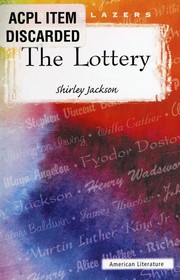
"The Lottery" is a short story by Shirley Jackson that was first published in The New Yorker on June 26, 1948. The story describes a fictional small American community that observes an annual tradition known as "the lottery", which is intended to ensure a good harvest and purge the town of bad omens. The lottery, its preparations, and its execution are all described in detail, though it is not revealed until the end what actually happens to the person selected by the random lottery: the selected member of the community is stoned to death by the other townspeople.
Jackson and The New Yorker were both surprised by the initial negative response from readers; subscriptions were canceled and large amounts of hate mail were sent throughout the summer of its first publication, with Jackson receiving at least 10 letters per day. The Union of South Africa banned it.
The story has been dramatized several times, including as a radio drama, film, and graphic novel. It has been subjected to considerable sociological and literary analysis and has been described as one of the most famous short stories in the history of American literature.
Plot
Details of contemporary small-town American life are embroidered upon a description of an annual rite known as "the lottery". In a small, unnamed village of about 300 residents, the locals are in an excited yet nervous mood on June 27. Children pile up stones as the adults assemble for their annual event, practiced to ensure a good harvest; Old Man Warner quotes an old proverb, "Lottery in June, corn be heavy soon." However, some nearby villages have already discontinued the lottery, and rumors are spreading that others are considering doing the same. Some in the village respond that the lottery has always been conducted and should continue every year henceforth.
The lottery preparations start the night before, with coal merchant Mr. Summers and postmaster Mr. Graves drawing up a list of all the extended families in town and preparing one paper slip per family. The slips are folded and placed in an age-stained black wooden box which is stored in a safe at Mr. Summers' office until the lottery is scheduled to begin.
The initial drawing takes place to choose one family. There is a sense of relief in those not chosen. In one case, a family member is sent to pass word to their injured father that their family was not picked. Bill Hutchinson draws the only marked slip in the box, and his wife Tessie complains that he was rushed into making his choice, despite her having been in a previously jovial mood and seemingly unbothered by the lottery system. Since their family consists of only one household, the second drawing to choose a household is skipped.
For the final drawing, one slip is placed in the box for each member of the Hutchinson household: Bill, Tessie, and each of their three children. Tessie tries to force her older married daughter and her husband to participate with them, even though it is a known rule that daughters draw with their husband's families. Each of the five draws a slip, and Tessie gets the marked one. The townspeople, including Tessie's young son Davy, pick up the gathered stones and begin throwing them at her as Tessie screams about the unfairness of the lottery.
Reception
Readers
The New Yorker received a "torrent of letters" inquiring about the story, "the most mail the magazine had ever received in response to a work of fiction". Many readers demanded an explanation of the situation in the story, and a month after the initial publication, Jackson responded in the San Francisco Chronicle (July 22, 1948):
Explaining just what I had hoped the story to say is very difficult. I suppose, I hoped, by setting a particularly brutal ancient rite in the present and in my own village to shock the story's readers with a graphic dramatization of the pointless violence and general inhumanity in their own lives.
Jackson lived in North Bennington, Vermont, and her comment reveals that she had Bennington in mind when she wrote "The Lottery". In a 1960 lecture, printed in her 1968 collection Come Along with Me, she recalled the hate mail she received in 1948:
One of the most terrifying aspects of publishing stories and books is the realization that they are going to be read, and read by strangers. I had never fully realized this before, although I had of course in my imagination dwelt lovingly upon the thought of the millions and millions of people who were going to be uplifted and enriched and delighted by the stories I wrote. It had simply never occurred to me that these millions and millions of people might be so far from being uplifted that they would sit down and write me letters I was downright scared to open; of the three-hundred-odd letters that I received that summer I can count only thirteen that spoke kindly to me, and they were mostly from friends. Even my mother scolded me: "Dad and I did not care at all for your story in The New Yorker", she wrote sternly; "it does seem, dear, that this gloomy kind of story is what all you young people think about these days. Why don't you write something to cheer people up?"
The New Yorker kept no records of the phone calls, but letters addressed to Jackson were forwarded to her. That summer she regularly took home 10 to 12 forwarded letters each day. She also received weekly packages from The New Yorker containing letters and questions addressed to the magazine or editor Harold Ross, plus carbon copies of the magazine's responses mailed to letter writers.
以上文字摘自英文维基百科「The Lottery」(有删节,去掉了参考文献等尾部小节),按 CC BY-SA 4.0 使用,作者为维基百科的各位编者。
资料卡
- 原题
- The Lottery
- 原作语言
- 英语
- 首次出版
- 1948 年
- 作品形式
- 短篇小说
- 体裁
- 推想虚构作品、恐怖作品
- 首发于
- The Lottery and Other Stories、Best Horror Stories 3 等 3 项
- 首版出版社
- 纽约客
资料卡来自 Wikidata Q1817456(CC0),众包数据,个别字段可能不全。
改编作品
电影2
名单来自 Wikidata(CC0):只列条目里写明「改编自 / 取材于」这本书的作品,不按名字猜;众包数据,可能不全。