 书单
百科
这个词条暂时没有中文维基百科条目,下面是英文维基百科的内容(英文原文):
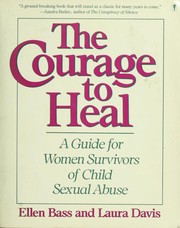
The Courage to Heal: A Guide for Women Survivors of Child Sexual Abuse (first published in 1988, with three subsequent editions, the last being a 20th anniversary edition in 2008) is a self-help book by poet Ellen Bass and Laura Davis that focuses on recovery from child sexual abuse.
The intent of the book is to provide a healing experience by means of explanations, practical suggestions, descriptions and accounts from women who have experienced sexual abuse. The authors say that individuals (mainly women) with a general set of symptoms may have been abused, but the memories of which have been repressed. They propose a variety of techniques to overcome their symptoms, including confronting their alleged abusers, adopting an identity as a "survivor", overcoming the associated trauma, and in cases where there is no memory of any abuse, recovering the memories. The book was a bestseller in North America and Europe. The 20th Anniversary Edition came out in 2008 and included an updated resource guide, additional stories and research.
The book has been criticized for being used primarily by incompetent therapists, for creating in children false memories of abuse, as well as for its authors' lack of qualifications, for creating an industry which has isolated and separated family members despite having no proof the abuse occurred, and for destructively replacing individual identities with that of a "survivor". Bass and Davis have also been criticized for leaping to unwarranted, implausible conclusions with significant consequences and for scientific errors found in the first edition that were not corrected in subsequent reprintings. Bass and Davis responded to the controversy surrounding the book by writing "Honoring the Truth: A Response to the Backlash", a new chapter included in the 1994 edition to respond to and rebut criticisms of the book, though this was removed from the 20th anniversary edition.
Authors
The Courage to Heal is written by Ellen Bass, a poet and creative writing teacher and her student Laura Davis, an author and incest survivor. Bass worked as a counselor and group facilitator with survivors of child sexual abuse. Bass is married to a survivor of child sexual abuse and Davis was sexually abused as a child and participated in one of Bass' creative writing workshops. Bass and Davis attributed efforts to confront incest and child sexual abuse to the women's liberation movement. While working with students, Bass and Davis came to believe that the stories of some students were trying to convey painful memories of incest. From this idea, the two developed methods to assist students in recovering memories of abuse in childhood.
Neither Bass nor Davis have any training in psychotherapy or science, and they state that nothing in the book is based on any psychological theories. They have defended their lack of training, saying that a PhD is not necessary "to listen carefully and compassionately to another human being". Bass and Davis still define themselves as healers and experts in the area of child sexual abuse, due to leading workshops with victims.
Summary
The 2008 edition is divided into six sections:
Taking Stock
The Healing Process
Changing Patterns
For Supporters of Survivors
Courageous Women
Resource Guide
The book includes in-depth interviews, writing exercises, and a resource list.
The third edition featured an afterword called "Honoring the Truth: A Response to the Backlash", which was added to respond to and rebut negative reactions to the book. The section has been characterized as an effort to dismiss all research contradicting the book as being part of a backlash against victims of incest. The chapter was removed from the 20th anniversary edition.
The book was written as a response to the authors' frequent encounters with women who were the victims of sexual abuse during their childhood and adolescence, and is predicated on the belief that extreme childhood trauma, of which sexual abuse is one, is spontaneously repressed. The authors suggest that people experiencing dysfunction in their lives (including a wide-ranging set of problems such as depression, anxiety, alcoholism, drug addiction, dysfunctional relationships, dissociative identity disorder, self-injury and suicidal thoughts) or feel there was something traumatic in their childhood should investigate these feelings; Bass and Davis also present what they believe is a path to healing from the trauma of alleged childhood abuse. The latest edition features language more inclusive of male sexual abuse victims.
The original edition of the book contained an influential chapter discussing satanic ritual abuse (though satanic ritual abuse is now considered a moral panic, the case specifically discussed in The Courage to Heal is that of Judith Spencer, which has since been discredited) and the discredited autobiography Michelle Remembers - citing the latter approvingly along with other alleged survivor stories of satanic ritual abuse. Subsequent editions renamed the phenomenon "sadistic ritual abuse". The Courage to Heal was part of the vision that childhood sexual abuse could be discovered with no corroborating evidence beyond a vague set of symptoms.
Psychologists Carol Tavris and Elliot Aronson state that basic errors regarding the science of memory have never been corrected between editions; in the third edition, the book stated that for a small number of women their symptoms may have originated in emotional rather than sexual abuse.
以上文字摘自英文维基百科「The Courage to Heal」(有删节,去掉了参考文献等尾部小节),按 CC BY-SA 4.0 使用,作者为维基百科的各位编者。
资料卡
- 原题
- The Courage to Heal
- 原作语言
- 英语
- 首次出版
- 1988 年
- 体裁
- 自助书籍
- 主题
- 性虐待、儿童性虐待
- 故事发生地
- 美国
资料卡来自 Wikidata Q2410536(CC0),众包数据,个别字段可能不全。