书单
百科
这个词条暂时没有中文维基百科条目,下面是英文维基百科的内容(英文原文):
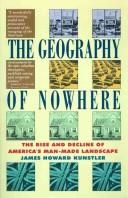
The Geography of Nowhere: The Rise and Decline of America's Man-Made Landscape is a book written in 1993 by James Howard Kunstler exploring the effects of suburban sprawl, civil planning, and the automobile on American society and is an attempt to discover how and why suburbia has ceased to be a credible human habitat, and what society might do about it. Kunstler proposes that by reviving civic art and civic life, we will rediscover public virtue and a new vision of the common good: "The future will require us to build better places," Kunstler says, "or the future will belong to other people in other societies."
Summary
The Geography of Nowhere traces America's evolution from a nation of Main Streets and coherent communities to a land where every place is like no place in particular, where the cities are dead zones and the countryside is a wasteland of cartoon architecture and parking lots. Kunstler depicts the nation's evolution from Pilgrim settlements to the modern auto suburb, examining what he calls a "process of destruction" that has transformed the American landscape into what he terms "scary places" and a "geography of nowhere" that has "simply ceased to be a credible human habitat."
The book argues that American individualism leads to the neglect of the public realm, with developers and the private car serving as instruments of landscape destruction. Kunstler contends that while rail systems historically connected neighborhoods and allowed dense hubs to develop around stations, the automobile and highway system encouraged undifferentiated suburban sprawl and isolated people from each other. He demonstrates how town centers disappeared and were replaced by malls, streets were no longer fronted by buildings, and housing developments became dormitories to which people had no particular allegiance.
Central to Kunstler's critique is his analysis of zoning laws and planning policies. He argues that restrictive zoning laws make it impossible to create lively towns by prohibiting residential use above shops or requiring large setbacks, thus destroying connections between streets and buildings and leading to segregation and community destruction. The author examines specific case studies, including the decline of Saratoga Springs, New York, the economic collapse of Detroit following the auto industry's downturn, and the contrasting success of Portland, Oregon, where deliberate environmental protection policies preserved both the city's character and economy.
The Geography of Nowhere tallies up what Kunstler sees as the huge economic, social, and spiritual costs that America is paying for its car-crazed lifestyle. Beyond documenting problems, the book serves as a wake-up call for citizens to reinvent the places where we live and work, to build communities that are once again worthy of our affection. Kunstler proposes that by reviving civic art and civic life, we will rediscover public virtue and a new vision of the common good, arguing that "The future will require us to build better places, or the future will belong to other people in other societies."
The book combines historical analysis with contemporary observation, examining how architectural movements like Modernism contributed to the problem while also exploring "capitals of unreality" like Disney World and Atlantic City that provide fantasy escapes from the bland uniformity of suburban life. Through this comprehensive critique, Kunstler challenges readers to recognize how car-dependent development patterns have fundamentally altered American social and physical landscapes, often in ways that diminish community connection and environmental sustainability.
Reception
The Geography of Nowhere received both widespread praise and criticism. Kirkus Reviews noted that while Kunstler provided "an accessible overview" for popular audiences, his discussions "lack the original ideas, cutting analysis, and stimulating insights" found in more scholarly works on urban planning. The review also suggested that "his attachment to the small towns of the past seems an insufficient answer to the problems of the present and future."
Publishers Weekly described the analysis as "inconsistent but provocative" and noted that while Kunstler "writes ably" and offers "an intriguing history" of urban decline, his "worthy but sketchily described solutions—a sustainable economy, better neighborhood development and preservation of the countryside—could, however, each merit a book."
Sequel
Kunstler published a sequel titled Home from Nowhere: Remaking Our Everyday World for the 21st Century in 1996, which offers practical solutions and prescriptions for urban planning challenges identified in the original work.
以上文字摘自英文维基百科「The Geography of Nowhere」(去掉了参考文献等尾部小节),按 CC BY-SA 4.0 使用,作者为维基百科的各位编者。
资料卡
- 原题
- The Geography of Nowhere
- 原作语言
- 英语
- 首次出版
- 1993 年
- 首版出版社
- Free Press
资料卡来自 Wikidata Q7736156(CC0),众包数据,个别字段可能不全。