 书单
百科
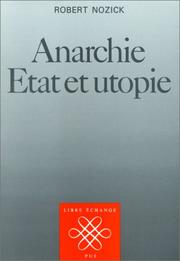
《无政府、国家与乌托邦》(英语:Anarchy, State, and Utopia), 是美国哲学家罗伯特·诺齐克在1974年发表的政治哲学著作。诺齐克反驳了约翰·罗尔斯在《正义论》中发表的观点,并主张自由意志主义所提倡的最小国家,即国家权力应该仅限于防止盗窃,维护合约等。
批评
罗伯特·诺齐克本人在几年后所著的《生命之检验》一书里宣称他已抛弃了《无政府、国家与乌托邦》当中属于自由至上主义的观点,他称当年自己的观点其实“相当不适当”。不过, 在2001年接受访问时,诺齐克澄清了他的立场:“我在《生命之检验》一书里所要表达的,是我已经不再抱持之前非常坚定的自由至上主义立场了。但许多指控我脱离了(或背叛了)自由意志主义的谣言也未免太过夸张了。”
以上文字摘自维基百科「無政府、國家與烏托邦」(去掉了参考文献等尾部小节),按 CC BY-SA 4.0 使用,作者为维基百科的各位编者。
中文维基百科的条目比较短,下面附上英文维基百科的内容(英文原文):
Anarchy, State, and Utopia (ASU) is a 1974 book by the American philosopher Robert Nozick. A work of analytic philosophy in the libertarian capitalist tradition, it popularised and developed the concepts of the night-watchman state, entitlement theory of property, and Lockean proviso, employing original thought experiments, such as the utility monster, experience machine, Wilt Chamberlain argument, and demoktesis, an experiment with the aim of demonstrating a progressive loss in self-ownership in democratic government.
In opposition to A Theory of Justice (1971) by John Rawls, and in debate with Michael Walzer, Nozick argues in favor of a minimal state, "limited to the narrow functions of protection against force, theft, fraud, enforcement of contracts, and so on".
As a work of analytic philosophy, the work offers an original interpretation and synthesis of the Lockean state of nature, Immanuel Kant's theory of persons being and in themselves, and economic research in game theory and welfare economics. Though highly controversial, the book was acclaimed by philosophers, political theorists, and American libertarians.
Background
Anarchy, State, and Utopia came out of a semester-long course that Nozick taught with Michael Walzer at Harvard in 1971, called Capitalism and Socialism. The course was a debate between the two; Nozick's side was later detailed in Anarchy, State, and Utopia, and Walzer's side produced his Spheres of Justice (1983).
Nozick further envisioned ASU as a response to John Rawls' A Theory of Justice (1971), challenging, in particular, Rawls's second principle that "social and economic inequalities are to be arranged so that they are to be of greatest benefit to the least-advantaged members of society."
Intellectual history
In writing the book, Nozick was particularly influenced by John Locke, Immanuel Kant, and Friedrich Hayek. Nozick frames the first part of the book through John Locke's state of nature and draws on the Kantian idea that individuals are separate persons who may not simply be used for the benefit of others.
Rawls's A Theory of Justice
Nozick presents Part II of the book as an argument that no state more extensive than the minimal state can be justified. In developing his entitlement theory, he concentrates on Rawls's account of distributive justice and the difference principle.
H. L. A. Hart's fairness principle
Nozick also discusses a principle proposed by H. L. A. Hart and called the "principle of fairness" by Rawls. On this principle, participants in a just and mutually advantageous cooperative practice may require similar restraint from those who accept the practice's benefits.
Reception
Following its publication in 1974, ASU won the 1975 US National Book Award in category Philosophy and Religion, has been translated into 11 languages, and was named one of the "100 most influential books since the war" (1945–1995) by the UK Times Literary Supplement. ASU remains particularly popular among American libertarian circles as a canonical intellectual articulation of libertarianism. As such, Nozick, alongside Murray Rothbard and Ayn Rand, became regarded as the leading intellectual leaders of libertarianism, although Nozick did not publish substantive work in political philosophy after 1974.
Philosopher Jan Narveson described Nozick's book as "brilliant". In 1991, Jonathan Wolff published Robert Nozick: Property, Justice and the Minimal State, a general overview of the debate around Nozick's political philosophy.
Criticism
G. A. Cohen criticized Nozick's libertarian-style concept of property rights and the proprietary freedom view.
In the article "Social Unity and Primary Goods", republished in his Collected Papers (1999), Rawls notes that Nozick handles the liberal paradox in a manner that is similar to his own. However, the rights that Nozick takes to be fundamental and the basis for regarding them to be such are different from the equal basic liberties included in justice as fairness and Rawls conjectures that they are thus not inalienable.
以上文字摘自英文维基百科「Anarchy, State, and Utopia」(有删节,去掉了参考文献等尾部小节),按 CC BY-SA 4.0 使用,作者为维基百科的各位编者。
资料卡
- 原题
- Anarchy, State, and Utopia
- 原作语言
- 英语
- 首次出版
- 1974 年
- 主题
- Distributive justice
- 获奖
- 美国国家图书奖(1975)
资料卡来自 Wikidata Q486385(CC0),众包数据,个别字段可能不全。