 书单
百科
这个词条暂时没有中文维基百科条目,下面是英文维基百科的内容(英文原文):
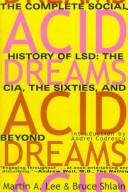
Acid Dreams: The Complete Social History of LSD: the CIA, the Sixties, and Beyond, originally released as Acid Dreams: The CIA, LSD, and the Sixties Rebellion, is a 1985 book by Martin A. Lee and Bruce Shlain, in which the authors document the 40-year social history of lysergic acid diethylamide (LSD), beginning with its synthesis by Albert Hofmann of Sandoz Pharmaceuticals in 1938. During the Cold War period of the early 1950s, LSD was tested as an experimental truth drug for interrogation by the United States intelligence and military community. Psychiatrists also used it to treat depression and schizophrenia. Under the direction of Sidney Gottlieb, the drug was used by the Central Intelligence Agency (CIA) in cooperation with participating "colleges, universities, research foundations, hospitals, clinics, and penal institutions". LSD was tested on "prisoners, mental patients, volunteers, and unsuspecting human subjects".
In the mid to late 1950s, many intellectuals began experimenting with LSD. Alfred Matthew Hubbard introduced Aldous Huxley to the drug in 1955 and Timothy Leary began taking it in 1962. By 1963, LSD had escaped the laboratory and became popular as a legal recreational drug with the emerging counterculture. Lee and Shlain argue that LSD influenced the social movements of the 1960s. The Free Speech Movement began in 1964, followed by the wide availability of street acid in 1965, the birth of the hippie movement in 1966, and the growing antiwar movement associated with the New Left. In response to queries by journalists about a "massive, illegal domestic intelligence operation" by the Nixon Administration, government hearings were held in the 1970s. Investigations by the Rockefeller Commission (1975), the Church Committee (1976), and a release of declassified documents under the Freedom of Information Act in 1977 which led to new Senate hearings that same year, uncovered information about LSD experiments for the first time.
The book is divided into two parts, with the first part of the book based on many of the public hearings, reports, and declassified files. Part one, "The Roots of Psychedelia", discusses the pioneering research by the intelligence, military, scientific, and academic community. Part two, "Acid for the Masses", discusses the hippie movement and the effects of LSD on the counterculture. Since its initial release in 1985, the book has received mostly positive reviews. A revised edition was published by Grove Atlantic in 1992, with a new introduction by essayist Andrei Codrescu.
Background
Swiss chemist Albert Hofmann first synthesized LSD at Sandoz Laboratories in 1938, while searching for medicinal ergot alkaloid derivatives, but its potential use as a psychedelic was not discovered until 1943. Sandoz made LSD available as a psychiatric drug in 1947. In World War II, under the direction of William J. Donovan, the Office of Strategic Services (OSS) experimented with cannabis as a truth serum but it was a failure. The U.S. Navy became interested in testing mescaline as a truth drug after discovering it was used on prisoners at the Dachau concentration camp. From 1947 to 1953, the navy experimented with testing mescaline and several different drugs on human subjects in Project CHATTER.
In the 1940s, the Central Intelligence Agency (CIA) began experimenting with different techniques for interrogation—one used sedatives to induce a trance state while another used two different drugs, such as an upper and a downer. Director Roscoe H. Hillenkoetter authorized funds for a secret mind control project code named Project BLUEBIRD, which became Project ARTICHOKE in 1951. Project MKULTRA, a covert research operation run by the CIA's Scientific Intelligence Division, began experimenting with human behavioral engineering in 1953. LSD became illegal in 1966. CIA testing of drugs in various forms continued until 1967. LSD was listed as a Schedule I drug in 1970.
In 1974, New York Times journalist Seymour Hersh, going on a government source, accused the Central Intelligence Agency of "directly violating its charter" and conducting "a massive, illegal domestic intelligence operation during the Nixon Administration against the antiwar movement and other dissident groups in the United States". The Rockefeller Commission was formed in 1975 to respond to these accusations. The commission found that the CIA destroyed 152 files documenting LSD testing in 1973 to prevent public knowledge of illegality. After 1975, the media began reporting widely about how the CIA tested LSD as a "mind control weapon".
In 1976, the Church Committee reported that from 1954 to 1963, the CIA "randomly picked up unsuspecting patrons in bars in the United States and slipped LSD into their food and drink." In 1977, a Freedom of Information Act request uncovered a cache of 20,000 documents relating to Project MKULTRA, which led to a subsequent joint hearing by the Senate Select Committee on Intelligence and the Senate Subcommittee on Health and Scientific Research in August 1977.
Development
Investigative journalist Martin A. Lee (1954–) was 14 years old during the height of the countercultural movement of the 1960s; his personal motivation for writing the book was spurred by his attempt to understand himself and the culture he was a part of during this time. His early interest in the Kennedy assassination led him to work with the Assassination Information Bureau, an activist group founded by Carl Oglesby. While the group was pursuing leads on the killings of JFK and Oswald, Lee pursued a different angle involving drug testing and mind control, which eventually led him to research the relationships—but not necessarily any conspiracy—between the CIA, drug testing, and the counterculture of the 1960s.
以上文字摘自英文维基百科「Acid Dreams (book)」(有删节,去掉了参考文献等尾部小节),按 CC BY-SA 4.0 使用,作者为维基百科的各位编者。
资料卡
- 原题
- Acid Dreams
- 原作语言
- 英语
- 首次出版
- 1986 年
- 主题
- LSD、中央情报局
- 故事发生地
- 美国
资料卡来自 Wikidata Q14945392(CC0),众包数据,个别字段可能不全。