 书单
百科
这个词条暂时没有中文维基百科条目,下面是英文维基百科的内容(英文原文):
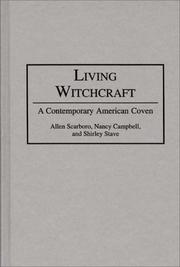
Living Witchcraft: A Contemporary American Coven is a sociological study of an American coven of Wiccans who operated in Atlanta, Georgia, US, during the early 1990s. It was co-written by the sociologist Allen Scarboro, psychologist Nancy Campbell and literary critic Shirley Stave and first published by Praeger in 1994. Although largely sociological, the study was interdisciplinary, and included both insider and outsider perspectives into the coven; Stave was an initiate and a practicing Wiccan while Scarboro and Campbell remained non-initiates throughout the course of their research.
The trio became friends after meeting at an academic seminar devoted to the study of religion held at Emory University, Atlanta in 1990. Stave subsequently revealed herself to the group as a Wiccan, a member of a new religious movement that interested Scarboro and Campbell, and together the three decided to undertake a study of the Wiccan coven to which Stave belonged. This, the Ravenwood coven, met in the local area, where it was led by a High Priestess named Lady Sintana. Learning of their proposals, Lady Sintana gave them her permission to attend the coven's rituals, classes and open houses and also to interview its members.
Divided into three parts, Living Witchcraft offers a sociological investigation of a coven of Wiccans located in Atlanta known as Ravenwood.
Background
Wicca in the United States
Contemporary Paganism, which is also referred to as Neo-Paganism, is an umbrella term used to identify a wide variety of modern religious movements, particularly those influenced by or claiming to be derived from the various pagan beliefs of pre-modern Europe. The religion of Pagan Witchcraft, or Wicca, was developed in England during the first half of the 20th century and is one of several pagan religions. The figure at the forefront of Wicca's early development was the English occultist Gerald Gardner (1884–1964), the author of Witchcraft Today (1954) and The Meaning of Witchcraft (1959) and the founder of a tradition known as Gardnerian Wicca. Gardnerian Wicca revolved around the veneration of both a Horned God and a Mother Goddess, the celebration of eight seasonally-based festivals in a Wheel of the Year and the practice of magical rituals in groups known as covens. Gardnerianism was subsequently brought to the U.S. in the early 1960s by an English initiate, Raymond Buckland (born 1934), and his then-wife Rosemary, who together founded a coven on Long Island.
In the U.S., new variants of Wicca developed, including Dianic Wicca, a tradition founded in the 1970s which was influenced by second wave feminism, emphasized female-only covens, and rejected the veneration of the Horned God. One initiate of both the Dianic and Gardnerian traditions was a woman known as Starhawk (born 1951) who went on to found her own tradition, Reclaiming Wicca, as well as publishing The Spiral Dance: a Rebirth of the Ancient Religion of the Great Goddess (1979), a book which helped spread Wicca throughout the U.S.
Academic fieldwork into Wicca
Prior to the authors' work, several American researchers working in the field of Pagan studies had separately published investigations of the Pagan community in both the United States and the United Kingdom. The first of these had been the practicing Wiccan, journalist and political activist Margot Adler in her Drawing Down the Moon: Witches, Druids, Goddess-Worshippers, and Other Pagans in America Today, which was first published by Viking Press in 1979. A second study was produced by the anthropologist Tanya M. Luhrmann in her Persuasions of the Witch's Craft: Ritual Magic in Contemporary England (1989), in which she focused on both a Wiccan coven and several ceremonial magic orders that were then operating in London.
At the same time as Scarboro, Campbell and Stave were undertaking their research, the American anthropologist and practicing Wiccan Loretta Orion was also undertaking an investigation into the Pagan movement in the East Coast and Midwest of the United States. Orion's work would come to be published as Never Again the Burning Times: Paganism Revisited by Waveland Press in 1995, although would be heavily criticized in reviews written by both Luhrmann and T.O. Beidelman, both of whom were of the opinion that Orion's Pagan beliefs had clouded her critical interpretation. The sociologist Helen A. Berger of the West Chester University of Pennsylvania had also been undertaking fieldwork among the Wiccan community of New England during that decade, having developed an interest in researching the subject in 1986. The results of Berger's 11 years of research would come to be published by the University of South Carolina Press in 1999 as A Community of Witches: Contemporary Neo-Paganism and Witchcraft in the United States, to predominantly positive academic reviews.
Scarboro, Campbell, Stave and their research
The project that resulted in Living Witchcraft originated at a seminar led by Robert Detweiler, a professor at Emory University's Graduate Institute of the Liberal Arts. Sponsored by the Dana Foundation, the seminar took place in Autumn 1990, and involved six professors from various U.S. colleges meeting together in Atlanta to share their research into various different aspects of religion and discuss conceptions of duality between the mind and the body. One of the academics attending the seminar, Shirley "Holly" Stave, a literary critic and untenured faculty member at Emory, soon admitted to the group that she was a practicing Wiccan, and told them of her belief that her religion could provide "a way of reuniting mind and body." Stave later explained to the group that she felt "moved" by "Spirit" to inform them of her own spiritual beliefs, in spite of the discrimination that this could bring upon her in the largely Christian state of Georgia. She also felt that in helping to educate others about Wiccan beliefs, it would ultimately help to prevent the misinformation and persecution that many Wiccans faced.
以上文字摘自英文维基百科「Living Witchcraft」(有删节,去掉了参考文献等尾部小节),按 CC BY-SA 4.0 使用,作者为维基百科的各位编者。
资料卡
- 原题
- Living Witchcraft
- 原作语言
- 英语
- 首次出版
- 1994 年
- 首版出版社
- 格林伍德出版集团
- 主题
- 宗教社会学
资料卡来自 Wikidata Q6659360(CC0),众包数据,个别字段可能不全。