书单
百科
这个词条暂时没有中文维基百科条目,下面是英文维基百科的内容(英文原文):
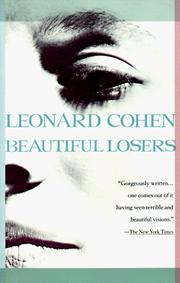
Beautiful Losers is the second and final novel by Canadian writer and musician Leonard Cohen. It was published in 1966, before he began his career as a singer-songwriter.
Set in the Canadian province of Quebec, the story of 17th-century Mohawk saint Catherine Tekakwitha is interwoven with a love triangle among an unnamed anglophone Canadian folklorist; his Native wife, Edith, who has committed suicide; and his best friend, the mystical F, a Member of Parliament and a leader in the Quebec separatist movement. The complex novel makes use of a vast range of literary techniques, and a wealth of allusion, imagery, and symbolism. It is filled with the mysticism, radicalism, sexuality, and drug-taking emblematic of the 1960s era, and is noted for its linguistic, technical, and sexual excesses.
Cohen wrote the novel over two eight-month sessions while living on the Greek island of Hydra in 1964 and 1965. He fasted and consumed amphetamines to focus his creativity on the novel. Despite a lavish rollout, sales were disappointing, and critics were initially unsympathetic or hostile. The book gained critical and commercial attention only after Cohen had given up novel-writing and turned to the songwriting and performing upon which his fame rests. Beautiful Losers has come to be seen as having introduced postmodernism into Canadian literature. It has become a steady seller, and is considered a part of the Canadian literary canon.
Overview
The novel reflects the zeitgeist of the 1960s. While its prose is simple, the book itself is difficult, and dense in imagery and symbolism. It is broken into three "books", each with a different narrator: the historian (called "I." by critics) is the narrator of book one, "The History of Them All", which is the longest book; "A Long Letter from F." makes up the second book, a letter from F. to the narrator of the first book; and the third book is narrated by an unnamed third person, and is called "Beautiful Losers: An Epilogue in the Third Person".
Synopsis
At the centre of the novel are the members of a love triangle, united by their obsessions and fascination with a 17th-century Mohawk, Saint Catherine Tekakwitha. The triangle is made up of the unnamed narrator, an authority on the vanishing A———— tribe; his wife Edith, one of the last surviving members of the tribe; and their maniacal and domineering friend, "F.", who may or may not exist.
Book one opens with an unnamed anglophone Canadian narrator asking "Who are you, Catherine Tekakwitha?" The narrator's wife hides in an elevator shaft, intending to have her husband kill her when he comes home. Her plan misfires somewhat, however—it is a delivery boy, instead, who takes the elevator that kills her. The narrator and F. console each other in bed over Edith's death.
The narrator and F. attend a demonstration in Montreal's "Parc Lafontaine", where I. gets so caught up in the nationalistic Québécois that he joins in himself, shouting, "Fuck the English!"
The narrator flees to the treehouse F. has left him in his will.
Book two consists of a letter composed by F., intended to be read five years after his death by the narrator of book one. As such, chronologically it takes place before book one.
F. escapes the asylum he is in and makes for the treehouse he will leave for the narrator of the first book. F. is cared for in an insane asylum by nurse Mary Voolnd, of the A———— as was Edith. The letter is written in the occupational therapy room of the hospital.
Book three opens with a figure in a treehouse, with burnt fingers like the first book's narrator, but also missing a thumb, as F. did after blowing up the statue of Queen Victoria. He is being hunted down as an escaped inmate and terrorist. He is given a ride by a blond woman wearing moccasins, who calls herself Isis, in Greek.
Primary characters
"I."
The unnamed narrator of the first book is an anthropological scholar specializing in the "A———s", a First Nations tribe whose "brief history is characterized by incessant defeat."
Though unnamed, several critics have taken to calling this narrator "I."
"F."
The bewildering mystical "best friend" of "I." "I." describes their relationship as one of pupil and teacher, with F. presenting himself as having such intellectual and spiritual capacities as have enabled him to develop an all-encompassing "system," though one that escapes "I." and the reader. His declarations appear profound and truth-like, with the weight of axioms.
F. is fond of quoting Nietzsche, and like Nietzsche was driven insane by syphilis. He consciously plays the role of teacher to "I."
Edith
Married to "I.", Edith is a member of the dying "A————" tribe that her husband studies.
Catherine Tekakwitha
The Mohawk Kateri Tekakwitha was a 17th-century Christian convert. She is raised by a "kind uncle" and "cruel aunts" after the death of her parents when she was four. The aunts try to get her a husband, but first he turns her down; later she runs away from him. When she returns she is beaten by her aunts.
She takes to pious self-mortification with great zeal–to such a degree that the Jesuit priests find they must restrain her. Following her death at the age of 24, her skin becomes white.
She is associated with Edith, the Virgin Mary and Isis throughout the work.
At the time the book was written, she had been beatified by the Church and was known as Blessed Kateri Tekakwitha. In 2012 she was canonised as a saint.
Themes
Sex plays a major role in the novel, though the sex scenes tend to be oral or masturbatory. Homosexuality and bisexuality are prominent.
Natives are seen as being displaced by the French, while the English displace the French, and are themselves oppressed by the Americans. The English and French in Canada are seen as both oppressors and oppressed, which ties F. and I. together. According to F., the Québécois are able to come together under their feeling of oppression by the anglophones, but anglophone Canada is unable to bring together a national identity to distinguish themselves from the Americans.
以上文字摘自英文维基百科「Beautiful Losers」(有删节,去掉了参考文献等尾部小节),按 CC BY-SA 4.0 使用,作者为维基百科的各位编者。
资料卡
- 原题
- Beautiful Losers
- 原作语言
- 英语
- 首次出版
- 1966 年
- 作品形式
- 长篇小说
- 首版出版社
- 麦克莱兰与斯图尔特
- 前作
- The Favourite Game
资料卡来自 Wikidata Q2701408(CC0),众包数据,个别字段可能不全。