书单
百科
这个词条暂时没有中文维基百科条目,下面是英文维基百科的内容(英文原文):
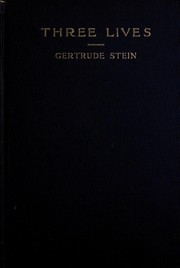
Three Lives (1909) is a work of fiction written in 1905 and 1906 by American writer Gertrude Stein. The book is separated into three stories, "The Good Anna," "Melanctha," and "The Gentle Lena."
The three stories are independent of each other, but all are set in Bridgepoint, a fictional town based on Baltimore.
Synopses
"donc je suis un malheureux et ce n’est ni ma faute ni celle de la vie"
"therefore, I am unhappy and this is neither my fault nor that of my life"
Each of the three tales in Three Lives tells of a working-class woman living in Baltimore.
"The Good Anna"
"The Good Anna," the first of Gertrude Stein’s Three Lives, is a novella set in "Bridgepoint" about Anna Federner, a servant of "solid lower middle-class south german stock."
Part I describes Anna’s happy life as housekeeper for Miss Mathilda and her difficulties with unreliable under servants and "stray dogs and cats". She loves her "regular dogs": Baby, an old, blind, terrier; "bad Peter," loud and cowardly; and "the fluffy little Rags." Anna is the undisputed authority in the household, and in her five years with Miss Mathilda she oversees in turn four under servants: Lizzie, Molly, Katy, and Sallie. Sometimes even the lazy and benign Miss Mathilda feels rebellious under Anna’s iron hand; she is also concerned because Anna is always giving away money, and tries to protect her from her many poor friends.
Part II, "The Life of the Good Anna", fills in the background. Born in Germany, in her teens Anna emigrates to "the far South", where her mother dies of consumption. She moves to Bridgepoint near her brother, a baker, and takes charge of the household of Miss Mary Wadsmith and her young nephew and niece, who are orphans. Little Jane resists Anna’s strong will, but after Anna has provoked a showdown becomes "careful and respectful" and even gives Anna a green parrot. When after six years Jane is finally married, Anna refuses to follow Miss Mary in the new household. Mrs. Lehntman, a widow and midwife who "was the romance of Anna’s life", helps Anna tell Miss Wadsmith that she cannot accompany her. Anna then goes to work for Doctor Shonjen, a hearty bachelor, with whom she gets along. Previously Shonjen has operated on her, and Anna’s general health remains poor: she has headaches and is "thin and worn". When Mrs. Lehntman, who has two careless children, adopts a baby without consulting Anna, the latter is offended and spends more time with another large working family, the Drehtens. She also visits her brother the baker, but has trouble with her sister-in-law, though she eventually helps with her savings when her god-daughter niece is married. Mrs. Lehntman rashly decides to open a boarding house, and Anna despite her misgivings lends her the necessary money, for "Romance is the ideal in one’s life and it is very lonely living with it lost". Having been once defeated in the matter of Johnny's adoption, she can no longer impose her will in the relationship. ("In friendship, power always has its downward curve.") When Dr. Shonjen marries a "proud" and "unpleasant" woman, Anna seeks a new position. Encouraged by a fortune-teller, she goes to work for Miss Mathilda, and these are her happiest years, until finally her ailing favorite dog Baby dies and Miss Mathilda leaves permanently for Europe.
Part III, "The Death of the Good Anna," chronicles her last years. Anna continues to live in the house Miss Mathilda has left her and takes in boarders, but charges too little to make ends meet and has to dismiss her help Sallie. She is still happy with her customers and her dogs, but works too much and weakens. Mrs. Drehten, her only remaining friend, convinces her to be operated. "Then they did the operation, and then the good Anna with her strong, strained, worn-out body died". Mrs. Drehten writes the news to Miss Mathilda.
The story is written in Stein’s straightforward and sometimes repetitive prose, with a few notable digressions, like the discussion on power and friendship in a romance, and the description of the medium’s dingy house. Stein portrays brilliantly the tense confrontations between Anna and her (female) adversaries. At one point she describes Anna’s quite elaborate costume. One theme is female bonding, since the narrator insists on Anna’s "romance" with Mrs. Lehntman. Anna likes to work only for passive and big women who let her take care of everything, otherwise she prefers to work for men, because "Most women were interfering in their ways."
"The Good Anna" is indebted to Gustave Flaubert's Un Coeur Simple (the first of the Three Tales), which is about a servant and her eventual death (in both stories a parrot figures). But Stein’s Anna is much more determined and wilful than Flaubert’s Felicité, and, though generous to a fault, gets her way in most things.
"Melanctha"
"Melanctha," the longest of the Three Lives stories, is an unconventional novella that focuses upon the distinctions between, and blending of, race, sex, gender, and female health. Stein uses a unique form of repetition to portray characters in a new way. "Melanctha", as Mark Schorer depicts it on Gale's Contemporary Authors Online, "attempts to trace the curve of a passion, its rise, its climax, its collapse, with all the shifts and modulations between dissension and reconciliation along the way". But "Melanctha" is more than one woman’s bitter experience with love; it is a representation of internal struggles and emotional battles in finding meaning and acceptance in a tumultuous world.
以上文字摘自英文维基百科「Three Lives (book)」(有删节,去掉了参考文献等尾部小节),按 CC BY-SA 4.0 使用,作者为维基百科的各位编者。
资料卡
- 原题
- Three Lives
- 原作语言
- 英语
- 首次出版
- 1909 年
- 作品形式
- 长篇小说、中篇小说
资料卡来自 Wikidata Q7797597(CC0),众包数据,个别字段可能不全。