书单
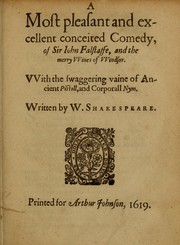
温莎的风流妇人 (1602)
百科
《温莎的风流妇人》(The Merry Wives of Windsor)是莎士比亚所著之喜剧,咸认为著作时间应早于1597年,首次出版于1602年,标题中的“温莎”是指英格兰柏克郡的温莎城堡,且虽然剧中时代设定在亨利四世时期,但却毫不掩饰其描写的是当代伊丽莎白时代的中产阶级生活。剧内角色胖骑士法斯塔夫已出现于莎士比亚的剧作“亨利四世”第一部与第二部中,该角色后来也被数部歌剧所采用。
本剧描写贪财好色的胖骑士法斯塔夫看中了福德太太和佩芝太太,两位聪明的妇人发现后,开始一连串整人计划,借机整整爱吃飞醋的先生,也让法斯塔夫在众人面前出丑,于是一连串整人计划一幕幕上演。
剧中人物
约翰·福克斯塔夫爵士(Sir John Falstaff)
巴道夫(Bardolph)、毕尔斯托(Pistol)、尼姆(Nym):福克斯塔夫的仆从
罗宾(Robin):福克斯塔夫的侍童
福德(Frank Ford)、培琪(George Page):住在温莎的两位绅士威廉·培琪(William Page):培琪的儿子休·爱文斯爵士(Sir Hugh Evans):爱尔兰人
卡厄斯医生(Doctor Caius):法国医生
勒格比(John Rugby):卡厄斯医生的仆人
快嘴桂嫂(Mistress Quickly):卡厄斯医生的仆人
夏禄(Robert Shallow):县治安官
斯兰德(Abraham Slender):夏禄的堂弟
辛普儿(Peter Simple):斯兰德的仆人
范顿(Fenton):年轻绅士
嘉德饭店(Garter Inn)店主
福德大嫂(Mistress Alice Ford)
培琪大嫂(Mistress Margaret Page)
安·培琪(Anne Page):培琪的女儿,范顿的恋人
以上文字摘自维基百科「溫莎的風流婦人」(去掉了参考文献等尾部小节),按 CC BY-SA 4.0 使用,作者为维基百科的各位编者。
中文维基百科的条目比较短,下面附上英文维基百科的内容(英文原文):
The Merry Wives of Windsor or Sir John Falstaff and the Merry Wives of Windsor is a comedy by William Shakespeare first published in 1602, though believed to have been written in or before 1597. The Windsor of the play's title is a reference to the town of Windsor, the location of Windsor Castle, in Berkshire, England. Though nominally set in the reign of Henry IV or early in the reign of Henry V, the play makes no pretense to exist outside contemporary Elizabethan-era English middle-class life. It features the character Sir John Falstaff, the fat knight who had previously been featured in Henry IV, Part 1 and Part 2.
Tradition has it that The Merry Wives of Windsor was written at the request of Queen Elizabeth I, who watching Henry IV, Part 1, is said to have asked Shakespeare to write a play depicting Falstaff in love.
Among literary critics, the play is one of Shakespeare's lesser-regarded works. It has been adapted for the opera at least ten times.
Plot
The play is nominally set in the early 15th century, during the same period as the Henry IV plays featuring Falstaff, but there is only one brief reference to this period, a line in which the character Fenton is said to have been one of Prince Hal's rowdy friends (he "kept company with the wild prince and Poins"). In all other respects, the play implies a contemporary setting of the Elizabethan era, c. 1600.
Falstaff arrives in Windsor very short of money. He decides that, to obtain financial advantage, he will court two wealthy married women, Mistress Ford and Mistress Page. Falstaff decides to send the women identical love letters and asks his servants – Pistol and Nym – to deliver them to the wives. When they refuse, Falstaff sacks them, and, in revenge, the men tell the husbands Ford and Page of Falstaff's intentions. Page is not concerned, but the jealous Ford persuades the Host of the Garter Inn to introduce him to Falstaff as a 'Master Brook' so that he can find out Falstaff's plans.
Meanwhile, three different men are trying to win the hand of Page's daughter, Anne Page. Mistress Page would like her daughter to marry Doctor Caius, a French physician, whereas the girl's father would like her to marry Master Slender. Anne herself is in love with Master Fenton, but Page had previously rejected Fenton as a suitor due to his having squandered his considerable fortune on high-class living. Hugh Evans, a Welsh parson, tries to enlist the help of Mistress Quickly (servant to Doctor Caius) in wooing Anne for Slender, but the doctor discovers this and challenges Evans to a duel. The Host of the Garter Inn prevents this duel by telling each man a different meeting place, causing much amusement for himself, Justice Shallow, Page and others. Evans and Caius decide to work together to be revenged on the Host.
When the women receive the letters, each goes to tell the other, and they quickly find that the letters are almost identical. The "merry wives" are not interested in the ageing, overweight Falstaff as a suitor; however, for the sake of their own amusement and to gain revenge for his indecent assumptions towards them both, they pretend to respond to his advances.
This all results in great embarrassment for Falstaff. Mr. Ford poses as 'Mr. Brook' and says he is in love with Mistress Ford but cannot woo her as she is too virtuous. He offers to pay Falstaff to court her, saying that once she has lost her honour he will be able to tempt her himself. Falstaff cannot believe his luck, and tells 'Brook' he has already arranged to meet Mistress Ford while her husband is out. Falstaff leaves to keep his appointment and Ford soliloquizes that he is right to suspect his wife and that the trusting Page is a fool.
以上文字摘自英文维基百科「The Merry Wives of Windsor」(有删节,去掉了参考文献等尾部小节),按 CC BY-SA 4.0 使用,作者为维基百科的各位编者。
资料卡
- 原题
- The Merry Wives of Windsor
- 原作语言
- 英语
- 首次出版
- 1602 年
- 作品形式
- 剧作
- 体裁
- 莎士比亚喜剧
- 主要人物
- 法斯塔夫、魁格来夫人、Corporal Nym、Robert Shallow、Bardolph、Ancient Pistol
资料卡来自 Wikidata Q844836(CC0),众包数据,个别字段可能不全。
改编作品
电视剧 / 剧集1
舞台剧 / 歌剧 / 芭蕾2
- 《温莎的风流娘儿们》The Merry Wives of Windsor
- 《法尔斯塔夫》Falstaff
名单来自 Wikidata(CC0):只列条目里写明「改编自 / 取材于」这本书的作品,不按名字猜;众包数据,可能不全。
更多资料与书评
在哪读
威廉·莎士比亚 的其他作品
作者页 › 豆瓣 #241