书单
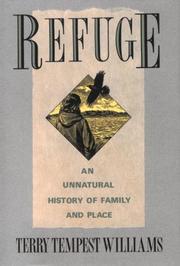
Refuge: An Unnatural History of Family and Place (1991)
- 作者
- Terry Tempest Williams
- 首版
- 1991 年
- 国家/地区
- 美国
- Open Library
- 9 个版本
百科
这个词条暂时没有中文维基百科条目,下面是英文维基百科的内容(英文原文):
Refuge: An Unnatural History of Family and Place is a book-length essay by environmentalist Terry Tempest Williams. This book explores the relationship between the natural and unnatural along with condemning the American government for testing nuclear weapons in the West. Williams uses components of nature such as the flooding of the Great Salt Lake and the resulting dwindling populations of birds at Bear River Migratory Bird Refuge to illustrate the importance of nature preservation, acceptance of change, and the impact of human intervention on the natural world.
Themes
Williams's many themes in Refuge revolve around humans, nature, and other natural and unnatural phenomena, such as cancer and death. Some themes are evident in her narrative, while other themes require some critical thinking to discover. Themes that can be found in her book include:
Unnatural vs natural: A theme of unnatural vs natural is shown through Williams's belief that the breast cancer in her family was caused by the unnatural phenomenon of atomic testing and radiation testing where she lived. However, cancer can occur naturally in others because of how it is a part of the body.
Humans have the need to “fix” the environment to suit their needs. This theme is shown through government of Utah's attempts to control the water level of the Great Salt Lake through the use of pumping, while the birds that live in the refuge nearby simply fly to another more suitable habitat to live.
Cancer is a disease that affects everyone: Williams reveals this theme by writing about how she, her father, and the rest of the family struggled with Williams's mother through her cancer. Williams's father was especially affected by her mother's cancer.
Women and their innate connection to nature: The Williams's women feel a deep adoration and understanding of the natural world, and are easily angered by humanity's negligence towards "Mother Earth".
The decision to treat a medical illness or not: Should Williams's mother receive the chemotherapy and prolong her life or accept the inevitability of death? Humans struggle with the advances in modern medicine and lose sight of the cycle of life.
Human desire for solitude within nature is apparent in Williams's book because of her relationship with the bird refuge. She seeks a place to escape and exist only for herself. The bird refuge provides that quiet place to reflect and reconnect with the natural world.
Delusion within humanity: Is present when Terry's father neglects to accept his wife's cancer. He continues to push treatments upon her in order to preserve her life. However, Terry's mother wants to live unassisted and faces wholeheartedly the reality of her situation.
The strength and depth of relationships between women is a major aspect of the narrative, as the majority of people with whom Williams connects on a complex level are women, particularly her mother and grandmother. It is either in the company of women or in solitude that Williams comes to important conclusions and realizes the strength of humanity.
The power of nature over the lives of humans is demonstrated throughout the narrative with the rising of the water levels of the Great Salt Lake. Just by the flooding alone, the residents of the area had their lives interrupted to the point that they considered intervention the only option. Williams, however, points out that nature is too powerful to be contained by technology, and is instead humbled by it. Humans should learn to live with nature, as they cannot win against it.
Synopsis
Terry Tempest Williams, the author, who narrates the book, will be referred to as "Terry" in the synopsis.
Pages 1-80
Terry Tempest Williams opens up the book by talking about nature. The Great Salt Lake, the burrowing owl refuge, climate change, everything. She begins the story with a distinct focus on nature. She has an unparalleled connection with nature. She feels a close personal tie to the Great Salt Lake, with the animals in the Salt desert area, but most specifically with the burrowing owls. This connection goes back to her days as a child, bird watching with her grandmother and spending carefree days on bus tours, or just simply at the refuge. Williams goes on to explain how every woman in her family, blood related and not, have all been afflicted with breast cancer. The women have had very serious cases, almost always requiring a mastectomy. And while the cancer only manifests itself in the women, it affects the entire family. This book focuses on Terry's mother, Diane's, cancer relapses, and she is faced with a bout of ovarian cancer. At first, she almost refuses any treatment, citing that she would rather live her life naturally, rather than deal with the pain and suffering of chemotherapy and radiation treatment which are not guaranteed to cure her. However, after some deliberation, she agrees to go through with eleven month chemotherapy. Meanwhile, the Great Salt Lake is getting increasingly uncontrollable, so the government comes up with five separate options of how to keep the lake in check. Diane's treatment appeared to have gone well, and the doctor happily informs them that all seems well. However, he was wrong, and there was some cancer which appeared to remain. This would require an extra six weeks of radiation treatment.
以上文字摘自英文维基百科「Refuge: An Unnatural History of Family and Place」(有删节,去掉了参考文献等尾部小节),按 CC BY-SA 4.0 使用,作者为维基百科的各位编者。
资料卡
- 首次出版
- 1991 年
- 体裁
- 回忆录
资料卡来自 Wikidata Q7307621(CC0),众包数据,个别字段可能不全。