书单
百科
这个词条暂时没有中文维基百科条目,下面是英文维基百科的内容(英文原文):
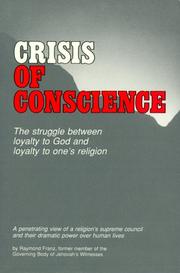
Crisis of Conscience is a biographical book by Raymond Franz, a former high-profile member of the Governing Body of Jehovah's Witnesses, written in 1983, three years after his expulsion from the Jehovah's Witnesses denomination. As one of the most extensive autobiographical accounts by a former Jehovah's Witness leader detailing his departure from the religion, the book serves as a major study and exposé of the internal workings of the Watch Tower Bible and Tract Society during the 1960s and 1970s.
The work has become widely regarded as one of the most significant revelatory texts within the ex-Jehovah's Witness community and among critics of the faith, providing unprecedented insight into the organization's hierarchy and decision-making processes. The book was updated and revised four times, with the final revisions made in 2004, and has been translated into Croatian, Czech, Danish, Dutch, French, German, Greek, Italian, Japanese, Korean, Polish, Portuguese, Romanian, Russian, Spanish and Swedish.
Argument
The central argument presented by Raymond Franz in Crisis of Conscience revolves around the tension between personal conscience and organizational authority within the Jehovah's Witnesses. Drawing extensively from his own experiences and intimate knowledge as a former member of the Governing Body, Franz critiques what he sees as an increasingly authoritarian structure within the Watch Tower Bible and Tract Society.
Franz contends that the Society, originally characterized by a relatively open approach to biblical interpretation and spirituality, progressively adopted rigid policies enforcing conformity and obedience. He emphasizes the transformation of the Jehovah's Witnesses from a loosely affiliated group emphasizing individual conscience and scriptural study into a tightly centralized organization, demanding strict adherence to official doctrines and interpretations.
Franz underscores a fundamental shift from earlier teachings of the Watch Tower, citing historical documents, including early editions of the organization's publications. He demonstrates that the early Witnesses discouraged organizational structures, advocating instead for a direct, unmediated relationship with God. Contrasting sharply with later developments, Franz highlights original teachings such as those found in the Watch Tower publications from the late 19th and early 20th centuries, which explicitly warned against formalized organizational control and stressed individual accountability before God.
A significant component of Franz's argument focuses on the Governing Body's internal processes and decision-making procedures. He provides detailed accounts of how doctrinal decisions were often made without clear biblical backing, driven instead by a perceived need to maintain organizational unity or avoid embarrassment over failed prophetic predictions. Franz cites the handling of significant doctrinal issues such as the interpretation of the year 1975 and the concept of "this generation" mentioned in Matthew 24:34 as examples. He critically assesses the rationale behind such doctrines, suggesting that the organization's interpretations were often more influenced by human reasoning and organizational expediency than by consistent biblical exegesis.
Franz further criticizes the culture of secrecy and authoritarian control fostered by the Governing Body. He argues that such an environment severely restricts intellectual freedom and spiritual growth among members. Through his descriptions of internal discussions, disciplinary hearings, and his own experiences, Franz illustrates how questioning or expressing personal convictions contrary to official teachings frequently led to disciplinary actions, including disfellowshipping—a practice that isolates members socially and spiritually.
Central to Franz's critique is the organization's handling of the 1980s internal upheaval, during which Franz himself was eventually disfellowshipped. He portrays the disciplinary actions taken against individuals like Edward Dunlap, a respected biblical scholar and longtime contributor to Watch Tower publications, as disproportionately severe and motivated more by organizational loyalty than genuine scriptural fidelity. He compares these disciplinary measures with actions taken by other religious bodies facing similar challenges, underscoring that even traditionally authoritarian organizations like the Catholic Church displayed greater tolerance towards internal dissent than did the Watch Tower Society.
Furthermore, Franz argues that the organization's doctrinal rigidity and authoritarianism have tangible negative impacts on the lives of Jehovah’s Witnesses. He details instances where strict adherence to organizational doctrines, such as the refusal of blood transfusions and the isolation from family members who have been disfellowshipped, leads to significant emotional and social harm. Franz maintains that such doctrinal positions lack strong biblical justification and are sustained primarily through organizational enforcement mechanisms that discourage open questioning and debate.
Throughout Crisis of Conscience, Franz also addresses the ethical implications of blind adherence to organizational authority over personal conscience. He draws parallels with historical examples, particularly the experiences of early Christians who confronted religious authority with personal conviction based on scriptural understanding. Franz argues that genuine spirituality cannot thrive under coercion or fear, but rather requires freedom of conscience and open, respectful dialogue.
以上文字摘自英文维基百科「Crisis of Conscience」(有删节,去掉了参考文献等尾部小节),按 CC BY-SA 4.0 使用,作者为维基百科的各位编者。
资料卡
- 原题
- Crisis of Conscience
- 原作语言
- 英语
- 首次出版
- 1983 年
- 体裁
- 非虚构作品、回忆录、自传、随笔
- 主题
- 宗教、耶和华见证人
资料卡来自 Wikidata Q5185981(CC0),众包数据,个别字段可能不全。