书单
百科
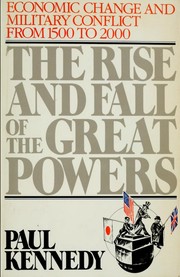
《大国的兴衰:1500年到2000年的经济变迁和军事冲突》(英语:The Rise and Fall of the Great Powers: Economic Change and Military Conflict From 1500 to 2000,台湾作《霸权兴衰史:1500至2000年的经济变迁与军事冲突》),是英国历史学家保罗·肯尼迪1987年首次出版的书,探讨了1500年到1980年间大国兴衰的政治和经济等方面,并预测了中国、日本、欧洲经济共同体、苏联和美国在20世纪末的发展。
本书是保罗·肯尼迪最为著名的著作,1987年兰登书屋第一版677页,出版后成为畅销书,并被认为是对大国史最为综合的论述。该书于1989年再版,704页。
汉译本
1995年五南图书出版繁体中文版《霸权兴衰史:1500至2000年的经济变迁与军事冲突》,张春柏等译。
2006年国际文化出版公司出版简体中文版《大国的兴衰:1500年到2000年的经济变迁和军事冲突》,陈景彪等译。由于译者认为作者对国际共产主义和社会主义制度存在曲解,对马克思理论和实践态度偏激,因此对此书进行删节,并未提到删节部分。
以上文字摘自维基百科「大国的兴衰」(去掉了参考文献等尾部小节),按 CC BY-SA 4.0 使用,作者为维基百科的各位编者。
中文维基百科的条目比较短,下面附上英文维基百科的内容(英文原文):
The Rise and Fall of the Great Powers: Economic Change and Military Conflict from 1500 to 2000, by Paul Kennedy, first published in 1987, explores the politics and economics of the Great Powers from 1500 to 1980 and the reason for their decline. It then continues by forecasting the positions of China, Japan, the European Economic Community (EEC), the Soviet Union and the United States through the end of the 20th century.
Summary
Kennedy argues that the strength of a Great Power can be properly measured only relative to other powers, and he provides a straightforward thesis: Great Power ascendancy (over the long term or in specific conflicts) correlates strongly to available resources and economic durability; military overstretch and a concomitant relative decline are the consistent threats facing powers whose ambitions and security requirements are greater than their resource base can provide for.
Throughout the book he reiterates his early statement (page 71): "Military and naval endeavors may not always have been the raison d'être of the new nations-states, but it certainly was their most expensive and pressing activity", and it remains such until the power's decline. He concludes that declining countries can experience greater difficulties in balancing their preferences for guns, butter and investments.
Kennedy states his theory in the second paragraph of the introduction as follows:
The "military conflict" referred to in the book's subtitle is therefore always examined in the context of "economic change". The triumph of any one Great Power in this period, or the collapse of another, has usually been the consequence of lengthy fighting by its armed forces; but it has also been the consequences of the more or less efficient utilization of the state's productive economic resources in wartime, and, further in the background, of the way in which that state's economy had been rising or falling, relative to the other leading nations, in the decades preceding the actual conflict. For that reason, how a Great Power's position steadily alters in peacetime, is as important to this study as how it fights in wartime.
Kennedy adds on the same page:
The relative strengths of the leading nations in world affairs never remain constant, principally because of the uneven rate of growth among different societies and of the technological and organizational breakthroughs which bring a greater advantage to one society than to another.
Early modern era
The book starts at the dividing line between the Renaissance and early modern history—1500 (chapter 1). It briefly discusses the Ming (page 4) and Muslim worlds (page 9) of the time and the rise of the western powers relative to them (page 16). The book then proceeds chronologically, looking at each of the power shifts over time and the effect on other Great Powers and the "Middle Powers".
Kennedy uses a number of measures to indicate real, relative and potential strength of nations throughout the book. He changes the metric of power based on the point in time. Chapter 2, "The Habsburg Bid for Mastery, 1519–1659" emphasizes the role of the "manpower revolution" in changing the way Europeans fought wars (see military revolution). This chapter also emphasizes the importance of Europe's political boundaries in shaping a political balance of power.
The argument in this chapter is not, therefore, that the Habsburgs failed utterly to do what other powers achieved so brilliantly. There are no stunning contrasts in evidence here; success and failure are to be measured by very narrow differences. All states, even the United Provinces, were placed under severe strain by the constant drain of resources for military and naval campaigns... The victory of the anti-Habsburg forces was, then, a marginal and relative one. They had managed, but only just, to maintain the balance between their material base and their military power better than their Habsburg opponents. (page 72)
以上文字摘自英文维基百科「The Rise and Fall of the Great Powers」(有删节,去掉了参考文献等尾部小节),按 CC BY-SA 4.0 使用,作者为维基百科的各位编者。
资料卡
- 原题
- The Rise and Fall of the Great Powers
- 原作语言
- 英语
- 首次出版
- 1987 年
- 体裁
- 经济学、历史
- 首版出版社
- 兰登书屋
- 页数
- 409
- 主题
- 大国、历史、商业活动
资料卡来自 Wikidata Q760055(CC0),众包数据,个别字段可能不全。