书单
百科
这个词条暂时没有中文维基百科条目,下面是英文维基百科的内容(英文原文):
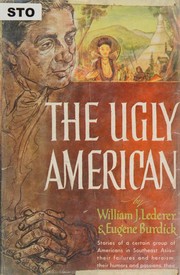
The Ugly American is a 1958 political novel by Eugene Burdick and William Lederer that depicts the failures of the U.S. diplomatic corps in Southeast Asia.
The book caused a sensation in diplomatic circles and had major political implications. The Peace Corps was established during the Kennedy administration partly as a result of the book. The bestseller has remained continuously in print and is one of the most influential American political novels. It has been called an "iconic Cold War text."
Background
Authors
William Lederer was an American author and captain in the U.S. Navy who served as special assistant to the commander in chief of U.S. forces in the Pacific and Asian theater.
Eugene Burdick was an American political scientist, novelist, and non-fiction writer, and served in the Navy during World War II. The two met in the build-up to the Vietnam War.
The authors were disillusioned with the style and substance of U.S. diplomatic efforts in Southeast Asia. They sought to demonstrate through their writings their belief that American officials and civilians could make a substantial difference in Southeast Asian politics if they were willing to learn local languages, follow local customs and employ regional military tactics.
Historical and political
In 1958 the Cold War was in full force, pitting the two geopolitical giants, the United States and the Soviet Union, against each other for military and geopolitical influence and dominance. NATO and the Warsaw Pact divided Europe into two competing visions of the world: the Western world viewed countries in the Eastern Bloc as behind an Iron Curtain, as evidenced by the failed Hungarian Revolution. The Eastern Bloc countered by portraying itself as the liberator of countries that were still in thrall to colonialist machinations, as evidenced by banana republics. The nuclear arms race was underway with the U.S. well ahead initially, but by 1955, the Soviets had exploded a hydrogen bomb and were beginning to catch up, sparking fears of nuclear armageddon.
The Soviet launching of Sputnik into orbit in 1957 gave the Soviets a huge technological and propaganda victory and sparked a crisis of confidence in the United States and worries about falling behind technologically and militarily. In Asia, the French had left Indochina in 1954 after their defeat at the Battle of Dien Bien Phu and the U.S. became involved in Vietnam to fill the perceived power vacuum. The U.S. and the Soviets struggled for preeminence in the Third World through proxies in Latin America, Africa, and Asia.
In the Middle East, the U.S. feared the spread of Communism starting in Egypt and attempted to secure the region's most populous and politically powerful country for the West by guarantees of funding for construction of the Aswan Dam, but it was eventually the Soviets who prevailed. Soviet diplomatic and political successes in the Third World left the West worried about losing one country after another to Communism according to the domino theory invoked by President Dwight D. Eisenhower.
It was in this atmosphere of fear, mistrust, and uncertainty in the United States about Soviet military and technological might and Communist political success in unaligned nations of the Third World that the novel was published in 1958, with an immediate impact.
Lyman Kirkpatrick, Inspector General of the Central Intelligence Agency thought it wise to alert the Director of Central Intelligence to send a memo when the book was published and serialized by the Saturday Evening Post. The Foreign Service Journal, a monthly publication of the American Foreign Service Association, commented in the Editorial Page that "no thoughtful reader will be able to dismiss 'The Ugly American' lightly because, with all its errors and distortions, it still states candidly a problem which has long been debated within the Foreign Service itself."
Content
The book depicts the failures of the U.S. diplomatic corps, whose insensitivity to local language, culture, and customs and refusal to integrate were in marked contrast to the polished abilities of Eastern Bloc (primarily Soviet) diplomacy and led to Communist diplomatic success overseas.
Title
The title of the novel is a play on Graham Greene's 1955 novel The Quiet American and was sometimes confused with it.
The "Ugly American" of the book title refers to the book's hero, plain-looking engineer Homer Atkins, whose "calloused and grease-blackened hands always reminded him that he was an ugly man." Atkins, who lives with the local people, comes to understand their needs, and offers genuinely useful assistance with small-scale projects such as the development of a simple bicycle-powered water pump.
Setting
The novel takes place in a fictional nation called Sarkhan (an imaginary country in Southeast Asia that somewhat resembles Laos, but which is meant to allude to Vietnam) and includes several real people, most of whose names have been changed. The book describes the United States' losing struggle against Communism because of the ineptitude and the bungling of the U.S. diplomatic corps stemming from innate arrogance and their failure to understand the local culture. The book implies that the Communists were successful because they practiced tactics similar to those of protagonist Homer Atkins.
Category and structure
The book is written as a series of interrelated vignettes. It was originally commissioned by the publisher as a work of nonfiction, but was changed to a fictionalized novel at an editor's suggestion. The authors say in the introduction that the work represents "the rendering of fact into fiction."
Plot summary
In one vignette, a Burmese journalist says, "For some reason, the [American] people I meet in my country are not the same as the ones I knew in the United States. A mysterious change seems to come over Americans when they go to a foreign land. They isolate themselves socially. They live pretentiously. They are loud and ostentatious."
以上文字摘自英文维基百科「The Ugly American」(有删节,去掉了参考文献等尾部小节),按 CC BY-SA 4.0 使用,作者为维基百科的各位编者。
资料卡
- 原题
- The Ugly American
- 原作语言
- 英语
- 首次出版
- 1958 年
- 作品形式
- 长篇小说、中篇小说
资料卡来自 Wikidata Q21869946(CC0),众包数据,个别字段可能不全。
改编作品
电影1
- 《丑陋的美国人》The Ugly American
名单来自 Wikidata(CC0):只列条目里写明「改编自 / 取材于」这本书的作品,不按名字猜;众包数据,可能不全。