 书单
百科
这个词条暂时没有中文维基百科条目,下面是英文维基百科的内容(英文原文):
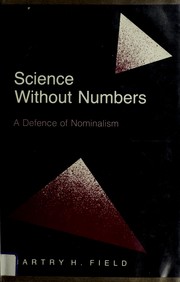
Science Without Numbers: A Defence of Nominalism is a 1980 book on the philosophy of mathematics by Hartry Field. In the book, Field defends nominalism, the view that mathematical objects such as numbers do not exist. The book was written broadly in response to an argument for the existence of mathematical objects called the indispensability argument. According to this argument, belief in mathematical objects is justified because mathematics is indispensable to science. The main project of the book is producing technical reconstructions of science that remove reference to mathematical entities, hence showing that mathematics is not indispensable to science.
Modelled on Hilbert's axiomatization of geometry, which eschews numerical distances in favor of primitive geometrical relationships, Field demonstrates an approach to reformulate Newton's theory of gravity without the need to reference numbers. According to Field's philosophical program, mathematics is used in science because it is useful, not because it is true. He supports this view with the idea that mathematics is conservative; that is, mathematics cannot be used to derive any physical facts beyond those already implied by the physical aspects of a theory. He further proves that statements in his nominalist reformulation can be systematically associated with mathematical statements, which he believes explains how mathematics can be used to legitimately derive physical facts from scientific theories.
Science Without Numbers was immediately influential upon release and generated much discussion in the philosophy of mathematics. Areas of debate included to what extent Field's reformulation of Newtonian gravitational theory was an attractive alternative to the original, mathematical theory, and whether its reliance on geometrical objects like spacetime points was acceptable. Technical issues were also raised concerning the definition of conservativeness and Field's use of metalogic and second-order logic. Following the release of the book, other philosophers worked to extend Field's account to areas such as quantum mechanics and general relativity.
Background
Science Without Numbers emerged during a period of renewed interest in the philosophy of mathematics following a number of influential papers by Paul Benacerraf, particularly his 1973 article "Mathematical Truth". In that paper, Benacerraf argued that it is unclear how the existence of non-physical mathematical objects such as numbers and sets can be reconciled with a scientifically acceptable epistemology. This argument was among Field's motivations for writing Science Without Numbers; he aimed to provide an account of mathematics that was compatible with a naturalistic view of the world.
The main goal of the book was to defend nominalism, the view that mathematical objects do not exist, and to undermine the motivations for platonism, the view that mathematical objects do exist. Field believed that the only good argument for platonism is the Quine–Putnam indispensability argument, which argues for belief in mathematical objects because mathematics is indispensable to science. A key motivation for the book was to undermine this argument by showing that mathematics is indeed dispensable to science.
Independently of the appeal of nominalism, Field was motivated by a desire to formulate scientific explanations "in terms of the intrinsic features of [the] system, without invoking extrinsic entities". For Field, numbers are extrinsic to physics since they are causally irrelevant to the behaviour of physical systems. He argued that things intrinsic to physical theories, like physical objects and spacetime, should be preferred when constructing explanations in science.
According to Field, he began work on the book in the winter of 1978/79, intending to write a long journal article. However, during the process of writing, it became too long to be feasibly published in a journal format. It was initially published in 1980 by Princeton University Press; a second edition was published in 2016 by Oxford University Press featuring minimal changes to the main text and a new preface.
Summary
Science Without Numbers starts with some preliminary remarks in which Field clarifies his aims for the book. He outlines that he is concerned mainly with defending nominalism from the strongest arguments for platonism—the indispensability argument in particular—and is less focused on putting forward a positive argument for his own view. He distinguishes the form of nominalism he aims to defend, fictionalism, from other types of nominalism that were more popular in the philosophy of mathematics at the time. The forms of nominalism popular at the time were revisionist in that they aimed to reinterpret mathematical sentences so that they were not about mathematical objects. In contrast, Field's fictionalism accepts that mathematics is committed to the existence of mathematical objects, but argues that mathematics is simply untrue.
Field adopts an instrumentalist account of mathematics, arguing that mathematics does not have to be true to be useful. Field argues that, unlike theoretical entities like electrons and quarks, mathematical objects do not allow theories to predict anything new. Instead, mathematics' role in science is simply to aid in the derivation of empirical conclusions from other empirical claims, which could theoretically occur without using mathematics at all. Field develops this instrumentalist idea in more technical detail using the idea that mathematics is conservative. This means that if a nominalistic statement is derivable from a scientific theory with the use of mathematics, then it is also derivable without the mathematics. Therefore, the predictive success of the theory can be fully explained by the truth of the nominalist portions of science, excluding any mathematics.
以上文字摘自英文维基百科「Science Without Numbers」(有删节,去掉了参考文献等尾部小节),按 CC BY-SA 4.0 使用,作者为维基百科的各位编者。
资料卡
- 原题
- Science Without Numbers
资料卡来自 Wikidata Q134995787(CC0),众包数据,个别字段可能不全。