书单
百科
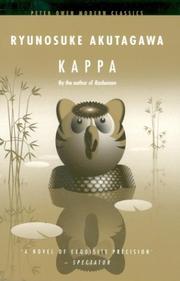
《河童》(日语:河童/かっぱ,罗马化:Kappa),是日本作家芥川龙之介于1927年(昭和2年)在《改造》杂志上发表的短篇小说。
故事情节
河童是日本神话中的传说生物,被描述为一种近似两栖动物的妖怪,有鸟的喙、青蛙的四肢、猴子的身体及乌龟的壳,身材矮小。芥川笔下的河童不再是可怕的水中怪物形象,反而是一些幽默风趣的物种。小说中巨细靡遗地描绘了河童的长相:它们的头上有个碟子,常会做出青蛙跳跃的姿势,或是爬在树上看人,身体略微透明,且能随着环境而改变颜色(像是树蛙或雨蛙)。河童父亲会询问在河童母亲肚子里的婴孩是否愿意出生,如果孩子不愿出生,接生员就会将一种液体注入河童母亲的胎内使婴孩消失。
这篇故事记述的是一个误入河童国的人的见所闻。小说的最后一章,主角好不容易才返回人世间,由于他已经无法习惯人类的生活,而被当作是疯子对待。
以上文字摘自维基百科「河童 (小說)」(去掉了参考文献等尾部小节),按 CC BY-SA 4.0 使用,作者为维基百科的各位编者。
中文维基百科的条目比较短,下面附上英文维基百科的内容(英文原文):
Kappa (Japanese: 河童, Hepburn: Kappa) is a 1927 novella written by the Japanese author Ryūnosuke Akutagawa.
The story is narrated by a psychiatric patient who claims to have travelled to the land of the kappa, a creature from Japanese folklore. Critical opinion has often been divided between those who regard it as a biting satire of Taishō Japan and those who see it as an expression of Akutagawa's private agony.
Synopsis
A psychiatric patient, who is known only as "Number 23", tells the story of a time he visited the land of the kappa. He had lost his way in the mountains of Hotakadake and was surrounded by a group of the strange creatures, who then showed him around their home. They explain to him the kappas' religion, called Lifeism, whose god, the Tree of Life, teaches them to 'live avidly'.
He found that the world of the kappa often appeared to be the opposite of how things were in the human world. For instance, fetuses are asked by their fathers whether or not they want to be born. One replied, "I do not wish to be born. In the first place, it makes me shudder to think of all the things I shall inherit from my father—the insanity alone is bad enough."
The psychiatric patient relates how he met with kappas of many occupations. One of them, Geeru, told him that unemployed laborers are gassed and then eaten by the other kappa. Patient 23 also encountered Maggu, a philosopher writing a collection of aphorisms titled The Words of a Fool, which included the line "a fool always considers others fools". He met another kappa called Tokku, a sceptical poet who had committed suicide and appeared to Patient 23 as a ghost by means of necromancy. Tokku, while concerned about being famous after his death, admires writers and philosophers who have killed themselves, such as Heinrich von Kleist, Philipp Mainländer and Otto Weininger. He esteems Michel de Montaigne who justified voluntary death, but dislikes Arthur Schopenhauer because he was a pessimist who did not commit suicide. On his return to the real world, Patient 23 muses that the kappas were clean and superior to human society and becomes a misanthrope.
Reception
When it was first published, many Japanese reviewers saw it as an unsophisticated social satire that lacked insight. Since then, critics in Japan have often been divided between those who regard it as a satire of Taishō Japan, and those who see it as an expression of Akutagawa's personal agony. When the first English translation appeared in 1947, a review in Time magazine declared that, to "American readers, Ryunosuke Akutagawa's satire seemed almost too good to have been written by a Japanese." Yoshida Seiichi, drawing on Akutagawa's letters, argued that Kappa was not a social satire, but rather reflected Akutagawa's personal worldview. Susan J. Napier has called Kappa "Japan's first full-blown dystopian novel". Tsuruta Kinya, writing in the 1970s, said that the work is "obviously a mixed-bag of public themes and private fantasies" allowing for many different interpretations.
Jonathan Swift's Gulliver's Travels as well as Samuel Butler's Erehwon have both been suggested as influences on Akutagawa. Nikolai Gogol's Diary of a Madman and Lu Xun's work of the same name have also both been cited as precedents, as they both feature insane narrators, as has Enzō Matsunaga's Dream-Eaters, which takes place in a psychiatric hospital.
Tokku, the suicidal poet kappa, has often been seen as a self-portrait of Akutagawa, who took his own life the same year that Kappa was published. The anniversary of his death is sometimes known as "Kappaki" (河童忌) in honour of this novel.
以上文字摘自英文维基百科「Kappa (novella)」(有删节,去掉了参考文献等尾部小节),按 CC BY-SA 4.0 使用,作者为维基百科的各位编者。
资料卡
- 原题
- 河童
- 原作语言
- 日语
- 首次出版
- 1927 年
- 作品形式
- 长篇小说
资料卡来自 Wikidata Q866812(CC0),众包数据,个别字段可能不全。