书单
百科
这个词条暂时没有中文维基百科条目,下面是英文维基百科的内容(英文原文):
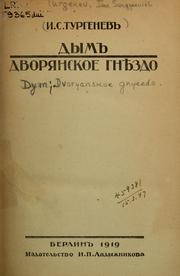
Smoke (Russian: «Дым») is an 1867 novel by the Russian writer Ivan Turgenev (1818–1883) that tells the story of a love affair between a young Russian man and a young married Russian woman while also delivering the author's criticism of Russia and Russians of the period. The story takes place largely in the German resort town of Baden-Baden.
Background and critical reception
Ivan Turgenev began work on what was to become Smoke in late 1865 and he carried a finished manuscript of the novel with him when he visited Russia in early 1867. In St. Petersburg, in February 1867, he gave several public charity readings from chapters of the book, all of which were met with approbation. Smoke was first published in the March 1867 issue of The Russian Messenger (Русский вестник Russkiy vestnik), one of the premier literary magazines of nineteenth-century Russia. The reception to Turgenev’s public readings was a bellwether, for upon publication in Russia the novel was met with almost immediate and universal condemnation in that country. Conservatives were enraged by his portrayal of the nobility, Slavophiles denounced Turgenev for denigrating his native Russia, while revolutionaries called the author a senile dodderer unable or unwilling to appreciate young Russians’ strength and will. As for Alexander Herzen, the exiled revolutionary the likes of whom Turgenev satirized in the character of Gubaryov, he wrote a largely negative review of the work in his revolutionary publication The Bell. The criticism of the novel for its supposed “anti-Russian” attitude arose from the fact that Smoke, more than simply a story of a ménage à trois (or even ménage à quatre) and a failed loved affair, is a roman à thèse, meant largely to display in ironical or farcical light the different strata of Russian society and to offer a political critique on the problems Russia was facing and the shortcomings of Russia’s would-be saviours.
Indeed, Smoke is a deeply satirical novel aimed not only at the conservative elements of Russian society who stubbornly refused reform and modernization but also at those Russian Slavophiles Turgenev had witnessed first hand abroad, more specifically Alexander Herzen and his young followers, who were rejecting European culture and glorifying a Slav mysticism in their campaign to remake Russia, and in the process badgering Turgenev for what appeared to them as his slavish adoration of European culture. In this, Turgenev focuses his ire on two groups that play prominently in the novel. On the one hand are a group of aristocratic “generals” who are resident in Baden and who form part of the entourage surrounding Litvinov's love interest Irina (and one of whom, General Ratmirov, is her husband). Their apparent disdain for Russia includes a pernicious chauvinism. Opposing them is a mixed group of radicals, who represent a new Slavophile socialism that is at least in part derived from the ideas of Herzen and his circle. Thus, for Turgenev, the similarities between them, rather than the surface opposition, lie at the heart of his criticism. Both groups deal in abstracts; both are far removed from any practical realities; and both ignore what for Turgenev remains the necessary element for the future of Russia: hard work in the context of the lessons of Western "civilization" in the broadest sense and above all concrete practicality. That viewpoint is presented by one of Turgenev's most problematic protagonists, Sozont Potugin, whose unsuccessful personal life stands in sharp contrast with the forcefulness of his Westernist views.
Aside from the few stories within the story, such as the early history of Litvinov and Irina Ratmirov, and the brief concluding chapters, the entirety of the novel takes place in Baden-Baden, a German resort town famous for its waters and gambling houses and a popular gathering spot for the elite of nineteenth century Europe. Turgenev’s description of the town came first-hand, for he had lived for a period in Baden, the novel was written there, and the episodes and characters are undoubtedly drawn from life. Turgenev had come to Baden-Baden to be near Madame Viardot, the opera singer and his most intimate, lifelong friend.
Plot
The novel opens in the German bathing resort of Baden-Baden (or simply Baden) in the summer of 1862, where the young Russian Grigory Litvinov has arrived en route home to Russia to meet his fiancée Tatiana Shestov, who will soon be arriving with her aunt and guardian, Kapitolina Markovna Shestov, from Dresden. In Baden Litvinov soon encounters Rostislav Bambaev, an acquaintance from Moscow. Later that evening at a social gathering Bambaev introduces Litvinov to the political activist Stepan Nikolaevitch Gubaryov. Litvinov is not overly impressed by the gathering nor especially by the nondescript looking Gubaryov. After this Litvinov returns to a local restaurant where he is approached by Sozont Ivanitch Potugin, who introduces himself to Litvinov as a fellow Russian. Litvinov had noted Potugin at the earlier get-together at Gubaryov’s where Potugin had not spoken a word. Potugin now opens up to Litvinov and Litvinov in turn is captivated by Potugin’s way with words. In a rather one-sided conversation Potugin vents his frustrations regarding the Russian character – its tendency towards servitude and flights of idealism that lead nowhere. Later back in his rooms, Litvinov finds a letter from his father and also a gift of heliotrope flowers on his windowsill brought by a mysterious woman who, according to the servant, did not leave her name. The letter from his father reveals the superstition of the rural Russian. The flowers, though they come without a note, seem to strike a deep and powerful resonance with Litvinov. Later that night, unable to sleep, he suddenly realizes who might have brought them.
以上文字摘自英文维基百科「Smoke (Turgenev novel)」(有删节,去掉了参考文献等尾部小节),按 CC BY-SA 4.0 使用,作者为维基百科的各位编者。
资料卡
- 原题
- Дым
- 原作语言
- 俄语
- 首次出版
- 1867 年
- 作品形式
- 长篇小说
- 体裁
- 政治小说
- 首发于
- The Russian Messenger(1867)
- 首版出版社
- The Russian Messenger
- 前作
- 父与子
- 故事发生地
- 巴登-巴登
资料卡来自 Wikidata Q5724762(CC0),众包数据,个别字段可能不全。