 书单
百科
这个词条暂时没有中文维基百科条目,下面是英文维基百科的内容(英文原文):
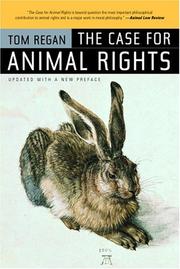
The Case for Animal Rights is a 1983 book by the American philosopher Tom Regan, in which the author argues that at least some kinds of non-human animals have moral rights because they are the "subjects-of-a-life", and that these rights adhere to them whether or not they are recognized. The work is considered an important text within animal rights theory.
Arguments
Immanuel Kant argued narrowly that all humans are "subjects-of-a-life" (see definition below, and compare subjectivity), and so possess inherent value. Thus, they must be treated as ends-in-themselves, never as a means to an end. Regan extends this position to non-humans. He also argues that, while being the subject-of-a-life is a sufficient condition for having intrinsic value, it is not a necessary one: an individual might not be the subject-of-a-life, yet still possesses intrinsic value.
The argument is a deontological one, as opposed to consequentialist. If an individual possesses a moral right to not be used as a means to an end, that right ought not be sacrificed, even if the consequences of doing so are considered appealing. Regan challenges Kant's assertion that moral patienthood is predicated on rationality by observing, following Jeremy Bentham, that this theory would not allow for irrational humans to possess moral status, and proposes the possession of a subjectivity instead. He describes his "subject-of-a-life criterion" as follows:
[It] involves more than merely being alive and more than merely being conscious. ... individuals are subjects-of-a-life if they have beliefs and desires; perception, memory, and a sense of the future, including their own future; an emotional life together with feelings of pleasure and pain; preference- and welfare-interests; the ability to initiate action in pursuit of their desires and goals; a psychophysical identity over time; and an individual welfare in the sense that their experiential life fares well or ill for them, logically independently of their utility for others and logically independently of their being the object of anyone else's interests. Those who satisfy the subject-of-a-life criterion themselves have a distinctive kind of value – inherent value – and are not to be viewed or treated as mere receptacles."
Regan argues that normally mental mammals over a year old satisfy the conditions, including most human beings, with the possible exception of those in persistent vegetative states, as do several species of birds, and possibly fish. The key attribute is that – following Thomas Nagel's "What Is it Like to Be a Bat?" (1974) – there is something that it is like to be those individuals; they are the subjects of experience, whose lives matter to them as individuals, even if they do not matter to anyone else.
In addition, Regan rejects the idea of denying animals rights by social contract theory, as he makes the argument that young children are also "unable to sign contracts", but are afforded rights anyway. Furthermore, he makes the argument that if he were to approach animal rights through human social contract, when somebody kicks one's dog, it is only morally wrong because it upsets the person, and not because a wrong has been done towards the dog, which he does not find sensible.
Regan argues that rights are not always absolute as there are times when to respect someone's right not to be harmed, another's right not to be harmed must be overridden. He states that when faced with overriding the rights of many innocent beings versus the rights of few innocent beings—when each individual involved would be equally harmed—we should override the rights of the few. He also states when individuals involved are not harmed in a comparable way given a certain course of action, we should mitigate the situation of those who would be worse-off. Thus, if the harm of a few innocent beings is greater than the harm to many innocent beings, the right action is to override the rights of the many. As this relates to animal rights, Regan asserts the harm in the death of an animal is not tantamount to the harm in the death of a normal, healthy human. This is supposedly because the ending of an animal life entails the loss of fewer opportunities when compared to the loss of a normal, healthy human.
Regan, to critique consequentialist ethics, provides a hypothetical in which he describes murdering a rich relative for a fortune in wealth, some of which he donates for a tax cut to a local children's hospital, resulting in the well-being of the children, their relatives, and their friends. He maintains that most people would find such an action unpalatable, and uses this to critique Peter Singer's hedonic utilitarianism. He further asserts that as the motives in the hypothetical were not noble to begin with, such an action was actually immoral, even if it did result in some positive consequences.
Finally, Regan concludes that animal exploitation in modern society is not justifiable, as animal industries view animals as a means to an end for trivial reasons; meat is not necessary for health, most cases of animal testing are for unnecessary consumer products, and hunting is similarly unnecessary. He therefore advocates abolishing the exploitation of animals for food, animal testing, and commercial hunting.
以上文字摘自英文维基百科「The Case for Animal Rights」(有删节,去掉了参考文献等尾部小节),按 CC BY-SA 4.0 使用,作者为维基百科的各位编者。
资料卡
- 原题
- The Case for Animal Rights
- 原作语言
- 英语
- 首次出版
- 1983 年
- 体裁
- 随笔
- 主题
- 动物权利、伦理学
资料卡来自 Wikidata Q3790708(CC0),众包数据,个别字段可能不全。