 书单
百科
这个词条暂时没有中文维基百科条目,下面是英文维基百科的内容(英文原文):
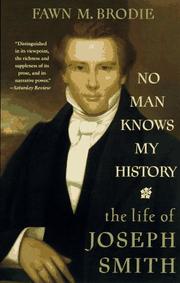
No Man Knows My History: The Life of Joseph Smith is a 1945 book by Fawn M. Brodie that was one of the first significant non-hagiographic biographies of Joseph Smith, the progenitor of the Latter Day Saint movement. No Man Knows My History was influential in the development of Mormon history as a scholarly field.
No Man Knows My History has never been out of print, and 60 years after its first publication, its publisher, Alfred A. Knopf, continues to sell about a thousand copies annually. For a revised edition released in 1971, Brodie added a supplement incorporating psychohistorical commentary. In 1995, Utah State University (USU) marked the 50th anniversary of the book's first publication by hosting a symposium to re-examine the book, its author, and her methods, and in 1996 USU published the symposium papers as a book of essays.
Background
Fawn M. Brodie was born in 1915 into a respected, if impoverished, Latter-day Saint family. Brodie drifted away from religion during her graduate studies in literature at the University of Chicago. Having found temporary employment at the Harper Library, Brodie began researching the origins of Mormonism as a biographical study of Joseph Smith. The writing of the biography was slowed by the birth of her first child and by three rapid moves to follow her husband's career, but in 1943, Brodie entered a 300-page draft of her book in a contest for the Alfred A. Knopf literary fellowship; in May, the publisher judged her application to be the best of the 44 entries.
Other scholars of Mormonism enlarged and critiqued Brodie's research, most notably Dale Morgan, who became a lifelong friend, mentor, and sounding board. Brodie finally completed her biography of Smith in 1944, and Knopf published it in 1945, when Brodie was 30 years old.
Perspective on Smith
In No Man Knows My History, Brodie presented the young Smith as a good-natured, lazy, extroverted, and unsuccessful treasure seeker, who, in an attempt to improve his family's fortunes, first developed the notion of golden plates and then the concept of a religious novel, the Book of Mormon. This book, she asserts, was based in part on an earlier work, View of the Hebrews, by a contemporary clergyman, Ethan Smith (no relation). While previous "naturalistic approaches to Joseph's visions had explained them through psychological analysis", regarding Smith as honest but deluded, Brodie instead interpreted him as having been deliberately deceptive. In No Man Knows My History, Brodie depicts Smith as having been a deliberate impostor, who at some point, in nearly untraceable steps, became convinced that he was indeed a prophet—though without ever escaping "the memory of the conscious artifice" that created the Book of Mormon. Jan Shipps, a preeminent non-LDS scholar of Mormonism who rejects this theory, nevertheless called No Man Knows My History a "beautifully written biography [...] the work of a mature scholar [that] represented the first genuine effort to come to grips with the contradictory evidence about Smith's early life."
Although Brodie's analysis of Smith has sometimes been termed psychobiography or psychohistory, she did not gain a reputation as a psychohistorian until later in life, and she denied the presence of psychohistory in No Man Knows My History "except by inadvertence." In 1971, Brodie added a supplement to the book that engaged more directly—though still somewhat sparingly—in psychoanalysis, revising her earlier portrayal of Smith from a deliberate charlatan to a conflicted person torn by unconscious internal dissonance in a "personality disorder" that nevertheless defied clinical models.
Reception
Prominence
Upon its publication, Dale Morgan called Brodie's first book the "finest job of scholarship yet done in Mormon history and perhaps the outstanding biography in several years—a book distinguished in the range and originality of its research, the informed and searching objectivity of its viewpoint, the richness and suppleness of its prose, and its narrative power." For decades afterward, No Man Knows My History enjoyed broad acceptance. In 1971, Latter-day Saint historian Marvin S. Hill observed that at the time, "most professional American historians" regarded the book "as the standard work on the life of Joseph Smith." By 1995, although four other book-length studies of Joseph Smith had been produced, none achieved as much prominence as No Man Knows My History.
In 1995, Utah State University sponsored a symposium to commemorate the 50th anniversary of the publication of No Man Knows My History during which scholars reflected on the book's contributions to Mormon studies.
In his 2005 biography of Smith titled Joseph Smith: Rough Stone Rolling, Richard Bushman noted that at that time Brodie's "biography was acknowledged by non-Mormon scholars as the premier study of Joseph Smith," and he called Brodie "the most eminent of Joseph Smith's unbelieving biographers." In 2007, Bushman observed Knopf still sold about a thousand copies of No Man Knows My History annually and noted Brodie had "shaped the view of the Prophet for half a century. Nothing we have written has challenged her domination. I had hoped my book would displace hers, but at best it will only be a contender in the ring, whereas before she reigned unchallenged." However, historian Laurie Maffly-Kipp, who is not Mormon, believed the influence of No Man Knows My History was waning, as while it had been "the 'go to' book on Smith's life" for "most historians", Rough Stone Rolling displaced it as a "definitive account" of Smith.
以上文字摘自英文维基百科「No Man Knows My History」(有删节,去掉了参考文献等尾部小节),按 CC BY-SA 4.0 使用,作者为维基百科的各位编者。
资料卡
- 原题
- No Man Knows My History: The Life of Joseph Smith
- 原作语言
- 英语
- 首次出版
- 1945 年
- 首版出版社
- 阿尔佛雷德·A·克诺夫
- 主题
- 约瑟·斯密
资料卡来自 Wikidata Q7044440(CC0),众包数据,个别字段可能不全。