书单
百科
这个词条暂时没有中文维基百科条目,下面是英文维基百科的内容(英文原文):
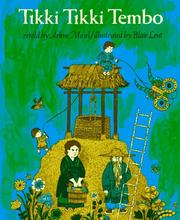
Tikki Tikki Tembo is a 1968 picture book written by Arlene Mosel and illustrated by Blair Lent. The book tells the story of a Chinese boy with a long name who falls into a well. It is an origin myth story about why Chinese names are so short today.
Plot
Tikki Tikki Tembo is set in ancient China and invents a fictitious ancient Chinese custom whereby parents honor their first-born sons with long, elaborate names that everyone is obliged to say completely – no nicknames, no shortening of any kind – while second-born sons are typically given short, unimportant names. One of these boys is named Tikki Tikki Tembo No Sa Rembo Chari Bari Ruchi Pip Peri Pembo ("The Most Wonderful Thing in the Whole Wide World") who has a little brother Chang ("Little or Nothing"); their mother shows obvious favoritism towards her older son while often dismissing Chang.
One day the brothers are playing very close to a well at their house. Chang falls in the well and his older brother runs to their mother and tells her Chang has fallen down the well. Their mother tells him to get the Old Man with the Ladder. He goes and tells the Old Man. Chang is rescued and then recovers quickly, after which their mother forbids the two boys from playing by the well.
While initially keeping the promise to their mother, the boys go to the well again after a festival to eat their rice cakes. This time, the older brother falls in. Chang runs to their mother and tries to tell her that "Tikki Tikki Tembo-no Sa Rembo-chari Bari Ruchi-pip Peri Pembo has fallen into the well." At first, she cannot hear him so he says it again. However, because Chang is out of breath from running, he sputters and then mispronounces the name. His mother insists that he repeat the name—but with respect.
He tries repeatedly until finally, his mother tells Chang to get the Old Man with the Ladder. Chang goes to the Old Man with the Ladder. Initially, the old man does not respond because he is asleep. When Chang tries to wake him up, the Old Man with the Ladder—annoyed—tries to fall back asleep. After Chang breathlessly repeats his brother's predicament, the Old Man goes with Chang to save his brother from the well. They get Tikki Tikki Tembo-no Sa Rembo-chari Bari Ruchi-pip Peri Pembo from the well, but because of how long he had been in the well, due to his long name, it takes considerably longer for him to recover. The end of the story says that this is why all people now have short names, instead of great long names.
Reception
The book received accolades upon publication. The Kirkus Review found the illustrations to be "a skillful counterpoint of diminutive detail and spacious landscape and a fine setting for a sprightly folktale." The book won a 1968 Boston Globe–Horn Book Award in the Picture Book category.
In 1997, The New York Times selected it as one of the 59 children's books of the previous 50 years. In a 1999–2000 National Education Association online survey of children, the book was one of the "Kids' Top 100 Books". Based on a 2007 online poll, the National Education Association listed the book as one of its "Teachers' Top 100 Books for Children". In a 2008 online poll of "Top 100 Picture Books" by School Library Journal, the book ranked 35th; in a similar 2012 poll, the book ranked 89th. According to the publisher, over one million copies of the book had been sold by 2013.
The 2009 audio book version of the story received a Parents' Choice Foundation rating of "Approved".
Criticisms and inaccuracies
Cultural activists and Chinese citizens criticized the book for "reinforc[ing] the stereotype that Asian names sound like nonsense syllables",, and that the name of the title character sounds nothing like actual Chinese.
Background
The publisher states that the author "first heard the story ... as a child" and that the book is her retelling of it. There are previous stories also set in China. However, the story is thought to have originated in Japan rather than China. Similar tales existed in Japan since the early 18th century, and have been introduced to the United States by 1900.
From Japan
In 1900, a poem "Teki-teki-no. A little Jap tragedy" by Jerome Davis Greene appeared on The Century Magazine. A child
Teki-teki-no, teki-suri-ombo, so-take-nudo, Harima-no-betto, Cha-wan-chaus'no, Fushimi-no-Esuke drowns in the well. No sibling is mentioned in this version. Jerome Davis Greene was an American born in Yokohama, Japan. He moved to the United States and later became a businessman and organizer of Japanese studies.
Japanese novelist Etsu Inagaki Sugimoto introduced a tale called "The long-life name" in a 1918 issue of the children's magazine Everyland. It tells that a child was given a long name, in a wish to live for long. But the child
Het-toko het-toko hengo-no-kami, ik-kai niu-do waniudo, gaga-no fun-nai-zama, oodep-po kodep-po, sasara dep-po hibashi, ja-jan-janjan drowns in the well. Sugimoto notes that she learned this tale during her childhood from her nurse.
Non-Japanese elements
In 1924, the National Association of Junior Chautauquas published a book that contained a story by an anonymous author entitled "Tiki-Tiki-Tembo"; the story concerned a boy "in old Japan" named:
Tiki-tiki-tembo-no sa rembo-Hari bari broohski-Peri pen do-Hiki pon pom-Nichi no miano-Dom bori ko and his neglected sibling "Choi". After falling into the well, the title character "never grew up to be a fine Japanese man." It concludes that "And now in old [sic] Japan, boys are given tiny short names such as 'Su', 'Foy', 'Wang', or 'Sing' ". There are some non-Japanese elements in this version. A book published in 1968 (the same year as Tikki Tikki Tembo) reprinted the 1924 version of the story.
An early instance of Chinese setting is a 1941 audio recording titled "Long-Name-No-Can-Say", adapted and narrated by Paul Wing. 1941 was in a time of strong anti-Japanese sentiment in the United States.
以上文字摘自英文维基百科「Tikki Tikki Tembo」(有删节,去掉了参考文献等尾部小节),按 CC BY-SA 4.0 使用,作者为维基百科的各位编者。
资料卡
- 原题
- Tikki Tikki Tembo
- 插图
- Blair Lent
- 原作语言
- 英语
- 首次出版
- 1968 年
- 作品形式
- 绘本
- 首版出版社
- 霍尔特·麦克杜格尔
资料卡来自 Wikidata Q7801951(CC0),众包数据,个别字段可能不全。
改编作品
取材于它的书1
名单来自 Wikidata(CC0):只列条目里写明「改编自 / 取材于」这本书的作品,不按名字猜;众包数据,可能不全。