书单
百科
这个词条暂时没有中文维基百科条目,下面是英文维基百科的内容(英文原文):
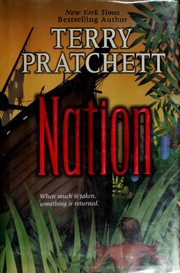
Nation is a novel by Terry Pratchett, published in the UK on 11 September 2008 and in the US on 6 October 2009. It was the first non-Discworld Pratchett novel since Johnny and the Bomb (1996). Nation is a low fantasy set in an alternative history of our world in the 1860s. The book received recognition as a Michael L. Printz Honor Book for 2009.
Development
Pratchett took his editors by surprise by writing it before the previously scheduled Tiffany Aching conclusion. He said "I want to write this one so much I can taste it", and that he had been ready to do it for four years. Pratchett said in February 2007, "At the moment I'm just writing. If it needs to be Discworld it will be Discworld. It could be set in this world 150 years ago while still more or less being a fantasy. The codename for it is Nation."
Synopsis
Context
Written loosely in a third-person perspective, the novel is set in an alternative history of our world, shortly after Charles Darwin has published On the Origin of Species. A recent Russian influenza pandemic has just killed the British king and his next 137 heirs. Except for the opening chapter, the novel's action entirely occurs in the Great Southern Pelagic Ocean (the fictionalised South Pacific Ocean) on a particular island known by its indigenous inhabitants as "the Nation".
The first chapter involves a subplot in which the Gentlemen of Last Resort, a secret society serving the Crown, urgently set out for Port Mercia in the Great Southern Pelagic Ocean to seek the next man in the British line of succession: Henry Fanshaw, the unsuspecting governor of England's oceanic territories. Fanshaw's 13-year-old daughter, Ermintrude, is one of the novel's two protagonists. The other protagonist, Mau, is an indigenous native of the Nation who is first depicted alone at neighbouring Boys' Island, where he has hand-built a canoe to complete his initiation rite from boyhood into manhood. Ermintrude, meanwhile, is travelling in a leisurely manner aboard a British schooner, the Sweet Judy, when mutineers, led by the ruthless First Mate Cox, are subdued and set adrift at sea, returning to the plot at a later time.
Plot summary
The main plot begins when an enormous tsunami carries the two central characters, Ermintrude and Mau, to the shores of Mau's home island: the Nation. Mau survives the tsunami in his canoe, while Ermintrude is the lone survivor of the Sweet Judy, which is run aground. The tsunami has killed all the indigenous villagers of the Nation, except Mau, who now angrily rejects the gods and believes that his interrupted rite of passage has left him soulless. Devastated, Mau carries all his people's corpses into the ocean, based on their religious belief that humans buried at sea become dolphins. Ermintrude timidly and sometimes recklessly interacts with Mau, but, eventually, the two start cooperating for mutual survival and establish some basic level of communication, though they are ignorant of each other's culture and language. Ermintrude introduces herself as "Daphne" and never reveals her given name, which she has always hated.
Survivors from neighbouring islands sporadically arrive, including the priest Ataba, who constantly derides Mau for his loss of faith, and two English-speaking brothers. One of these men gratefully employs the reluctant Daphne as a makeshift midwife for his pregnant wife, Cahle. Meanwhile, Mau sleeplessly keeps vigil, obsessively looking out for local cannibals who are known to strike without warning. At the same time, he frequently hears the pestering, disembodied voices of the Grandfathers: ancestral spirits who make angry (and often incoherent) demands. They insist that Mau replace the "god anchors", carved white stones traditionally said to have "anchored" the gods before the tsunami displaced them. Mau discovers the anchors in the Nation's lagoon alongside an additional, previously unknown stone, but Ataba attempts to destroy it, purportedly because it is heretical. Mau then rescues Ataba from the lagoon, but his resulting hypothermia and exhaustion lead to a coma; Daphne accepts a lump of poison from Mrs. Gurgle, a shaman who is one of the refugees, that successfully lets her travel in her mind to the land of the dead in order to rescue Mau's consciousness.
Daphne begins hearing the voices of the Grandmothers, who claim to be the neglected but more sensible counterparts to the Grandfathers. They suggest that Daphne explore an ancient, closed-off crypt called the Grandfathers' cave. Mau, Daphne, Ataba, and their companions enter this cave and discover that the Nation is probably the oldest civilization on Earth, whose citizens once made astounding scientific progress with such creations as telescopes, eyeglasses, and even accurate star charts.
After exiting the cave, the group is confronted by two of Sweet Judy's villainous mutineers, who abruptly kill a spear-wielding Ataba and briefly abduct Daphne before she devises a cunning escape. In the meantime, the mutineers' leader, Cox, has since joined the cannibals, becoming their self-proclaimed chief and planning to raid the Nation. The new inhabitants of the Nation convince the arriving Cox and the cannibals to follow tradition by having the leaders of each side fight in hand-to-hand mortal combat, so as to avoid large-scale bloodshed. Mau accepts his role as leader of the Nation, and then cleverly outwits and kills Cox in the lagoon, causing the cannibals to flee.
以上文字摘自英文维基百科「Nation (novel)」(有删节,去掉了参考文献等尾部小节),按 CC BY-SA 4.0 使用,作者为维基百科的各位编者。
资料卡
- 原题
- Nation
- 原作语言
- 英语
- 首次出版
- 2008 年 9 月 11 日
- 作品形式
- 长篇小说
- 体裁
- 架空历史、奇幻、科学幻想
资料卡来自 Wikidata Q2640690(CC0),众包数据,个别字段可能不全。
更多资料与书评
在哪读
泰瑞·普莱契 的其他作品
作者页 ›