 书单
百科
这个词条暂时没有中文维基百科条目,下面是英文维基百科的内容(英文原文):
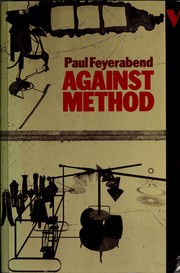
Against Method: Outline of an Anarchistic Theory of Knowledge is a 1975 book by Austrian philosopher of science Paul Feyerabend. The central thesis of the book is that science should become an anarchic enterprise. In the context of the work, the term "anarchy" refers to epistemological anarchy, which does not remain within one single prescriptive scientific method on the grounds that any such method would restrict scientific progress. The work is notable in the history and philosophy of science partially due to its detailed case study of Galileo's hypothesis that the earth rotates on its axis and has since become a staple reading in introductory philosophy of science courses at undergraduate and graduate levels.
Against Method contains many verbatim excerpts from Feyerabend's earlier papers including "Explanation, Reduction, and Empiricism", "How to be a Good Empiricist: A Plea for Tolerance in Matters Epistemological", and "Problems of Empiricism, Part I." Because of this, Feyerabend claims that "[Against Method] is not a book, it is a collage." Later editions of Against Method included passages from Science in a Free Society.
Publication, Translations, and Editions
Feyerabend began writing Against Method in 1968 and it was originally released as a long paper in the Minnesota Studies in the Philosophy of Science series in 1970. At the behest of Imre Lakatos, who originally planned to write For Method in contrast to Against Method but then died, the paper was expanded into a book published in 1975. Lakatos originally encouraged Feyerabend to publish with Cambridge University Press because they would be less concerned with their reputation than smaller presses, but Feyerabend chose to publish with Verso Books (then called New Left Books). Feyerabend came to regret this decision because of their editorial choices. Three more editions were released, in 1988, 1993, and posthumously in 2010. Significant changes were made including removing or adding chapters and appendices with new, updated introductions.
Against Method was an international best seller and, as a result, it has been translated into many languages. This includes:
German translation by Hermann Vetter (revised and enlarged): Wider den Methodenzwang: Skizze einer anarchistischen Erkenntnistheorie, Suhrkamp: Frankfurt am Main 1976, 443 pp.
Dutch translation by Hein Kray: In strijd met de methode: Aanzet tot een anarchistische kennistheorie, Meppel: Boom 1977, 375 pp.
Portuguese translation by Octanny S. da Mota and Leonidas Hegenberg: Contra o método: Esboça de una teoria anárquica da teoria do conhecimento, Livraria Francisco Alves: Rio de Janeiro 1977, 487 pp.
Swedish translation by Thomas Brante: Ned med metodologin! Skiss till en anarkistisk kunskapsteori, Raben and Sjogren: Zenit 1977, 326 pp.
French translation by Baudouin Jurdant and Agnès Schlumberger: Contre la methode: Esquisse d'une théorie anarchiste de la connaissance, Seuil: Paris 1979, 350 pp.
Italian translation by Libero Sosio: Contro il metodo: Abbozzo di una teoria anarchica della conscenza, Feltrinelli: Milan 1979, viii+262 pp.
Spanish translation by Diego Ribes: Tratado contra el método, Tecnos: Madrid 1981, xvii+319 pp.
Japanese translation: Hoho eno chosen: Kagakuteki sozo to chi no anakizumu, Shin'yosha: Tokyo 1981, 13+438 pp.
Turkish translation by Ahmet İnam: Yönteme Hayır: Bir Anarşist Bilgi Kuramının Ana Hatları, Ara: Istanbul 1989, 325 pp.
Chinese translation by Changzhong Zhou: Shanghai Translation Publishing House: Shanghai 1994, 269 pp.
The 4th edition, released after Feyerabend's death on the 35th anniversary of the initial book release, includes an introduction from Ian Hacking.
Content
Epistemological anarchism
The primary thesis of Against Method is that there is no such thing as the scientific method and that it is not appropriate to impose a single methodological rule upon scientific practices. Rather, 'anything goes', meaning that scientists should be free to pursue whatever research seems interesting to them. The primary target of Against Method is 'rationalism', or the view that there are rational rules that should guide scientific practices. The German title of Against Method, Wider den Methodenzwang translates more directly to "Against the Forced Constraint of Method" emphasizing that it is the imposition of methodological rules that is rejected rather than the uses of methods altogether. Feyerabend offers two parallel arguments for this position, one conceptual and one historical. The conceptual argument aims to establish that it is always legitimate to violate established forms of scientific practice with the hopes of establishing a new form of scientific rationality. The historical argument provides examples of scientists profitably violating rules. Against Method contains dozens of case studies, though the majority of them are relegated to footnotes or passing remarks. The primary case study in Against Method is Galileo's hypothesis that the earth rotates on its axis.
以上文字摘自英文维基百科「Against Method」(有删节,去掉了参考文献等尾部小节),按 CC BY-SA 4.0 使用,作者为维基百科的各位编者。
资料卡
- 原题
- Against Method
- 原作语言
- 英语
- 首次出版
- 1975 年
- 体裁
- 科学哲学
- 主题
- 科学史、认识论无政府主义
资料卡来自 Wikidata Q4691050(CC0),众包数据,个别字段可能不全。