书单
百科
这个词条暂时没有中文维基百科条目,下面是英文维基百科的内容(英文原文):
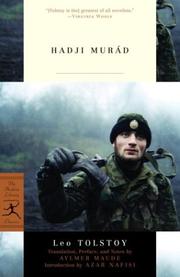
Hadji Murat, also written Hadji Murad (Russian: Хаджи-Мурат, romanized: Khadzhi-Murat), is a novella written by Leo Tolstoy from 1896 to 1904 and published posthumously in 1912 (though not the full text until 1917). Its titular protagonist Hadji Murat is an Avar rebel commander who, to gain revenge, forges an uneasy alliance with the Russians he has been fighting.
Inspiration
The theme of struggle while remaining faithful resonated with an ailing Tolstoy as he approached death. His letters suggest that this work gave him a brief, final moment of vigor. Just as the author struggled with failing health, his meditation on a man refusing to give in to the demands of the world helped him to complete the book, although he did not intend to publish it and was only concerned with its completion. In addition to the theme of resistance, determinism is a major theme, as it is in War and Peace. Another prominent theme is the struggle between imperial Russia and the Caucasian Imamate, reflecting the broader East vs. West dichotomy frequently explored in 19th-century Russian literature.
The work recalls Alexander Pushkin's historical novel The Captain's Daughter (1836) because its realism is also based on actual people and events, though the main character in Pushkin does not meet the same end. Tolstoy used material in Russian archives, including Hadji Murad's own account of his life.
Historical context
Tolstoy created this story, set in the Caucasus Mountains during the mid-nineteenth century, when Russian imperial expansion sought to subdue Chechen and Dagestani tribes. Hadji Murat is also linked with Tolstoy's own military experiences in the region. He wrote to his brother in 1851: "If you wish to show off with news… you may recount that a certain Hadji Murad [...] surrendered a few days ago to the Russian government. He was the leading dare-devil and ‘brave’ of all Chechnya, but has been led into committing a mean action."
In the book he described the Caucasian War that both he and Hadji Murad were caught up in. Although written about fifty years after the events occurred, Tolstoy highlights the contrast between the bureaucratic rigidity of the Russian imperial court and the passionate life of the mountain tribes.
Plot summary
The narrator prefaces the story with the image of a crushed, but still living thistle he finds in a field (a symbol for the main character), after which he begins to tell the story of Hadji Murat, a renowned guerrilla leader who falls out with his own commander and eventually sides with the Russians, hoping to save his family, who are captives of Imam Shamil, the Avar leader who abducted his mother, two wives, and five children. He also wants to avenge the deaths of other family members. The story opens with Murat and two of his followers fleeing Shamil, the commander of the Caucasian warriors fighting the Russians. They find refuge at the house of Sado, a loyal supporter of Murat. Villagers learn of his presence, and Murat escapes before they can do him harm.
His lieutenant succeeds in making contact with the Russians, who promise to meet Murat. He eventually arrives at the fortress of Vozdvizhenskaya to join the Russian forces, hoping to draw their support to overthrow Shamil and save his family. Before his arrival, a small skirmish occurs with some Chechen and Dagestani mountaineers outside the fortress, and Petrukha Avdeyev, a young Russian soldier, dies in a military hospital from gunshot wounds. Tolstoy makes a chapter-length aside about Petrukha: childless, he volunteered as a conscript in place of his brother, who had a family of his own. Petrukha's father regrets this because he was a dutiful worker compared to his lazy brother.
While at Vozdvizhenskaya, Murat befriends Prince Semyon Vorontsov, the Viceroy's son, his wife Maria and his son, and wins over the goodwill of the soldiers stationed there. They are at once in awe of his physique and reputation, and enjoy his company, finding him honest and upright. The Vorontsovs give him a present of a watch which fascinates him. On the fifth day of Murat's stay, the governor-general's adjutant, Mikhail Loris-Melikov, arrives with orders to write down Murat's story, and the reader learns some of his history: he was born in the village of Tselmes and early on became close to the local khans because his mother was the royal family's wet nurse. When he was fifteen some followers of Muridism came into his village, calling for a holy war (ghazavat) against Russia. Murat declines at first, but after a learned man is sent to explain how it will be run, he tentatively agrees. However, in their first confrontation, Shamil—then a lieutenant for the Muslims hostile to the Russians—embarrasses Murat when he goes to speak with the leader Hamzat. Hamzat eventually launches an attack on the capital of Khunzakh and kills the pro-Russian khans, taking control of this part of Dagestan. The slaughter of the khans throws Hadji and his brother against Hamzat, and they eventually succeed in killing him. Unfortunately, Murat's brother is killed as well and Shamil replaces Hamzat as leader. He calls on Murat to join his struggle, but Murat refuses because the blood of his brother and the khans is on Shamil.
Once Murat has joined the Russians, who are aware of his position and bargaining strength, they find him a useful tool for getting to Shamil. However, Vorontsov's plans are complicated by the War Minister, Chernyshov, a rival prince who is jealous of him, and Murat has to remain in the fortress because the Tsar is told he might be a spy. The story includes a satirical depiction of Tsar Nicholas I of Russia, portraying him as vain, autocratic, and bitter, and detailing his contempt for women, his brother-in-law Frederick William IV of Prussia, and Russian students.
以上文字摘自英文维基百科「Hadji Murat (novella)」(有删节,去掉了参考文献等尾部小节),按 CC BY-SA 4.0 使用,作者为维基百科的各位编者。
资料卡
- 原题
- Хаджи-Мурат
- 译者
- 艾尔默. 莫徳,
- 原作语言
- 俄语
- 首次出版
- 1912 年
- 作品形式
- 长篇小说、中篇小说
- 体裁
- 短篇小说、历史类虚构作品
- 故事发生地
- 俄罗斯帝国
资料卡来自 Wikidata Q2072257(CC0),众包数据,个别字段可能不全。