书单
百科
这个词条暂时没有中文维基百科条目,下面是英文维基百科的内容(英文原文):
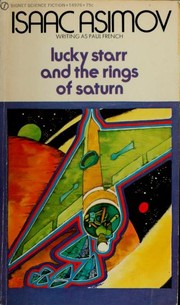
Lucky Starr and the Rings of Saturn is the final novel in the Lucky Starr series, six juvenile science fiction novels by Isaac Asimov that originally appeared under the pseudonym Paul French. The novel was first published by Doubleday & Company in 1958. It was the last novel to be published by Asimov until his 1966 novelization of Fantastic Voyage, and his last original novel until 1973's The Gods Themselves. Lucky Starr and the Rings of Saturn is the only novel by Asimov set in the Saturnian system.
Setting
Lucky Starr and the Rings of Saturn is set mostly within the Saturnian system, depicted as accurately as the knowledge of the late 1950s allowed. At that time, only nine satellites had been discovered, the innermost known satellite being Mimas. Asimov describes Mimas as being 340 miles in diameter, but its diameter is now known to be 240 miles. Several of the novel's chapters are set on Titan, which was then thought to be the third largest satellite in the Solar System, after Ganymede and Triton. Its atmosphere is described as "almost as thick as Earth's" and composed mostly of methane. It is now known that Titan is the second largest satellite in the Solar System after Ganymede, and that its atmosphere is denser than Earth's and is 98.4% nitrogen and only 1.6% methane.
The final chapters take place on the asteroid Vesta, which Asimov notes is the brightest of the asteroids. At the time, it was believed that Vesta was 215 miles in diameter, although its mean diameter is now known to be closer to 330 miles.
Plot summary
Six weeks after returning from the Jovian system, David "Lucky" Starr learns that Jack Dorrance, the chief of a Sirian spy ring uncovered by Starr in the Jovian system, has escaped from Earth.
Starr and his sidekick Bigman Jones follow Dorrance to the Saturnian system, where Dorrance tries to lose them in Saturn's rings, but his ship is destroyed by a ring fragment. A Sirian ship then contacts Starr and informs him that the Sirians have built a colony on Titan and claimed it for Sirius, contrary to the traditional principle that inhabitants of one world in a stellar system have sovereignty over the entire system, even those parts without permanent settlements. Starr orders the pursuing Terrestrial fleet back to Earth; but returns with Bigman and Councilman Ben Wessilewsky to the Saturnian system.
When several Sirian ships pursue the Shooting Starr, Starr conceals himself and his ship in the interior of Mimas; leaves Wessilewsky below the surface with enough supplies to maintain himself for several months; then takes the Shooting Starr back into space, where they are captured by the Sirians and taken to the colony on Titan. There, Sirian commander Sten Devoure threatens to have Bigman killed unless Starr agrees to testify at an upcoming interstellar conference on the asteroid Vesta that he entered the Saturnian system to attack the Sirians. When Bigman endangers himself by defeating Devoure in a duel, Starr makes a deal with Devoure: if he spares Bigman's life, Starr will testify that he entered the Saturnian system in an armed ship, and will lead the Sirians to Wessilewsky's base on Mimas.
As delegates assemble for the conference, Agas Doremo, the leader of the neutralist forces of the Galaxy, tells Conway they should let the Sirians stay. While he supports the idea of stellar systems being indivisible, Doremo cannot see a way to get the Sirians out of the Solar System without a war, given the other worlds' distrust of Earth. However, should the Sirians remain, they might eventually overplay their hand, allowing for a new conference under more favorable conditions. However, he agrees to do what he can to support Earth's view should the opportunity arise.
Doremo is elected to preside over the conference; the one thing both sides agree upon. Devoure admits that the Sirians have established a base on Titan, but insists that the fact that Saturn and its moons are part of Earth's stellar system is irrelevant: "An empty world is an empty world, regardless of the particular route it travels through space. We colonized it first and it is ours". Devoure then brings out Starr, who admits to having re-entered the Saturnian system after being warned off, and also that Wessilewsky established a base on Mimas. Conway then receives permission to cross-examine Starr.
When asked his reasons, according to a secret plan of his own, Starr replies that Wessilewsky was placed to establish a colony on Mimas. At this, Conway states that by removing Wessilewsky from Mimas, the Sirians violated the very principle they attempted to establish - Devoure has stated earlier that the Sirians have never even approached Mimas earlier, so it is Earth's regardless of whose point of view is taken. Seeing the opportunity, Doremo points out the demonstrated implications of accepting the Sirian view; a war can start literally over every single rock. Then he manipulates the delegates into a vote before Sirius can work out a proper response. The conference ends with three client worlds voting with the Sirians, and the rest voting with Earth, with the result that the Sirians are ordered to leave Titan within a month – the principle of "Indivisibility of Stellar Systems" being firmly established, which the protagonists consider a positive and desirable outcome.
Themes
Lucky Starr and the Rings of Saturn was written between December 1957 and February 1958, in the immediate aftermath of the launch of Sputnik I by the Soviet Union, and Asimov comments thereon in chapter 8, by having Starr talk about the superiority of Sirian robots:
"These robots are a human achievement. The humans that did the achieving are Sirians, yes, but they are human beings, too, and all other humans can share pride in the achievement. If we fear the results of their achievement, let's match it ourselves, or more than match it. But there's no use denying them the worth of their accomplishment".
以上文字摘自英文维基百科「Lucky Starr and the Rings of Saturn」(有删节,去掉了参考文献等尾部小节),按 CC BY-SA 4.0 使用,作者为维基百科的各位编者。
资料卡
- 原题
- Lucky Starr and the Rings of Saturn
- 原作语言
- 英语
- 首次出版
- 1958 年
- 作品形式
- 长篇小说
- 体裁
- 科学幻想
- 首版出版社
- 双日出版社
- 所属系列
- 幸运之星系列
- 前作
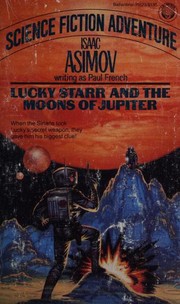
- Lucky Starr and the Moons of Jupiter
- 主要人物
- Lucky Starr
资料卡来自 Wikidata Q3839001(CC0),众包数据,个别字段可能不全。