 书单
百科
这个词条暂时没有中文维基百科条目,下面是英文维基百科的内容(英文原文):
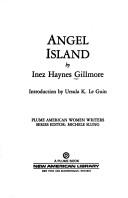
Angel Island is a science fiction/fantasy novel by American feminist author, journalist and suffragette Inez Haynes Irwin, writing under the name Inez Haynes Gillmore. It was originally published by Henry Holt in January 1914. The novel is about a group of men shipwrecked on an island occupied by winged-women.
Angel Island was reprinted in the February 1949 issue of Famous Fantastic Mysteries, and again in 1978 by Arno Press. In 1988 it was republished by Plume as a "classic of early feminist literature" with an introductory essay by science fiction and fantasy author Ursula K. Le Guin.
Plot summary
Five men are shipwrecked on an island in the Pacific Ocean while en route from America to the Orient. They are the only survivors, and their chances of being rescued are remote as a storm had driven their ship into uncharted waters before smashing it against rocks. The island is 20 miles long by 7 miles wide, and densely wooded with a freshwater lake in the center. After coming to terms with their predicament, the men begin collecting what they can from washed-up wreckage from the ship: food, clothes, tools and materials. They start building a camp near the beach and bemoan the fact that they are stuck on an island without women. But as the weeks pass, they begin to relish the absence of women and call the island an "Eveless Eden".
Then one day the men start seeing what look like huge birds flying high in the sky, but when the "birds" come closer they realise that they are five beautiful winged-women. Suddenly the men are interested in women again and change the island's name to "Angel Island". Over time the women gradually come closer and start following the men around, who quickly fall in love with the women and name them Julia (their leader), Lulu, Chiquita, Clara and Peachy. But the men become frustrated by the women's aloofness and how easily they frighten, and decide to capture them, saying that they need pampering and protection. Once caught the men subdue the frightened women and cut off their wings. The women, who cannot walk on their small, delicate feet, are now completely helpless. The men quickly win their hearts by showering them with gifts and attention, and teach them English. The men and women pair off and four of them marry; Julia resists this temptation. With the women now domesticated, the men start paying less attention to them and spend long periods inland building a new camp near the lake. The women, who cannot fly, nor walk any distance, are stuck in the camp near the beach.
With plenty of time on their hands, the women reminisce on how it was when they could fly. Back home, the five women, led by Julia, had rebelled when their people decided to migrate south, and flew north instead. They found Angel Island, deserted and inviting. Then the men came and the women were fascinated by these wingless creatures. They followed them, teased them, and then made the mistake of falling in love with them, resulting in their capture. The women long to fly again, but the men keep their wings clipped. Soon each of the women bears a child, four wingless boys, and a winged-girl, Angela. As Angela grows up she starts flying and the women are delighted. The men, however, are not so happy and announce that when Angela is older they will cut her wings. The women have accepted their own fate, but decide to put aside their "appealing helplessness" and stand up for Angela.
While the men are working at the new camp each day, the women teach themselves how to walk. When their feet are strong enough, they trek to the new camp one day, unannounced and much to the surprise of the men. Julia presents the men with an ultimatum, let Angela keep her wings, or they will leave the island with the children. The men laugh and remind them that they cannot fly. But the women, with wing stumps that have grown since their last clipping, take off and fly (not very gracefully) over the lake. The men, horrified at the prospect of losing their women, beg them to return and promise not to cut Angela's wings. Things change on Angel Island, and the men have a new respect for the women. Not only do they honor their promise about Angela's wings, they stop clipping the women's wings. Julia decides to marry and her final triumph comes years later on her death bed when she gives birth to a son with wings.
Major characters
The ship-wrecked men
Frank Merrill – self-appointed leader of the men; a professor of a small mid-West university and a solitary person; believes women should not receive any special treatment
Honey Smith – a businessman in partnership with Billy Fairfax; not that smart but very popular, particularly with women; believes women should be spoiled and pampered
Pete Murphy – an Irish writer, clever, but has a weakness for women's charm; believes women are angels and should be worshipped
Billy Fairfax – a businessman in partnership with Honey Smith; lacking charm, but in possession of a huge fortune; believes women should be cherished and protected
Ralph Addington – a salesman with a strong personality; tends to be course and arrogant; believes women should be tamed, subjugated and controlled
The winged-women, named by the men
Julia – Billy Fairfax's wife and leader of the women; silver winged and "heroic" and "clear-sighted"; dubbed "the quiet one" by the men
Lulu – Honey Smith's wife; orange winged and "chattering"; dubbed "the plain one"
Chiquita – Frank Merrill's wife; scarlet winged and "lazy" and "voluptuous"; dubbed "the dark one"
Clara – Pete Murphy's wife; green and gold winged and "excitement-craving"; dubbed "the thin one"
Peachy – Ralph Addington's wife; blue winged and "poetic"; dubbed "the peachy one"
以上文字摘自英文维基百科「Angel Island (novel)」(有删节,去掉了参考文献等尾部小节),按 CC BY-SA 4.0 使用,作者为维基百科的各位编者。
资料卡
- 原题
- Angel Island
- 原作语言
- 英语
- 作品形式
- 长篇小说
- 体裁
- 女性主义科幻小说、科学幻想
- 首版出版社
- Henry Holt
资料卡来自 Wikidata Q4762193(CC0),众包数据,个别字段可能不全。