书单
百科
这个词条暂时没有中文维基百科条目,下面是英文维基百科的内容(英文原文):
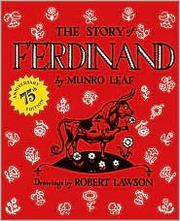
The Story of Ferdinand (1936) is the best-known work by the American author Munro Leaf. Illustrated by Robert Lawson, the children's book tells the story of a bull who would rather smell flowers than fight in bullfights. He sits in the middle of the bull ring failing to take heed of any of the provocations of the matador and others to fight. The Story of Ferdinand was published in 1936 by Viking Books. Later, after the Spanish Civil War, it was viewed as having a political agenda. During World War II, the British Air Transport Auxiliary started flying into Europe after D-Day and their pilots, who were non-combatants, used Ferdinand the Bull as their call sign. The book has been adapted into two films, the 1938 animated short Ferdinand the Bull and the 2017 animated feature film Ferdinand. The latter was nominated for Best Animated Feature at the 90th Academy Awards.
Plot
Young Ferdinand does not enjoy butting heads with other young bulls, preferring instead to sit under a cork tree smelling flowers. His mother is concerned that he might be lonely and tries to persuade him to play with the other calves, but when she sees that Ferdinand is content as he is, she leaves him alone.
Ferdinand grows to be the biggest bull in the herd and he often spends time alone. All the other bulls dream of being chosen to compete in the bullfights in Madrid, but Ferdinand still prefers smelling the flowers instead. One day, five men come to the pasture to choose a fighting bull. Ferdinand is again on his own, sniffing flowers, when he accidentally sits on a bumblebee. Upon getting stung as a result, he runs wildly across the field, snorting and stamping. Mistaking Ferdinand for a mad and aggressive bull, the men dub him "Ferdinand the Fierce" and take him away to Madrid.
All of Madrid, including many women, turn out to see the handsome matador fight "Ferdinand the Fierce". When Ferdinand enters the bull ring, he is faced with the matador, banderilleros and picadors who panic when they see him. However, he is delighted by the flowers in the women's hair and sits down in the middle of the ring to smell them, upsetting and disappointing everyone and making the matador and other fighters throw tantrums. Ferdinand is then taken back to his pasture, where at the end he is still sitting under the cork tree happily smelling flowers.
Publication
The book's first run by Viking Press in 1936 sold 14,000 copies at a dollar each. The following year saw sales increase to 68,000 by 1938, the book was selling at 3,000 per week. That year, it outsold Gone with the Wind to become the number one best seller in the United States.
As of 2019 the book has never been out of print. The book has been translated into more than sixty languages. In 1962, a Latin translation, Ferdinandus Taurus, was published by David McKay Publications in New York and by Hamish Hamilton in London.
A first-edition copy sold at auction for $16,500 in 2014.
Reception
In 1938, Life magazine called Ferdinand "the greatest juvenile classic since Winnie the Pooh" and suggested that "three out of four grownups buy the book largely for their own pleasure and amusement". The article also noted that Ferdinand was accused of being a political symbol, noting that "too-subtle readers see in Ferdinand everything from a fascist to a pacifist to a burlesque sit-down striker". Others labelled the work "as promoting fascism, anarchism, and communism". The Cleveland Plain Dealer "accused the book of corrupting the youth of America" while The New York Times downplayed the possible political allegories, insisting the book was about being true to oneself.
The book was released less than two months after the outbreak of the Spanish Civil War, and was seen by many supporters of Francisco Franco as a pacifist book. It was banned in many countries, including in Spain (where it remained banned until after Franco's death). In Nazi Germany, Adolf Hitler ordered the book burned (as "degenerate democratic propaganda"), while it was the only American children's book available for sale in Cold War era Poland. It received particular praise from Thomas Mann, H. G. Wells, Gandhi, and Franklin and Eleanor Roosevelt. Following the 1945 defeat of Germany during the Second World War, 30,000 copies were quickly published and given out for free to the country's children.
In the United States, the book was so popular with the public in the 1930s that it was used in various commercial products, from toys to Post Toasties breakfast cereal. Disney made it into an animated short in 1938, which became a classic (winning the Academy Award for Best Animated Short Film) and was the basis for Ferdinand the Bull, based on 'The Story of Ferdinand' by Munro Leaf and Robert Lawson (Whitman Publishing Co., 1938), Walt Disney's Ferdinand and the Robbers (Random House, 1983) by Vincent H. Jefferds and Walt Disney's Ferdinand and the Bullies (Bantam Books, 1986, ISBN 978-0553055900).
In 1951, Holiday magazine published an Ernest Hemingway children's story called "The Faithful Bull". This story has been interpreted as a "rebuttal" to the earlier Leaf book.
According to one scholar, the book crosses gender lines in that it offers a character to whom both boys and girls can relate. More recently, in 2011 The New York Times positioned the story in the context of discrimination and social exclusion. It characterized the story as "an icon for the outsider and the bullied".
Background
Leaf is said to have written the story on a whim in an afternoon in 1935, largely to provide his friend, illustrator Robert Lawson (then relatively unknown) a forum in which to showcase his talents.
以上文字摘自英文维基百科「The Story of Ferdinand」(有删节,去掉了参考文献等尾部小节),按 CC BY-SA 4.0 使用,作者为维基百科的各位编者。
资料卡
- 原题
- The Story of Ferdinand
- 插图
- 罗伯特·劳森
- 原作语言
- 英语
- 首次出版
- 1936 年
- 作品形式
- 绘本
资料卡来自 Wikidata Q1367374(CC0),众包数据,个别字段可能不全。
改编作品
电影2
名单来自 Wikidata(CC0):只列条目里写明「改编自 / 取材于」这本书的作品,不按名字猜;众包数据,可能不全。