 书单
百科
这个词条暂时没有中文维基百科条目,下面是英文维基百科的内容(英文原文):
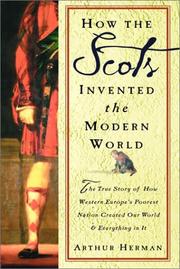
How the Scots Invented the Modern World: The True Story of How Western Europe's Poorest Nation Created Our World & Everything in It (or The Scottish Enlightenment: The Scots invention of the Modern World) is a non-fiction book written by American historian Arthur Herman. The book examines the origins of the Scottish Enlightenment and what impact it had on the modern world. Herman focuses principally on individuals, presenting their biographies in the context of their individual fields and also in terms of the theme of Scottish contributions to the world.
The book was published as a hardcover in November 2001 by Crown Publishing Group and as a trade paperback in September 2002. Critics found the thesis to be over-reaching but descriptive of the Scots' disproportionate impact on modernity. In the American market, the trade paperback peaked at #3 on The Washington Post bestseller list, while in the Canadian market it peaked at #1.
Background
At the time of publication, the author was the coordinator of the Western Civilization Program at the Smithsonian Institution in Washington, DC. The book grew out of a class topic at the Smithsonian regarding intellectual life in Edinburgh in the 18th century. Herman was impressed by the fact that so many prominent individuals who had a significant impact on modernity had come from such a specific geographic location and time-frame.
Herman had only once been to Scotland as a teenager when his father, a professor, spent a semester at Edinburgh University. Though born and raised in the Midwestern United States, his ancestry traces back to Norway; there are no Scots in his ancestral background of whom he is aware.
Synopsis
The book is divided into two parts. The first part, Epiphany, consists of eight chapters and focuses on the roots, development, and impact of the Scottish Enlightenment on Scotland and Great Britain. The roots come from an appreciation for democracy and literacy that developed from the Scottish Reformation, when John Knox brought Calvinist Presbyterianism to Scotland. He preached that God ordained power into the people and that it was for the people to administer and enforce God's laws, not the monarchy. For common people to understand God's laws they had to be able to read the Bible, so schools were built in every parish and literacy rates grew rapidly, creating a Scottish-oriented market for books and writers.
Though they each resented one another, the English and Scots joined in 1707 to form the Kingdom of Great Britain; the English wanted the Scots controlled and the Scots realized they could not match English power. The Scots immediately benefited from a centralized government that paid little attention to it—for example, inexpensive imports reduced the impacts of famines and allowed a Scottish culture to flourish. Herman calls the Scottish Enlightenment "more robust and original" than the French Enlightenment and that the product of the "Scottish school" was that humans are creatures of their environment, constantly evolving and trying to understand itself via social sciences.
The defeat of the 1745 Jacobite rising decimated the antiquated social structure based around clans lorded over by chieftains. This liberalized the Scottish way of life by allowing citizens to own land and keep the profits instead of giving all profits to the chieftains who owned all the land. Their literate foundation allowed the Scots to become economically literate and take advantage of trade. Edinburgh and Glasgow became epicenters of intellectual thought. There existed in Scotland a clergy who believed that a moral and religious foundation was required for, and compatible with, a free and open sophisticated culture, which moderated hardline conservatives. Herman presents biographies of Francis Hutcheson, Henry Home (Lord Kames), Robert Adam, Adam Smith, and others to illustrate the Scottish development.
The second part, Diaspora, focuses on the impacts of Scots on events, the world, and industries. Most Scots immigrants in the American colonies sympathized with the British during the American Revolutionary War but those who did fight in the militias were the most capable because many were the same refugee families from the 1745 Jacobite rising. Herman claims that the Scottish School of Common Sense influenced much of the American declaration of independence and constitution.
After Great Britain lost the American colonies, a second generation of Scottish intellectuals saved Britain from stagnation and reinforced a self-confidence that allowed the country to manage a world empire during the Victorian era. Scottish colonial administrators, like James Mill, were instrumental in formulating the idea of the civilizing mission, which posited that Europeans should take over indigenous cultures and run their society for their own good, as part of "the white man's burden". Herman claims that Sir Walter Scott invented the historical novel, giving modernity a "self-conscious antidote", and gave literature a "place as part of modern life".
In science and industry Herman states that James Watt's steam engine "gave capitalism its modern face, which has persisted down to today". It permitted business to choose its location, like in cities close to inexpensive labor, and it was Scots who rectified negative impacts industry had, i.e. the public health movement. Scots' contribution to modern society is illustrated with biographies of Scots like Dugald Stewart, John Witherspoon, John McAdam, Thomas Telford, and John Pringle, among others.
以上文字摘自英文维基百科「How the Scots Invented the Modern World」(有删节,去掉了参考文献等尾部小节),按 CC BY-SA 4.0 使用,作者为维基百科的各位编者。
资料卡
- 原题
- How the Scots Invented the Modern World
- 原作语言
- 英语
- 首次出版
- 2001 年 11 月
- 体裁
- 非虚构作品
- 首版出版社
- 王冠出版集团、Three Riverst出版
- 主题
- 苏格兰启蒙运动
资料卡来自 Wikidata Q5918390(CC0),众包数据,个别字段可能不全。