 书单
百科
这个词条暂时没有中文维基百科条目,下面是英文维基百科的内容(英文原文):
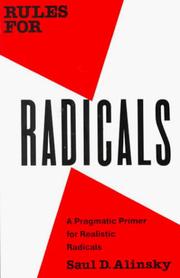
Rules for Radicals: A Pragmatic Primer for Realistic Radicals is a 1971 book by American community activist and writer Saul Alinsky about how to successfully run a movement for change. It was the last book written by Alinsky, and it was published shortly before his death in 1972. His goal was to create a guide for future community organizers, to use in uniting low-income communities, or "Have-Nots", in order for them to gain by any effective, non-violent means social, political, legal, environmental and economic wealth and power. Inside of it, Alinsky compiled the lessons he had learned throughout his experiences of community organizing from 1939 to 1971. He targeted these lessons at the current, new generation of radicals.
Divided into ten chapters, Rules for Radicals provides ten lessons on how a community organizer can accomplish the goal of successfully uniting people into an active grassroots organization with the power to affect change on a variety of issues. Though targeted at community organization, these chapters also touch on other issues that range from ethics, education, communication, and symbol construction and political philosophy.
Although it was published for the new generation of counterculture-era organizers in 1971, Alinsky's principles have been applied by numerous government, labor, community, and congregation-based organizations, and the main themes of his organizational methods have been recurring elements in political campaigns into the 21st century.
Inspiration
The inspiration for Rules for Radicals was drawn from Alinsky's personal experience as a community organizer. It was also taken from the lessons he learned from his University of Chicago professor, Robert Park, who saw communities as "reflections of the larger processes of an urban society". The methods Alinsky developed and applied were described in his book as a guide on future community organizing for the new generation of radicals emerging from the 1960s.
Alinsky believed in collective action as a result of the work he did with the C.I.O. and the Institute for Juvenile Research in Chicago where he first began to develop his own, distinct method of community organizing. Additionally, his late work with the Citizens Action Program (CAP) provided some of his most developed practices in organizing through the empowerment of the poor. Alinsky saw community structure and the impoverished, together with the importance of their empowerment, as elements of community activism, and used both as tools to create powerful, active organizations. Also he used shared social problems as external antagonists to "heighten local awareness of similarities among residents and their shared differences with outsiders". This was one of Alinsky's most powerful tools in community organizing; to bring a collective together, he would bring to light an issue that would stir up conflict with some agency to unite the group. This provided an organization with a specific "villain" to confront and made direct action easier to implement. These tactics as a result of decades of organizing efforts, along with many other lessons, were poured into Rules for Radicals to create the guidebook for community organization.
On the 4th fly-leaf page, after a dedication to Alinsky's wife Irene and quotes from Rabbi Hillel and Thomas Paine, is the following text:
Lest we forget at least an over-the-shoulder acknowledgment to the very first radical: from all our legends, mythology, and history (and who is to know where mythology leaves off and history begins— or which is which), the first radical known to man who rebelled against the establishment and did it so effectively that he at least won his own kingdom — Lucifer
On the academic side, Alinsky quotes Tocqueville more than any other writer in both Reveille for Radicals and Rules for Radicals. He uses and descends from Tocqueville both in his conceptualization of freedom and equality in his focus on the importance of the middle class, quoting Tocqueville himself to define it: the "have a little, want some more class."
Themes
Rules for Radicals has various themes. Among them is his use of symbol construction to strengthen the unity within an organization. He would draw on loyalty to a particular church or religious affiliation to create a structured organization with which to operate, the reason being that symbols by which communities could identify themselves created structured organizations that were easier to mobilize in implementing direct action. Once the community was united behind a common symbol, Alinsky would find a common enemy for the community to be united against.
The use of common enemy against a community was another theme of Rules for Radicals, as a uniting element in communities.
Alinsky would find an external antagonist to turn into a "common enemy" for the community within which he was operating. Often, this would be a local politician or agency that had some involvement with activity concerning the community. Once the enemy was established, the community would come together in opposition of it. This management of conflict heightened awareness within the community as to the similarities its members shared as well as what differentiated them from those outside of their organization. The use of conflict also allowed for the goal of the group to be clearly defined. With an established external antagonist, the community's goal would be to defeat that enemy.
以上文字摘自英文维基百科「Rules for Radicals」(有删节,去掉了参考文献等尾部小节),按 CC BY-SA 4.0 使用,作者为维基百科的各位编者。
资料卡
- 原题
- Rules for Radicals
- 原作语言
- 英语
- 首次出版
- 1971 年
- 体裁
- 随笔
- 首版出版社
- 兰登书屋
- 主题
- 草根
- 故事发生地
- 美国
资料卡来自 Wikidata Q4375881(CC0),众包数据,个别字段可能不全。