书单
百科
这个词条暂时没有中文维基百科条目,下面是英文维基百科的内容(英文原文):
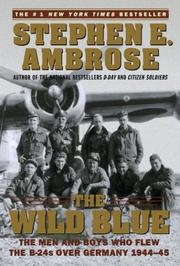
The Wild Blue: The Men and Boys who Flew the B-24s over Germany, by historian and best selling author Stephen Ambrose, is a New York Times best selling non-fiction book published in 2001. It details the lives and World War II experiences of pilots, bombardiers, navigators, radio operators and gunners flying B-24 bombers of the U.S. Army Air Force against Nazi Germany. The book entails a recounting of George McGovern's exceptional career as a chief pilot of a B-24 with the 455th Bomb Group in Italy, encompassing 35 bombing missions. With the odds of surviving all 35 missions as low as 50%, the bomber crews flew during dangerous daylight hours, in risky tight flying formations, and despite bad weather and assaults of heavy, deadly, flak from ground-based German anti-aircraft guns.
Author background
Ambrose was a history professor for 35 years from 1960-1995. After 1971, he taught at New Orleans University where he was named the Boyd Professor of History in 1989. Despite his academic credentials, his image was tarnished by accusations of plagiarism near the end of his career, particularly after his publication of The Wild Blue, his last volume. Revealing the sources of plagiarism in The Wild Blue, Fred Barnes reported in The Weekly Standard that Ambrose had taken passages from Wings of Morning: The Story of the Last American Bomber Shot Down over Germany in World War II, by Thomas Childers, a history professor at the University of Pennsylvania. Ambrose had footnoted sources, but had not enclosed in quotation marks numerous passages from Childers's book. The use of italics to indicate some of the text was copied from other writer's works, however, might have been sufficient to avoid charges of plagiarism at the time, and in subsequent editions Ambrose addressed the issue. A more sensitive researcher might have even forgiven Ambrose's scholarly oversights as he was not long from dying of cancer during his final drafts of The Wild Blue.
Perhaps best known of Ambrose's work's is a lengthy history of Dwight Eisenhower The Supreme Commander (1970) and a two-volume full biography (published in 1983 and 1984), which are considered "the standard" on the subject. His work on the Eisenhower volumes influenced the tone of admiration and reverence he took towards veterans in general, and particularly his characters in The Wild Blue. Focusing on the real attraction of The Wild Blue, Kennedy White House aide Arthur Schlesinger Jr. wrote that Dr. Ambrose "combined high standards of scholarship with the capacity to make history come alive for a lay audience."
Ambrose wrote an extensive history of Richard Nixon, though he was not a supporter of his presidency or presidential candidacy in 1972. While teaching at Kansas State University as the Dwight D. Eisenhower Professor of War and Peace during the 1970–1971 academic year, Ambrose participated in heckling Nixon during a speech the president gave on the KSU campus. His opposition to the Vietnam War stood in contrast to his research on "presidents and the military at a time when such topics were increasingly regarded by his colleagues as old fashioned and conservative." Ambrose may have secretly jumped at the opportunity to depict McGovern in Wild Blue as a strong, patriotic American in contrast to the 1972 Nixon re-election campaign that may have subtly portrayed the Dakota Senator, who campaigned for a quicker end to the bombing in Viet Nam, as a supporter of draft dodging, amnesty seeking, anti-American hippies. According to political scholar Theodore White, during the mid-term elections of November 1970, presidential front runner Edmund Muskie had felt the need to respond to statements by President Richard Nixon and Vice President Spiro Agnew impugning the patriotism of Democrats. In the divisive congressional era of the early 70's, McGovern's Hatfield-McGovern Amendment to bring a quicker end to the war had already been defeated in Congress by the time he was nominated before a divided party as the Democratic candidate for President against the incumbent Richard Nixon in 1972.
Content
Description of the B-24
The story is important as the B-24 was the most widely used and manufactured bomber in WWII, yet few novels have fully detailed the challenges faced by their Bomber crews who flew them in raids over Germany. At approximately 18,500 units produced – including 8,685 manufactured by Ford Motor Company – the B-24 holds records as the world's most produced bomber, heavy bomber, multi-engine aircraft, and American military aircraft in history. According to one source, the crews experienced an alarming casualty rate of slightly over fifty percent due to the dangers of daylight bombing, training flights, and other factors. For the better known Memphis Belle, a B-17 bomber, in her first three months of missions flown from Bassingbourn, England, her 8th Air Force Group experienced an even more astonishing casualty rate of 80%. Like the other planes in its bomb group, McGovern's B-24 bomber was a four engine craft that generally housed a crew of 9-10. Adding to the regular danger involved in takeoffs and landings of such a heavy, bomb-laden craft, "runways were often dangerous, patchwork affairs, the former farmland covered with steel matting."
以上文字摘自英文维基百科「The Wild Blue」(有删节,去掉了参考文献等尾部小节),按 CC BY-SA 4.0 使用,作者为维基百科的各位编者。
资料卡
- 原题
- The Wild Blue
- 原作语言
- 英语
- 首次出版
- 2001 年
- 体裁
- 历史编篆学
- 首版出版社
- 西蒙与舒斯特
- 主题
- 第二次世界大战
资料卡来自 Wikidata Q7774838(CC0),众包数据,个别字段可能不全。