书单
百科
这个词条暂时没有中文维基百科条目,下面是英文维基百科的内容(英文原文):
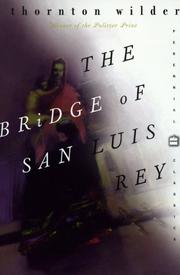
The Bridge of San Luis Rey is American author Thornton Wilder's second novel. It was first published in 1927 to worldwide acclaim. The novel won the Pulitzer Prize in 1928, and was the best-selling work of fiction that year.
Premise
The Bridge of San Luis Rey tells the story of people who die in the collapse of an Inca rope bridge in Peru during the viceregal era (when these territories formed part of the Spanish Monarchy), and the events that lead up to their being on the bridge. A friar who witnesses the accident then goes about inquiring into the lives of the victims, seeking some sort of cosmic answer to the question of why each had to die.
Plot
Part One: Perhaps an Accident
The first few pages of the first chapter explain the novel's premise: the story of a fictional event that happened in Peru on the road between Lima and Cuzco, at noon on Friday, July 20, 1714. A rope bridge woven by the Inca a century earlier collapsed, while five people were crossing it, sending them falling from a great height to their deaths in the river below. The collapse was witnessed by Brother Juniper, a Franciscan friar who was on his way to cross the bridge. A pious man who seeks to provide some sort of empirical evidence that might prove to the world God's Divine Providence, he sets out to interview everyone he can find who knew the five victims. Over six years, he compiles a huge volume of evidence to show that the beginning and end of a person is all part of God's plan for that person. Part One foretells the burning of the book that occurs at the end of the novel but it also says that one copy of Brother Juniper's book survives and is at the library of the University of San Marcos, where it sits neglected.
Part Two: the Marquesa de Montemayor; Pepita
Part Two focuses on one of the victims of the collapse: Doña María, the Marquesa de Montemayor. The daughter of a wealthy cloth merchant, the Marquesa was an ugly child who eventually entered into an arranged marriage and bore a daughter, Clara, whom she loved dearly. Clara was indifferent to her mother, though and became engaged to a Spanish man and moved across the ocean to Spain where she married. Doña María visits her daughter in Spain, but when they cannot get along, she returns to Lima. The only way that they can communicate comfortably is by letter, and Doña María pours her heart into her writing, which becomes so polished that her letters will be read in schools in the centuries after her lifetime.
Doña María takes as her companion, Pepita, a girl raised at the Convent of Santa María Rosa de las Rosas. When she learns that her daughter is pregnant in Spain, Doña María decides to make a pilgrimage to the shrine of Santa María de Cluxambuqua to pray that the baby will be healthy and loved. Pepita goes along as company and to supervise the staff. When Doña María is out at the shrine, Pepita stays at the inn and writes a letter to her patron, the Abbess María del Pilar, complaining about her misery and loneliness. Doña María sees the letter on the table when she gets back and reads it. Later, she asks Pepita about the letter, and Pepita says she tore it up because the letter was not brave. Doña María has new insight into the ways in which her own life and love for her daughter have lacked bravery. She writes her "first letter" (actually Letter LVI) of courageous love to her daughter, but two days later, returning to Lima, she and Pepita are on the bridge of San Luis Rey when it collapses.
Part Three: Esteban
Esteban and Manuel are twins who were left at the Convent of Santa María Rosa de las Rosas as infants. The Abbess of the convent, Madre María del Pilar, developed a fondness for them as they grew up. When they became older, they decided to be scribes. They are so close that they have developed a secret language that only they understand. Their closeness becomes strained when Manuel falls in love with Camila Perichole, a famous actress.
Perichole flirts with Manuel and swears him to secrecy when she retains him to write letters to her lover, the Viceroy. Esteban has no idea of their relationship until she turns up at the twins' room one night in a hurry and has Manuel write to a matador with whom she is having an affair. Esteban encourages his brother to follow her, but instead Manuel swears that he will never see her again. Later, Manuel cuts his knee on a piece of metal and it becomes infected. The surgeon instructs Esteban to put cold compresses on the injury: the compresses are so painful that Manuel curses Esteban, though he later remembers nothing of his curses. Esteban offers to send for Perichole, but Manuel refuses. Soon after, Manuel dies.
When the Abbess comes to prepare the body, she asks Esteban his name, and he says he is Manuel. Gossip about his ensuing strange behavior spreads all over town. He goes to the theater but runs away before the Perichole can talk to him; the Abbess also tries to talk to him, but he runs away, so she sends for Captain Alvarado.
Captain Alvarado, a well-known sailor and explorer, goes to see Esteban in Cuzco and hires him to sail the world with him, far from Peru. Esteban agrees, then refuses, then acquiesces if he can get all his pay in advance to buy a present for the Abbess before he departs. That night Esteban attempts suicide but is saved by Captain Alvarado. The Captain offers to take him back to Lima to buy the present, and at the ravine spanned by the bridge of San Luis Rey, the Captain goes down to a boat that is ferrying some materials across the water. Esteban goes to the bridge and is on it when it collapses.
以上文字摘自英文维基百科「The Bridge of San Luis Rey」(有删节,去掉了参考文献等尾部小节),按 CC BY-SA 4.0 使用,作者为维基百科的各位编者。
资料卡
- 原题
- The Bridge of San Luis Rey
- 原作语言
- 英语
- 首次出版
- 1927 年
- 作品形式
- 长篇小说
- 体裁
- 历史小说
资料卡来自 Wikidata Q941462(CC0),众包数据,个别字段可能不全。
改编作品
电影3
- 《断桥因果》The Bridge of San Luis Rey
- 《圣路易斯雷大桥》The Bridge of San Luis Rey
- 《圣路伊斯大桥》The Bridge of San Luis Rey
电视剧 / 剧集1
名单来自 Wikidata(CC0):只列条目里写明「改编自 / 取材于」这本书的作品,不按名字猜;众包数据,可能不全。