 书单
百科
这个词条暂时没有中文维基百科条目,下面是英文维基百科的内容(英文原文):
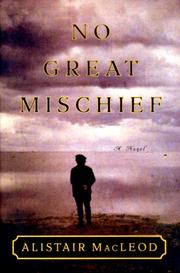
No Great Mischief is a 1999 novel by Alistair MacLeod.
Plot synopsis
The novel opens in the present day, with successful orthodontist Alexander MacDonald visiting his elderly older brother Calum in Toronto, Ontario. The novel explores the emotional bonds of family through flashbacks to their childhood in Cape Breton Island and young adulthood spent in the mines of Northern Ontario, clan history dating back to 1779, and present-day interactions between the two brothers and a sister. Though written primarily in English, Scottish Gaelic and French are used in dialogue and songs.
The novel also mirrors Canadian history as a whole, taking its title from James Wolfe's assertion in the Battle of the Plains of Abraham that Scottish soldiers should be sent into battle because "they are hardy, intrepid, accustomed to a rough country, and no great mischief if they fall." The enduring linguistic and cultural tensions that have defined Canadian society are also reflected in the novel; during their time working in the uranium mines of Elliot Lake, the brothers are frequently in conflict with their francophone co-workers.
The novel explores the themes of brotherhood and the conflict between the rise of individualism and family in the post-modern world. Alex loves his alcoholic brother, Calum, despite his problems because Alex sees the potential in Calum. Alex lets his brother die in peace and with dignity even though he is a convicted murderer and alcoholic. The author uses Alex as an example for all human beings. MacLeod wants the reader to realize that "all of us are better when we're loved" and that forgiveness and love for humanity are the only weapons humans have against the destructive forces of evil.
Calum is posited as a contemporary clan chief of the MacDonalds defending the lost cause of Gaelic culture. His defence of Highland values parallels the devastating consequences of the Highland support for Charles Stuart in 1745. Throughout the book, Calum defends clan values in spite of the personal consequences. His distant Californian nephew, who has no idea of these values, steals from the Quebec miners. Calum's defence leads to murder and hard time, while the nephew blithely returns to California. Calum becomes the beaten alcoholic shell of a formerly strong man due to his reflexive support of the old clan values that have long since vanished as guiding principles, even among his own direct family.
The title, "No great mischief if they fall", is found most easily in Findlay, J.T., "Wolfe in Scotland in the '45 and from 1749 to 1753." London: Longmans, Green and Co., 1928, p. 226. An earlier use of the citation that MacLeod used for his title appears in Gibson, John G. "Traditional Gaelic Bagpiping 1745–1945." Montreal and Kingston: MQUP, and Nat. Mus. Scot., 1998, p. 59.
Awards and nominations
Trillium Book Award, 1999
Thomas Head Raddall Award, 2000
Dartmouth Book Award
Atlantic Provinces Booksellers Choice Award
International Dublin Literary Award, 2001
Canadian Booksellers Association Libris Award for Fiction
In October 2009, Atlantic Canada's 100 Greatest Books selected No Great Mischief as the greatest Atlantic Canadian book of all time.
以上文字摘自英文维基百科「No Great Mischief」(去掉了参考文献等尾部小节),按 CC BY-SA 4.0 使用,作者为维基百科的各位编者。
资料卡
- 原题
- No Great Mischief
- 原作语言
- 英语
- 首次出版
- 1999 年
- 作品形式
- 长篇小说
资料卡来自 Wikidata Q9073873(CC0),众包数据,个别字段可能不全。
