书单
百科
这个词条暂时没有中文维基百科条目,下面是英文维基百科的内容(英文原文):
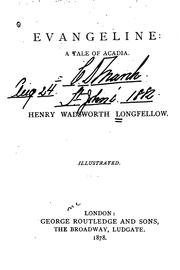
Evangeline, A Tale of Acadie is an epic poem by the American poet Henry Wadsworth Longfellow, written in English and published in 1847. The poem follows an Acadian girl named Evangeline and her search for her lost love Gabriel during the expulsion of the Acadians (1755–1764).
The idea for the poem came from Longfellow's friend Nathaniel Hawthorne. Longfellow used dactylic hexameter, imitating Greek and Latin classics. Though the choice was criticized, it became Longfellow's most famous work in his lifetime and remains one of his most popular and enduring works.
The poem had a powerful effect in defining both Acadian history and identity in the 19th and 20th centuries. It represents lost loved ones and heartbreak but also keeping hope. While Longfellow was a poet, not a historian, 21st-century scholarship has included those who chose to expound their view that Longfellow's work fails as a scientific historical document.
Plot
Evangeline describes the betrothal of a fictional Acadian girl named Evangeline Bellefontaine to her beloved, Gabriel Lajeunesse, and their separation as the British deport the Acadians from Acadie in the Great Upheaval. The poem then follows Evangeline across the landscapes of America as she spends years in a search for him, at some times being near to Gabriel without realizing he was near. Finally she settles in Philadelphia and, as an old woman, works as a Sister of Mercy among the poor. While tending the dying during an epidemic she finds Gabriel among the sick, and he dies in her arms.
Composition and publication history
Longfellow was introduced to the true story of the Acadians in Nova Scotia by his friend Nathaniel Hawthorne, who was told a story of separated Acadian lovers by Boston minister Rev. Horace Conolly, who heard it from his parishioners. Hawthorne and Longfellow had attended Bowdoin College together, though they were not friends at the time. Years later, in 1837, Hawthorne contacted Longfellow for his opinion on his recently published tales in the North American Review, which Longfellow praised as works of genius; the two became lifelong friends. Hawthorne was not interested in fictionalizing Conolly's idea, because, as he told Conolly, "It is not in my vein: there are no strong lights and heavy shadows." Longfellow took the idea and turned it into a poem after months of studying the histories of Nova Scotian families.
Longfellow, who had never visited the setting of the true story, relied heavily on Thomas Chandler Haliburton's An Historical and Statistical Account of Nova Scotia and other books for further background information. He noted his reliance on other sources in his journal on January 7, 1847: "Went to the library and got Watson's Annals of Philadelphia, and the Historical Collections of Pennsylvania. Also, Darby's Geographical Description of Louisiana. These books must help me through the last part of Evangeline, so far as facts and local coloring go. But for the form and the poetry,—they must come from my own brain."
Evangeline was published in book form on November 1, 1847 by William D. Ticknor & Co., and by 1857 it had sold nearly 36,000 copies. During this time, Longfellow's literary payment was at its peak; for Evangeline, he received "a net of twenty-five and sixteenths per cent" royalties, believed to be an all-time high for a poet. Longfellow said of his poem: "I had the fever a long time burning in my own brain before I let my hero take it. 'Evangeline' is so easy for you to read, because it was so hard for me to write."
Analysis
The poem is written in unrhymed dactylic hexameter, possibly inspired by Greek and Latin classics, including Homer, whose work Longfellow was reading at the time he was writing Evangeline. He also had recently, in 1841, translated "The Children of the Lord's Supper", a poem by Swedish writer Esaias Tegnér, which also used this meter. Evangeline is one of the few nineteenth-century compositions in that meter which is still read today.
Some criticized Longfellow's choice of dactylic hexameter, including poet John Greenleaf Whittier, who said the poem would have been better in a prose style similar to Longfellow's Hyperion. Longfellow was conscious of the potential criticism. When sending a copy of the poem to Bryan Procter, Longfellow wrote: "I hope you will not reject it on account of the meter. In fact, I could not write it as it is in any other; it would have changed its character entirely to have put it into a different measure." Even Longfellow's wife Fanny defended his choice, writing to a friend: "It enables greater richness of expression than any other, and it is sonorous like the sea which is ever sounding in Evangeline's ear." As an experiment, Longfellow reassured himself that he was using the best meter by attempting a passage in blank verse. Even so, while looking over the proofs for a second edition, Longfellow briefly wished he had used a different poetic structure:
It certainly would be a relief to the hexameters to let them stretch their legs a little more at their ease; still for the sake of uniformity I believe they must still sit a while longer with their knees bent under them like travelers in a stage-coach.
The name Evangeline comes from the Latin word "evangelium" meaning "gospel". The Latin word itself is derived from the Greek words "eu"—"good"—and "angela"—"news".
Prologue
Longfellow does not explicitly title the opening three stanzas as the prologue, but publishers generally treat these lines as such. The poem's story begins with the end. The French farmers and fishermen who once inhabited the colony of Acadie in Nova Scotia are gone; the moss-covered trees and the ocean are left to tell the tale.
以上文字摘自英文维基百科「Evangeline」(有删节,去掉了参考文献等尾部小节),按 CC BY-SA 4.0 使用,作者为维基百科的各位编者。
资料卡
- 原题
- Evangeline, A Tale of Acadie
- 原作语言
- 英语
- 首次出版
- 1847 年
- 作品形式
- 诗作
- 主要人物
- Evangeline
资料卡来自 Wikidata Q2625102(CC0),众包数据,个别字段可能不全。
改编作品
电影3
舞台剧 / 歌剧 / 芭蕾1
名单来自 Wikidata(CC0):只列条目里写明「改编自 / 取材于」这本书的作品,不按名字猜;众包数据,可能不全。