书单
百科
这个词条暂时没有中文维基百科条目,下面是英文维基百科的内容(英文原文):
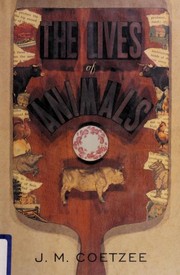
The Lives of Animals (1999) is a metafictional novella about animal rights by the South African novelist J. M. Coetzee, recipient of the 2003 Nobel Prize in Literature. The work is introduced by Amy Gutmann and followed by a collection of responses by Marjorie Garber, Peter Singer, Wendy Doniger and Barbara Smuts. It was published by Princeton University Press as part of its Human Values series.
The Lives of Animals consists of two chapters, "The Philosophers and the Animals" and "The Poets and the Animals," first delivered by Coetzee as guest lectures at Princeton on 15 and 16 October 1997, part of the Tanner Lectures on Human Values. The Princeton lectures consisted of two short stories (the chapters of the book) featuring a recurring character, the Australian novelist Elizabeth Costello, Coetzee's alter ego. Costello is invited to give a guest lecture to the fictional Appleton College in Massachusetts, just as Coetzee is invited to Princeton, and chooses to discuss not literature, but animal rights, just as Coetzee does.
In having Costello deliver the arguments within his lectures, Coetzee plays with form and content, and leaves ambiguous to what extent the views are his own. The Lives of Animals appears again in Coetzee's novel Elizabeth Costello (2003).
Coetzee's novella discusses the foundations of morality, the need of human beings to imitate one another, to want what others want, leading to violence and a parallel need to scapegoat non-humans. He appeals to an ethic of sympathy, not rationality, in our treatment of animals, to literature and the poets, not philosophy. Costello tells her audience, "Sympathy has everything to do with the subject and little to do with the object. ... There are people who have the capacity to imagine themselves as someone else, there are people who have no such capacity. ... and there are people who have the capacity but choose not to exercise it. ... There are no bounds to the sympathetic imagination."
Synopsis
The Lives of Animals
Elizabeth Costello is invited to Appleton College's annual literary seminar as a guest lecturer, much as Coetzee was invited to Princeton. Despite her stature as a celebrated novelist (much like Coetzee), she opts not to give lectures on literature or writing, but on animal cruelty. Much like Coetzee, Costello is a vegetarian and abhors industries that experiment on and slaughter animals.
The story is framed by a narrative involving Costello and her son, John Bernard, who happens to be a junior professor at Appleton. Costello's relationship with Bernard is strained, and her relationship with John’s wife, Norma, even more so. Bernard was not instrumental in bringing his mother to campus. In fact, the university's leaders were unaware of Bernard's relationship with Costello when they issued the invitation. Bernard’s fears that his mother’s presence and opinions will be polarizing and controversial are entirely prophetic. In his private thoughts, he more than once wishes she had not accepted Appleton’s invitation. Costello gives two lectures, then contributes to a debate with Appleton philosophy professor Thomas O’Hearne.
"The Philosophers and the Animals"
Costello's first lecture begins with an analogy between the Holocaust and the exploitation of animals. Costello makes the point that, just as residents in the neighborhoods of the death camps knew what was happening at the camps, but chose to turn a blind eye, so it is common practice today for otherwise respectable members of society to turn a blind eye to industries that bring pain and death to animals. This turns out to be the most controversial thing that Costello says during her visit, and it causes a Jewish professor of the college to boycott the dinner held in her honor. In her first lecture, Costello also moves to reject reason as the preeminent quality that separates humans from animals and allows humans to treat animals as less than the equals of humans. She proposes that reason might simply be a species specific trait, "the specialism of a rather narrow self-regenerating intellectual tradition ... which for its own motives it tries to install at the center of the universe."
At the same time that Costello rejects reason as the premier human distinction, she also challenges the assumption that animals do not possess reason. Her argument rests on the fact that, while science cannot prove that animals do abstract thinking, it also cannot prove that they do not. In support of this argument, Costello summarizes an ape experiment that was conducted in the 1920s by Wolfgang Kohler. The principal player in the experiment was an ape named Sultan who was variously deprived of his bananas until he reasoned his way into obtaining them. Faced with the challenge of stacking several crates into a makeshift ladder, in order to reach the bananas that have been suspended above his reach, Sultan succeeds in demonstrating this elementary form of reasoning.
What Costello objects to, however, is the basic inanity of the exercise which in no way explores any higher intellectual functions that Sultan might be capable of. The experiment, Costello objects, ignores any emotional hurt or confusion that the ape might be experiencing in favor of concentrating on what is, after all, a very elemental task. The ape might be thinking about the human who has constructed these tests: "What is wrong with him, what misconception does he have of me, that leads him to believe it is easier for me to reach a banana hanging from a wire than to pick up a banana from the floor?" Animal experiments, Costello concludes, fail to measure anything of real interest, because they ask the wrong questions and ignore the more interesting ones: "a carefully plotted psychological regimen conducts him [Sultan] away from ethics and metaphysics toward the humbler reaches of practical reason."
以上文字摘自英文维基百科「The Lives of Animals」(有删节,去掉了参考文献等尾部小节),按 CC BY-SA 4.0 使用,作者为维基百科的各位编者。
资料卡
- 原题
- The Lives of Animals
- 原作语言
- 英语
- 首次出版
- 1999 年
- 作品形式
- 中篇小说
- 体裁
- 虚构作品
- 主题
- 动物界
资料卡来自 Wikidata Q3824974(CC0),众包数据,个别字段可能不全。