书单
百科
这个词条暂时没有中文维基百科条目,下面是英文维基百科的内容(英文原文):
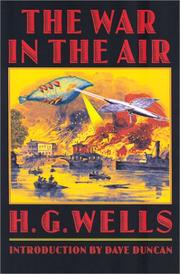
The War in the Air: And Particularly How Mr. Bert Smallways Fared While It Lasted is a military science fiction novel written by H. G. Wells and published in 1908.
The novel was written in four months in 1907, and was serialized and published in 1908 in The Pall Mall Magazine.
Like many of Wells's works, the novel is notable for its prophetic ideas, images, and concepts—particularly the use of aircraft for the purpose of warfare—as well as conceptualizing and anticipating events related to World War I. The novel's hero and main character is Bert Smallways, who is described as "a forward-thinking young man" and a "kind of bicycle engineer of the let's-'ave-a-look-at-it and enamel-chipping variety."
Plot summary
The first three chapters of The War in the Air expound on details of the life of the novel's hero Bert Smallways and his extended family. They reside in a location called Bun Hill, a fictional, former Kentish village that had become a London suburb.
The chapters introduce Bert's brother Tom, a stolid greengrocer, who views technological progress with apprehension. Also introduced is their aged father, who recalls, with longing, the time when Bun Hill was a quiet village and he had been able to drive the local squire's carriage. The story soon shifts focus to Bert; an unimpressive, unsuccessful, not particularly gifted young man with few ideas about larger things. Bert is far from unintelligent, however and we come to know that Bert has a strong attachment to a young woman named Edna.
When bankruptcy threatens his business one summer, he and his partner abandon their shop and devise a singing act, calling themselves "the Desert Dervishes". They attempt to resolve their misfortunes by staging performances at English sea resorts. As chance would have, their initial performance is interrupted by a certain balloon that lands on the beach before them. The balloon contains a new character: Mr. Butteridge.
Butteridge is famous for his successful invention of an easily maneuverable fixed-wing aircraft, whose secret he has not revealed. We come to know that he intends to sell his secrets to the British government or, if not possible, instead to Germany. We also come to know that prior to Mr. Butteridge's invention, nobody had succeeded in producing a practical, "heavier-than-air" machine—only a few awkward devices of limited utility had been made since (such as the German "Drachenflieger" which had to be towed aloft and released from an airship). Butteridge's invention is considered a major breakthrough. The invention is highly maneuverable, capable of both very fast and very slow flight, and requires only a small area to take off and land—reminiscent of the later autogyro.
Later in the novel, Bert is carried off in Butteridge's balloon and ends up discovering Butteridge's secret plans while he is on board. Bert is clever enough to appraise his situation, and when the balloon is shot down in a secret German "aeronautic park east of Hamburg" Bert tries to sell Mr. Butteridges's invention. However, he has unknowingly stumbled upon the German air fleet just as it is about to launch a surprise attack on the United States. Prince Karl Albert, the author and leader of the plan, decides to take him along for the campaign.
The Prince, world-famous as "the German Alexander" or Napoleon, is a living manifestation of German nationalism and boundless imperial ambitions—his personality as depicted by Wells in some ways resembling that of Kaiser Wilhelm II. Bert's disguise is soon seen through by the Germans, and, after he avoids being thrown overboard by the furious prince, he becomes relegated to the role of a witness to the true horror of war.
The German aerial forces, comprising airships and Drachenfliegers, are mounting their surprise attack on the United States before the Americans can build a large aerial navy; the pretext for the attack is a German demand for the US to abandon the Monroe Doctrine, so as to facilitate German imperial ambitions in South America. The Germans are, however, unaware that the "Confederation of Eastern Asia" (China and Japan) has secretly been building a massive air force. Tensions between Japan and the United States, exacerbated by the issue of American citizenship being denied to Japanese immigrants, leads to war breaking out between the Confederation of Eastern Asia and the US, whereupon the Confederation turns out to possess overwhelmingly strong aerial forces, and the US finds itself fighting a war on two fronts: the Eastern and the Western, in the air as well as on sea.
Bert Smallways is present as the Germans first attack an American naval fleet in the Atlantic, utterly obliterating it and proving dreadnoughts to be obsolete and helpless against aerial bombardment. The Germans then appear over New York City, bomb several key points, and establish that they have the city at their mercy, whereupon the mayor, with the consent of the White House, offers New York's surrender. However, the surrender announcement rouses the population's patriotic fury; local militias rebel and manage to destroy a German airship over Union Square using a concealed artillery piece. Following this, the vengeful prince orders a wholesale destruction, airships moving along Broadway and systematically raining death and destruction on the population below.
以上文字摘自英文维基百科「The War in the Air」(有删节,去掉了参考文献等尾部小节),按 CC BY-SA 4.0 使用,作者为维基百科的各位编者。
资料卡
- 原题
- The War in the Air
- 原作语言
- 英语
- 首次出版
- 1908 年
- 作品形式
- 长篇小说
- 体裁
- 末日幻想、科学幻想
- 前作
- In the Days of the Comet、First and Last Things 等 3 项
- 续作
- 托诺-邦盖
资料卡来自 Wikidata Q964055(CC0),众包数据,个别字段可能不全。