书单
百科
这个词条暂时没有中文维基百科条目,下面是英文维基百科的内容(英文原文):
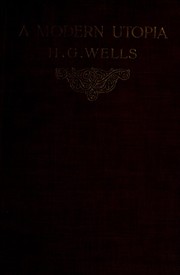
A Modern Utopia is a 1905 novel by H. G. Wells.
Because of the complexity and sophistication of its narrative structure, A Modern Utopia has been called "not so much a modern as a postmodern utopia." The novel is best known for its notion that a voluntary order of nobility known as the Samurai could effectively rule a "kinetic and not static" world state so as to solve "the problem of combining progress with political stability".
Conception of the work
In his preface Wells forecasts (incorrectly) that A Modern Utopia would be the last of a series of volumes on social problems that he began in 1901 with Anticipations and that included Mankind in the Making (1903). Unlike those non-fictional works, A Modern Utopia is presented as a tale told by a sketchily described character known only as the Owner of the Voice, who, Wells warns the reader, "is not to be taken as the Voice of the ostensible author who fathers these pages." He is accompanied by another character known as "the botanist." Interspersed into the narrative are discursive remarks on various matters, creating what Wells calls in his preface "a sort of shot-silk texture between philosophical discussion on the one hand and imaginative narrative on the other." In addition, there are frequent comparisons to and discussions of previous utopian works.
In his Experiment in Autobiography (1934) Wells wrote that A Modern Utopia "was the first approach I made to the dialogue form," and that "the trend towards dialogue, like the basal notion of the Samurai, marks my debt to Plato. A Modern Utopia, quite as much as that of More, derives frankly from the Republic."
The premise of the novel is that there is a planet (for "No less than a planet will serve the purpose of a modern Utopia") exactly like Earth, with the same geography and biology. Moreover, on that planet "all the men and women that you know and I" exist "in duplicate." They have, however, "different habits, different traditions, different knowledge, different ideas, different clothing, and different appliances." (Not however, a different language: "Indeed, should we be in Utopia at all, if we could not talk to everyone?").
Plot
To this planet "out beyond Sirius" the Owner of the Voice and the botanist are translated, imaginatively, "in the twinkling of an eye . . . We should scarcely note the change. Not a cloud would have gone from the sky." Their point of entry is on the slopes of the Piz Lucendro in the Swiss Alps.
The adventures of these two characters are traced through eleven chapters. Little by little they discover how Utopia is organized. It is a world with "no positive compulsions at all . . . for the adult Utopian—unless they fall upon him as penalties incurred."
The Owner of the Voice and the botanist are soon required to account for their presence. When their thumbprints are checked against records in "the central index housed in a vast series of buildings at or near Paris," both discover they have doubles in Utopia. They journey to London to meet them, and the Owner of the Voice's double is a member of the Samurai, a voluntary order of nobility that rules Utopia. "These samurai form the real body of the State."
Running through the novel as a foil to the main narrative is the botanist's obsession with an unhappy love affair back on Earth. The Owner of the Voice is annoyed at this undignified and unworthy insertion of earthly affairs in Utopia, but when the botanist meets the double of his beloved in Utopia the violence of his reaction bursts the imaginative bubble that has sustained the narrative and the two men find themselves back in early twentieth-century London.
Utopian economics
The world shares the same language, coinage, customs, and laws, and freedom of movement is general. Some personal property is allowed, but "all natural sources of force, and indeed all strictly natural products" are "inalienably vested in the local authorities" occupying "areas as large sometimes as half England." The World State is "the sole landowner of the earth." Units of currency are based on units of energy, so that "employment would constantly shift into the areas where energy was cheap." Humanity has been almost entirely liberated from the need for physical labor: "There appears to be no limit to the invasion of life by the machine."
The samurai and Utopian society
The narrator's double describes the ascetic Rule by which the samurai live: it includes a ban on alcohol and drugs, and a mandatory annual one-week solitary ramble in the wilderness. He also explains the social theory of Utopia, which distinguished four "main classes of mind": The Poietic, the Kinetic, the Dull, and the Base. Poietic minds are creative or inventive; kinetic minds are able but not particularly inventive; the Dull have "inadequate imagination," and the Base are mired in egotism and lack "moral sense."
The relations of the sexes
There is extensive discussion of gender roles in A Modern Utopia, but no recognition of the existence of homosexuality. A chapter entitled "Women in a Modern Utopia" makes it clear that women are to be as free as men. Motherhood is subsidized by the state. Only those who can support themselves can marry, women at 21 and men at 26 or 27. Marriages that remain childless "expire" after a term of three to five years, but the partners may marry again if they choose.
Race in Utopia
A Modern Utopia is also notable for Chapter 10 ("Race in Utopia"), an enlightened discussion of race. Contemporary racialist discourse is condemned as crude, ignorant, and extravagant. "For my own part I am disposed to discount all adverse judgments and all statements of insurmountable differences between race and race."
以上文字摘自英文维基百科「A Modern Utopia」(有删节,去掉了参考文献等尾部小节),按 CC BY-SA 4.0 使用,作者为维基百科的各位编者。
资料卡
- 原题
- A Modern Utopia
- 原作语言
- 英语
- 首次出版
- 1905 年 4 月
- 作品形式
- 长篇小说
- 首版出版社
- 查普曼和霍尔
- 前作
- 神的食物
- 续作
- 梦觉繁华
资料卡来自 Wikidata Q1249074(CC0),众包数据,个别字段可能不全。