 书单
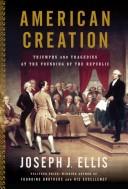
American Creation: Triumphs and Tragedies at the Founding of the Republic (2007)
百科
这个词条暂时没有中文维基百科条目,下面是英文维基百科的内容(英文原文):
American Creation: Triumphs and Tragedies at the Founding of the Republic is a 2007 non-fiction book written by American historian Joseph Ellis and published by Alfred A. Knopf, examining the successes and failures of the Founding Fathers. Structured episodically, the book examines six turning points in the early history of the United States: the writing of the Declaration of Independence, George Washington's winter at Valley Forge, James Madison's debate with Patrick Henry over Constitutional ratification, Washington's treaty with Creek leader Alexander McGillivray, Thomas Jefferson and James Madison's founding of the Democratic-Republican Party, and the Louisiana Purchase.
Ellis, who had previously won the National Book Award and the Pulitzer Prize for History, wanted to write a book portraying the Founders neither as demigods nor villains, but as flawed men who were improvising in response to immediate crises. The book reached #4 on The New York Times Best Seller list, and received largely positive reviews from critics.
Background
Joseph Ellis is an American professor of history who held an endowed Ford Foundation Chair at Mount Holyoke College in Massachusetts. His previous works on the Founding Fathers had received several awards, including a 1997 National Book Award for American Sphinx: The Character of Thomas Jefferson and the 2001 Pulitzer Prize for History for his Founding Brothers: The Revolutionary Generation. American Creation was his sixth book.
Ellis states in American Creation's foreword that the book was prompted by repeated questions he received on his 2000 book tour for Founding Brothers negatively comparing presidential candidates George W. Bush and Al Gore to the Founders. His difficulty in properly assessing the Founders made him want to write a book that both acknowledged their achievements and punctured the myth that they were "demigods". He stated in an interview that he wanted to show that "these folks didn't completely understand what they were doing... They were improvising on the edge of catastrophe." Ellis did the research for the book personally, rather than working with research assistants. He wrote the manuscript by hand with a rollerball pen.
Content
American Creation consists of a foreword, six chapters, and an afterword. In the prologue, Ellis discusses what he calls the "stunning achievement" of the Founders in creating a nation that became "the accepted global formula for national success". He criticizes the "wildly extravagant claims and equally hyperbolic counterclaims" that deify or vilify the Founders, particularly those of academic historians who treat the Founders as "racists, classists, and sexists". In contrast, Ellis states his intention to present a balanced portrayal of Founders—acknowledging their successes, such as the creation of a nation-sized, secular republic governed by political parties, as well as their failures to deal with slavery and to reach a just settlement with Native Americans.
The book's first chapter, "The Year", examines the Declaration of Independence as well as the American Revolutionary War. Ellis discusses how, "latently and surreptitiously", the Declaration held more long-term revolutionary implications than the Founders realized. The second chapter, "The Winter", discusses General George Washington's achievement in holding the Continental Army together during a hard winter at Valley Forge. The army's poor condition causes a critical shift in strategy that would prove decisive for the Americans, forcing Washington to attempt to control the countryside rather than stage a decisive battle with the British.
The third chapter, "The Argument", details James Madison's efforts to secure a strong federal government at the 1787 Constitutional Convention. Madison fails to win approval for a national government that can veto state laws, and initially considers the convention a failure. Instead the Constitution creates a political system in which sovereignty is shared and "blurred", providing a framework for ongoing debate. Madison emphasizes this advantage, as well as the weakness of the prior Articles of Confederation government during the Revolutionary War, to defeat Anti-Federalist orator Patrick Henry in a debate over Virginia's ratification of the Constitution. Chapter Four, "The Treaty", considers Washington's failure as president to reach an equitable settlement with Native Americans, with particular consideration to his treaty with Creek leader Alexander McGillivray. Though Washington declares the issue one of his highest priorities and successfully negotiates a treaty, it proves worthless in the face of the relentless expansion of white settlers into Creek territory, the intransigence of the Georgian legislature, and McGillivray's attempts to ally with Spain. Ellis calls the inability to make a fair peace with Native Americans "the greatest failure of the revolutionary generation", second only to their failure to end slavery.
以上文字摘自英文维基百科「American Creation」(有删节,去掉了参考文献等尾部小节),按 CC BY-SA 4.0 使用,作者为维基百科的各位编者。
资料卡
- 原题
- American Creation: Triumphs and Tragedies at the Founding of the Republic
- 原作语言
- 英语
- 首次出版
- 2007 年
- 体裁
- 非虚构作品
- 首版出版社
- 阿尔佛雷德·A·克诺夫
资料卡来自 Wikidata Q4743560(CC0),众包数据,个别字段可能不全。