书单
百科
这个词条暂时没有中文维基百科条目,下面是英文维基百科的内容(英文原文):
The Autobiography of Mark Twain is a written collection of reminiscences, the majority of which were dictated during the last few years of the life of the American author Mark Twain (1835–1910) and left in typescript and manuscript at his death. The Autobiography comprises a collection of anecdotes and ruminations rather than a conventional autobiography. Twain never compiled the writings and dictations into a publishable form in his lifetime. Despite indications from Twain that he did not want his autobiography to be published for a century, he serialized selected chapters during his lifetime; in addition, various compilations were published during the 20th century. However, it was not until 2010 that the first volume of a comprehensive three-volume collection, compiled and edited by The Mark Twain Project of the Bancroft Library at University of California, Berkeley, was published.
Twain's writings and dictations
Twain started the composition of an autobiography in 1870, but proceeded intermittently, abandoning the work and resuming it sporadically, accumulating a total of 30-40 of these “false starts” over the subsequent 35 years.
The majority of the autobiography was dictated rather than written directly—this was described by a reviewer in 2010 as "[having] a secretary follow him around and take down his every passing thought". In a 1904 letter to William Dean Howells, Twain wrote, "I’ve struck it! And I will give it away—to you. You will never know how much enjoyment you have lost until you get to dictating your autobiography." These dictations were made frequently in 1906 and 1907. Over the two subsequent years, Twain appeared to have neglected the book, scarcely adding new material; in 1909, following the death of his youngest daughter, Jean Clemens, he proclaimed the project completed. His experimental conception—to “talk only about the thing which interests you for the moment”—implied that his thoughts could wander freely. Twain surmised his autobiography would be most captivating if he deviated on whims and tangents in non-sequential order.
Twain's papers, including the autobiographical works, were left as part of a trust for the benefit of his surviving daughter, Clara Clemens. These papers passed through the control of a number of editors, and have been held by the Bancroft Library at the University of California, Berkeley since 1971.
Plans for posthumous publication
Twain intended for the majority of the material to be published posthumously. In an interview for The Times in 1899, Twain was reported to be considering a work which would be unpublished for a century.
Twain wrote instructions for future "editors, heirs, and assigns" in 1904, in which he outlined a century-long plan of publications 25 years apart from each other, with each subsequent release featuring progressively potentially-controversial material. In addition to these instructions, Twain celebrated posthumous publication allowing him to speak with his "whole frank mind."
In the introduction to the second edition of Mark Twain's Own Autobiography: The Chapters from the North American Review, however, scholar Michael Kiskis suggests that these delays were less due to Twain's purported concern for those who could be aggrieved by the text, and more likely an attempt to extend the copyright.
Various modern reports refer to a "100 year embargo", imposed by Twain on his own autobiography's release, which expired in 2010.
20th-century publications
Twain had published Chapters from My Autobiography in 25 installments in the North American Review from 1906 to 1907. Since Twain’s death in 1910, various editors have attempted to impose order on the entirety of the material by selection and reorganization, producing several different published versions of The Autobiography. Constructing a publishable Autobiography from the disordered mass of Twain’s unpublished writings posed a significant challenge; in addition, access to the physical materials of Twain’s papers was restricted to limited numbers of scholars for the first half-century after Twain's death.
The partial Autobiography was published in 1924 by Harper & Brothers, consisting of approximately two-fifths of the material. It was compiled by personal friend and literary executor Albert Bigelow Paine, who at the time had exclusive access to Twain's papers.
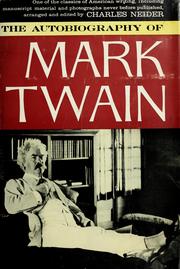
Editor and historian Bernard DeVoto succeeded Paine as literary executor for the Clemens estate and used his access to the material to produce a book collection of Autobiography material: Mark Twain in Eruption (1940), containing only passages Paine had not previously used and arranging them topically. In 1959 Charles Neider rejected both Paine's chronological-composition compilation and DeVoto's topic-organized compilation, re-arranging material to match the chronology of a standard autobiography and adding thirty thousand words in the process: The Autobiography of Mark Twain, Including Chapters Now Published for the First Time (1959). In 1990, scholar Michael Kiskis edited Mark Twain’s Own Autobiography: The Chapters from the North American Review.
Mark Twain Project edition
The Mark Twain Project of The Bancroft Library undertook to produce a complete autobiography of Twain, based upon material within their collection. The stated goal was "to publish the complete text as nearly as possible in the way Mark Twain intended it to be published after his death". This was published in three volumes between 2010 and 2015, with the first installment being released on the 100th anniversary year of Twain's death. All three volumes feature introductions and historical annotation from the editors of the work. The head editor for this work was Harriet Elinor Smith.
以上文字摘自英文维基百科「Autobiography of Mark Twain」(有删节,去掉了参考文献等尾部小节),按 CC BY-SA 4.0 使用,作者为维基百科的各位编者。
资料卡
- 原作语言
- 英语
- 首次出版
- 1906 年
- 体裁
- 自传
资料卡来自 Wikidata Q3202612(CC0),众包数据,个别字段可能不全。