 书单
百科
这个词条暂时没有中文维基百科条目,下面是英文维基百科的内容(英文原文):
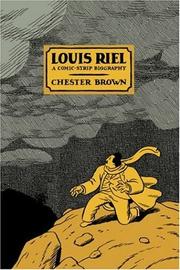
Louis Riel is a historical biography in comics by Canadian cartoonist Chester Brown, published as a book in 2003 after serialization in 1999–2003. The story deals with Métis rebel leader Louis Riel's antagonistic relationship with the newly established Canadian government. It begins shortly before the 1869 Red River Rebellion, and ends with Riel's 1885 hanging for high treason. The book explores Riel's possible schizophrenia—he believed God had named him Prophet of the New World, destined to lead the Métis people to freedom.
The work is noted for its emotional disengagement, its intentionally flat dialogue, and a minimalist drawing style inspired by that of Harold Gray's comic strip Little Orphan Annie. Unusual for comics of the time, it includes a full scholarly apparatus: a foreword, index, bibliography, and end notes. The lengthy, hand-lettered appendix provides insight into Brown's creative process and biases and highlights where he changed historical facts to create a more engaging story, such as incorporating a conspiracy theory not widely accepted by historians. Brown became interested in the issue of property rights while researching the book, which led to a public change in his politics from anarchism to libertarianism.
Although Brown intended it to be published only in book form, his publisher had him first serialize Louis Riel as a comic book, which lasted ten issues. The series was the first comic book to receive a grant from the Canada Council for the Arts. It won a favourable critical reception and three Harvey Awards. The serialization sold poorly, but the book version was a surprise bestseller. Its success played a major part in gaining shelf space for serious graphic novels in mainstream North American bookstores.
Background
Brown grew up in the Canadian province of Quebec, where the majority speaks French, and where Riel is often considered a martyr. However Brown, who grew up speaking only English, said he was largely ignorant of Riel's story until he read Maggie Siggins' 1994 biography Louis Riel: A Life of Revolution. Many of Brown's favourite topics are entwined in Louis Riel: anti-authoritarianism, outsider religion, insanity, and accuracy and objectivity in nonfiction.
In 1995, Brown published the anti-psychiatry comics essay "My Mom was a Schizophrenic", in which he examines society's role in mental illness, and questions the medical profession's accepted beliefs about it. The six-page strip came with two pages of end notes gathered from his research. Brown enjoyed this project and thought he would like to take on another in which he could "cram a lot of research into a comic strip". When he came across Siggins' biography of Riel, he had been working on the experimental Underwater series, a project on which he felt he had lost his way. His father died in late 1997, and he decided he did not "want to waste [his] time with projects that weren't working out". In 1998, he turned his attention to Riel, putting the unpopular Underwater series on hold.
While researching, Brown came across two books by political scientist Tom Flanagan: Louis "David" Riel: "Prophet of the New World" (1996) and Louis Riel and the Rebellion: 1885 Reconsidered (2000). Brown found "Prophet of the New World" particularly intriguing as it dealt with Riel's religious ideas while reevaluating his alleged diagnosis of mental illness, two topics Brown had especial interest in, as he had previously made "eccentric" adaptations of the Gospel, and comics dealing with his mother's schizophrenia. He also came across books by researcher Don McLean and historian Douglas N. Sprague that advanced the conspiracy theory that the 1885 North-West Rebellion was deliberately provoked by Prime Minister John A. Macdonald to gain support for the building of the transcontinental railway.
Brown had gained a reputation for improvised storytelling by the time he began work on Louis Riel. With Underwater, he had intended to write a script, but in the end chose to improvise. He found the results unsatisfactory, and decided to write a full script beforehand for his next project. The script for Louis Riel came to over 200 pages.
Brown's was not the first depiction of the Métis leader in comics. James Simpkins, a Canadian cartoonist best known for Jasper the Bear, made a mildly anti-Riel two-page strip in 1967, and Pierre Dupuis produced a French-language two-page summary in 1979. A 23-page pro-Riel strip appeared in Canadian History Comic Book No. 2: Rebellion in 1972. In 1980, Italian artist Hugo Pratt created a character called Jesuit Joe who was supposed to have descended from Riel. Publishing house Les Éditions des Plaines published two books on Riel: Robert Freynet's 58-page Louis Riel en bande dessinée ("Louis Riel in Comics") in 1990, and Zoran and Toufik's Louis Riel, le père du Manitoba ("Louis Riel, the Father of Manitoba") in 1996, both in French. Riel also played a secondary role in the 1995 comic album Le crépuscule des Bois-Brûlés ("The Twilight of Bois-Brûlés").
以上文字摘自英文维基百科「Louis Riel (comics)」(有删节,去掉了参考文献等尾部小节),按 CC BY-SA 4.0 使用,作者为维基百科的各位编者。
资料卡
- 原作语言
- 英语
- 首次出版
- 2003 年
- 体裁
- 传记
- 首版出版社
- 绘制和季度
资料卡来自 Wikidata Q928393(CC0),众包数据,个别字段可能不全。