书单
百科
这个词条暂时没有中文维基百科条目,下面是英文维基百科的内容(英文原文):
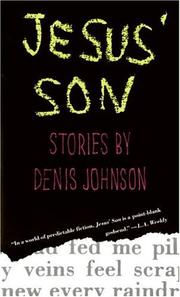
Jesus' Son is a collection of short fiction by Denis Johnson published in 1992 by Farrar, Straus & Giroux. A short story cycle comprising 11 pieces, Jesus' Son is Johnson's most critically acclaimed and popular literary effort, and the work with which Johnson is most identified. It was adapted into a 1999 film by Elizabeth Cuthrell, David Urrutia, and Oren Moverman, directed by Alison Maclean.
Stories
"Car Crash While Hitchhiking"
"Two Men"
"Out on Bail"
"Dundun"
"Work"
"Emergency"
"Dirty Wedding"
"The Other Man"
"Happy Hour"
"Steady Hands at Seattle General"
"Beverly Home"
Subject matter
The book takes its title from the Velvet Underground song "Heroin", and concerns the exploits of several addicts living in rural America as they engage in drug use, petty crime, and murder. The stories are linked by shared locations (such as a dive bar in small-town Iowa) and repeated imagery. They are all narrated by a troubled young man identified only as "Fuckhead" ("Emergency").
The book is known for its seemingly chaotic narrative style, which mirrors the mental state of its narrator and the disjointed perception of an addicted, drug-addled mind.
In "Car Crash While Hitchhiking" Fuckhead seems to have extra-sensory perception, which allows him to experience in the present a deadly car crash that won't happen until much later in the narrative. Despite his foreknowledge, he enters the car he claims to know will inevitably crash. "Emergency" picks up with Fuckhead while he's working a job as a hospital janitor and driving around under the influence of batches of prescription medications that he's stolen from the hospital. The orderly, with whom he takes a drug-fueled, bunny-killing trip, helps to save a man who's been stabbed in the eye by his wife (this character, Georgie, is also the one who reveals the nickname of the narrator).
The book ends on a more hopeful note as the final narrator enters a recovery program and begins to hold down a stable job writing a newsletter for the residents of a nursing home.
Plots
"Car Crash While Hitchhiking"
In this story, a drug-addicted narrator recounts hitchhiking in four different vehicles, first with a Cherokee, then a salesperson, then a college student, and finally a family composed of a husband, wife, young daughter and a baby. The salesperson is drunk and shares alcohol and pills with the narrator before leaving him off to find a student who drives him until he catches a ride with the family. Eventually, this vehicle is struck by another car resulting in the death of the driver of the other car. The story ends with the narrator looking back several years later, seemingly in detox, as he recounts his drug abuse, which the entire narration of the story reflects in a style of disconnect from reality.
"Two Men"
The narrator and his friends Tom and Richard are thrust into the role of reluctant chaperons of a mute man who unexpectedly climbs into their vehicle one evening after a dance. They drive him to several locations, the narrator berating the man constantly, for he believes he isn't actually mute. Upon arriving at the last location they discover that the mute man is an ex high school football star, and now is an addict in the company of wrongdoers. This realization strikes the narrator, proving that even the most successful or popular people can still fall from grace. After they deposit the mute man at the last location, he pursues the narrator and his friends as they attempt to leave him behind. He makes it as far as grabbing the side of the car before he crashes into a stop sign. Later, they run into a man named Thatcher, who the narrator recognizes at a gas station. Thatcher is a dealer who sold the narrator bad cocaine, and the narrator proceeds to follow Thatcher to his house, brandishing his gun and spitting threats. When they break into his residence, they encounter a woman who begs them to leave and informs them that Thatcher isn't present. The narrator presses, but the woman pleads and tells them that there are only two little children in the other rooms. Upon further investigation, Tom and Richard discover that there are in fact only two little children in the house. Thatcher had climbed out of the window.
"Out on Bail"
The narrator reflects on the young life of a well known man who he had connections with named Jack Hotel who was well kept, but kept his crimes a secret, while shifting to talk about his hard life in the present. He spends his time drinking at a bar known as the Vine (a reoccurring setting that the narrator finds himself at in later stories), where the other guests have also spent much of their lives consumed in drug addiction. Jack is no longer facing criminal charges but he and the narrator steal checks to fund their habit. The narrator is grateful for the apartment they find because he is still living but he is even more grateful for his life in the present, after Jack ultimately dies of an overdose. He ends the story by reflecting: "I am still alive" which shows that he can't believe that with the state of his addiction, he is continuing with his life.
"Dundun"
This story recounts the narrator's attempt to obtain pharmaceutical opium from a friend named Dundun. Upon arriving at Tim Bishop's farm, where Dundun lives, the narrator finds Dundun outside pumping water. Dundun casually informs the narrator that he has shot McInnes, who is still alive and inside the farmhouse. The rest of the story recounts two failed attempts at saving McInnes' life. It is in this story where the narrator reveals that McInnes bequeathed him the name "Fuckhead."
以上文字摘自英文维基百科「Jesus' Son (short story collection)」(有删节,去掉了参考文献等尾部小节),按 CC BY-SA 4.0 使用,作者为维基百科的各位编者。
资料卡
- 原题
- Jesus' Son
- 原作语言
- 英语
- 首次出版
- 1992 年 12 月 1 日
- 作品形式
- 短篇小说集
资料卡来自 Wikidata Q6188048(CC0),众包数据,个别字段可能不全。
改编作品
电影1
- 《耶稣之子》Jesus' Son
名单来自 Wikidata(CC0):只列条目里写明「改编自 / 取材于」这本书的作品,不按名字猜;众包数据,可能不全。