 书单
百科
这个词条暂时没有中文维基百科条目,下面是英文维基百科的内容(英文原文):
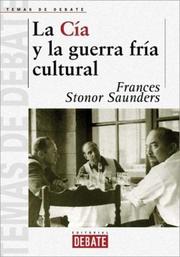
Who Paid the Piper? The CIA and the Cultural Cold War (US title The Cultural Cold War: The CIA and the World of Arts and Letters) is a 1999 book by the British historian Frances Stonor Saunders. She recounts the mid-20th-century efforts by the United States Central Intelligence Agency (CIA) to infiltrate and co-opt artistic movements, using funds that were mostly channelled through the Congress for Cultural Freedom and the Ford Foundation. She argues that the funds came with strings attached, that the aim of these CIA-backed cultural initiatives was to curb Soviet political influence in Europe, and expand American political influence. Her thesis is that by entangling the state in "free" artistic expression, the Agency undermined America's moral position. She further suggests that American Cold War cultural activities were similar in kind to those of the Soviet Union.
Saunders' research and conclusions stirred up considerable debate. In Dissent, Jeffrey Isaac characterised Who Paid the Piper? as a "widely discussed retrospective on post-Second World War liberalism that raises important questions about the relationships between intellectuals and political power." In 2000 the book was published in the US under a new title, The Cultural Cold War, which The New York Times reviewer praised as "more neutral" than the provocative Who Paid the Piper?.
Content
Saunders begins by depicting the devastation in Western and Central Europe following the Second World War, and how the Soviets began staging plays, opera performances and other events for the culture-starved populations. The Americans recognised they must respond to what was perceived as a "Soviet cultural offensive". She then details the flurry of cultural happenings—plays, concerts, art exhibitions, new works of literature and cinema, etc.—that were exported to Europe while secretly being subsidised by the CIA, for example, European tours of the Boston Symphony Orchestra, and film adaptations of Animal Farm and of 1984.
She notes how the Agency financed journals and magazines like Partisan Review, Kenyon Review, and The New Leader to provide "an intellectual bridgehead for American and European intellectuals whose common ground was anti-Communism." The CIA paid for the publication of over a thousand books, some funnelled through Praeger Publishing and other politically like-minded publishing houses. Among the books published and distributed with CIA help were Boris Pasternak's Doctor Zhivago, The New Class by the Yugoslav dissident Milovan Djilas, Melvin Lasky's La Revolution Hongroise, and translations of T. S. Eliot's poems.
She describes the growth of the Abstract Expressionist art movement, and its frequent showcasing in New York's Museum of Modern Art (MOMA), as largely a CIA-sponsored operation. She writes that, according to America's cultural mandarins, abstract expressionismspoke to a specifically anti-Communist ideology, the ideology of freedom, of free enterprise. Non-figurative and politically silent, it was the very antithesis to socialist realism. It was precisely the kind of art the Soviets loved to hate.
Since many abstract expressionist painters and sculptors were anarchistic, and strongly anti-CIA, a "long leash" policy was adopted that "kept CIA operatives at a remove of two or three degrees from the artists and art exhibitions—sometimes even more—so that they could not be linked to any furtive governmental bankrolling."
Saunders devotes a large portion of the book to the Paris-based Congress for Cultural Freedom (CCF) and its journal Encounter. She chronicles how the CIA set up fake foundations and used established bodies, such as the Ford Foundation and Rockefeller Foundation, to hide CCF's funding and covert activities. She says that CCF's objective was to create a battle line in Western Europe "from which the advance of Communist ideas could be halted." In the latter chapters, she narrates the CCF's downfall once its secret sponsor was revealed.
Throughout the book, Saunders addresses three key questions:
How altruistic was the CIA in underwriting Western art and literature during the Cold War? In the Introduction, she alludes to the CIA's "blank cheque" line of defence: "We simply helped people to say what they would have said anyway". But she rejects this notion by insisting that "the individuals and institutions subsidized by the CIA were expected to perform as part of a broad campaign of persuasion".
Were all of the Western artists and intellectuals truly unaware of where their funding was coming from? She doubts most of them were as ignorant of the situation as they later claimed to be. In one of the book's final chapters, titled "That Sinking Feeling", she says of two dozen writers and intellectuals: "Not all of them were 'witting' in the sense that they were active participants in the deception. But they all knew, and had known for some time."
Were Western intellectuals free of political manipulation by the state apparatus (unlike their Soviet counterparts)? She sees the manipulation as being of a subtle, insidious variety: "The real point was not that the possibility of dissent had been irrevocably damaged...or that intellectuals had been coerced or corrupted (though that may have happened too), but that the natural procedures of intellectual enquiry had been interfered with."
Reception
Who Paid the Piper? received extensive media attention after its 1999 publication in the UK. Likewise, The Cultural Cold War edition in the US attracted notice from a wide array of sources, including The New York Times, The Bulletin of the Atomic Scientists, the Organization of American Historians, as well as from Arthur Schlesinger Jr. and other former CCF participants. Left-wing publications such as Monthly Review, New Politics and The Nation gave the book a positive reception, while right-wing publications such as The American Spectator and National Interest were more negative in their appraisals. Who Paid the Piper? won the Guardian First Book Award.
以上文字摘自英文维基百科「Who Paid the Piper?」(有删节,去掉了参考文献等尾部小节),按 CC BY-SA 4.0 使用,作者为维基百科的各位编者。
资料卡
- 原作语言
- 英语
- 首次出版
- 1999 年
资料卡来自 Wikidata Q19881822(CC0),众包数据,个别字段可能不全。