 书单
百科
这个词条暂时没有中文维基百科条目,下面是英文维基百科的内容(英文原文):
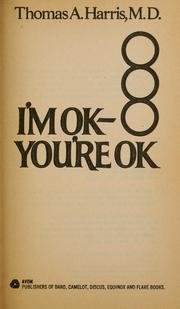
I'm OK – You're OK is a 1967 self-help book by psychiatrist Thomas A Harris. The book presents transactional analysis as a method for addressing personal challenges.
The book made the New York Times Best Seller list in 1972 and remained there for almost two years. It is estimated by the publisher to have sold over 15 million copies to date and to have been translated into over a dozen languages.
Content
In the preface, Harris praises the then-new procedure of transactional analysis (TA, or as Harris often refers to it, P-A-C) as a major innovation addressing the slow process and limited results that he and other psychiatric practitioners believed was characteristic of conventional psychiatry.
Harris' context for the book
Rather than working with abstract concepts of consciousness, Harris suggests that the pioneering work of brain surgeon Wilder Penfield in uncovering the neurological basis of memory could offer complementary insights grounded in observable reality.
Specifically, Harris emphasizes reports of Penfield's experiments stimulating small areas of the brains of conscious patients undergoing brain surgery (the brain does not have any pain receptors, so this can be done in relative comfort for the patient). Though the patients were conscious that they were on an operating table, the stimulation also caused them to recall specific past events in vivid detail—not just facts of the event, but as a vivid "reliving" of "what the patient saw and heard and felt and understood" when the memory was created. Based on these experiments, Harris postulates that the brain records past experiences like a tape recorder, in such a manner that it is possible subsequently to relive past experiences with all their original emotional intensity.
Harris continues by linking his interpretation of Penfield's experiments to the work of Eric Berne, whose model of psychotherapy is based on the idea that emotionally intense memories from childhood are ever-present in adults. Their influence can be understood by carefully analysing the verbal and non-verbal interchanges ('transactions') between people, hence Berne's name for his model: Transactional Analysis. Harris sees great merit in the ability of TA to define basic units through which human behaviour can be analysed—the 'strokes' that are given and received in a 'transaction' between two or more people—and a standardised language for describing those strokes. This readily understood standardisation, and the association Harris develops between TA and Penfield's neuroscience, gives TA a degree of credibility not possessed by earlier abstract models such as that developed by Freud.
Parent, Adult, Child (P-A-C) model
After describing the context for his belief of the significance of TA, Harris describes TA, starting from the observation that a person's psychological state seems to change in response to different situations. The question is, from what and to what does it change? Harris answers this through a simplified introduction to TA, explaining Berne's proposal that there are three states into which a person can switch: the Parent, the Adult and the Child.
Harris describes the mental state called the Parent by analogy, as a collection of "tape recordings" of external influences that a child observed adults doing and saying. The recording is a long list of rules and admonitions about the way the world is that the child was expected to believe unquestioningly. Many of these rules (for example: "Never run out in front of traffic") are relatively basic, often relating to immediate physical need or danger; others (e.g. "...you can never trust a cop", "...busy hands are happy hands") are more complex and concern more subtle or nuanced regions. Nevertheless, Harris asserts that both the former and the latter are 'recorded' in the child's memory in the same manner, as 'Parent' dictations, rather than actually understood concepts or philosophical precepts.
In parallel with those Parent recordings, the Child is a simultaneous recording of internal events—how life felt as a child. Harris equates these with the vivid recordings that Wilder Penfield was able to cause his patients to re-live by stimulating their brains. Harris proposes that adults may re-experience 'Child' memories when feeling discouraged, even if the original stimuli are no longer present or relevant.
According to Harris, humans start developing a third mental state, the Adult, about the time children start to walk and begin to achieve some measure of control over their environment. Instead of learning ideas directly from parents into the Parent, or experiencing simple emotion as the Child, children begin to be able to explore and examine the world and form their own opinions. They test the assertions of the Parent and Child and either update them or learn to suppress them. Thus the Adult inside us all develops over time, but it is very fragile and can be readily overwhelmed by stressful situations. Its strength is also tested through conflict between the simplistic ideas of the Parent and reality. Sometimes, Harris asserts, it is safer for a person to believe a lie than to acknowledge the evidence in front of them. This is called Contamination of the Adult.
Four life positions
The phrase I'm OK, You're OK is one of four "life positions" that each of us may take. The four positions are:
I'm Not OK, You're OK
I'm Not OK, You're Not OK
I'm OK, You're Not OK
I'm OK, You're OK
According to Harris, the most common position is I'm Not OK, You're OK, which he attributes to children's perceptions of adults as strong and competent, leading them to view themselves as less capable. Children who are abused may conclude I'm Not OK, You're Not OK or I'm OK, You're Not OK, but these are much less common. The emphasis of the book is helping people understand how their life position affects their communications (transactions) and relationships with practical examples.
以上文字摘自英文维基百科「I'm OK – You're OK」(有删节,去掉了参考文献等尾部小节),按 CC BY-SA 4.0 使用,作者为维基百科的各位编者。
资料卡
- 原题
- I'm OK – You're OK
- 原作语言
- 英语
- 首次出版
- 1967 年
- 体裁
- 自助
- 首版出版社
- 哈珀与罗出版公司
- 主题
- 心理学
资料卡来自 Wikidata Q5966660(CC0),众包数据,个别字段可能不全。