 书单
百科
这个词条暂时没有中文维基百科条目,下面是英文维基百科的内容(英文原文):
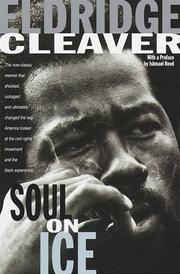
Soul on Ice is a book of essays and letters written by Eldridge Cleaver while he was serving time in San Quentin State Prison and Folsom State Prison. His writings first appeared in Ramparts magazine in 1966, and were collected in book form in Soul on Ice, published by McGraw-Hill in 1968. Although the book ranges over many topics, it is usually classified as a memoir because much of it is a retelling of Cleaver's life, how he came to be in prison, and the evolution of his religious beliefs and radical politics.
Soul on Ice was widely read and discussed for its searing commentary on white society in America, and the black experience within it. The book was highly controversial, and subject to censorship, for its provocative statements and opinions. The author was hailed as "an authentic voice of black rage in a white-ruled world." The New York Times named Soul on Ice one of the 10 best books of 1968.
By autumn of 1970, two million copies were in print. Cleaver went on to publish other writings, but Soul on Ice remains his best-known work and a seminal volume in African-American literature.
Background
Eldridge Cleaver was born in August 1935 in Wabbaseka, Arkansas, at a time when pernicious racism prevailed in the segregated South. In 1946, his family moved to Watts, California, where he began engaging in petty crime. After a series of arrests for bicycle theft and vandalism, he was sent in 1954 to Soledad State Prison for possessing a large quantity of marijuana. During this stretch in prison, he earned a high school diploma while reading the works of Niccolò Machiavelli, Voltaire, Jean-Jacques Rousseau, Thomas Paine, Karl Marx, Vladimir Lenin, W. E. B. Du Bois, Richard Wright, Thomas Merton, and Thomas Wolfe.
In 1957, Cleaver was released from Soledad. Later that year, he was convicted of sexual assault with intent to murder. He was sent to San Quentin and then transferred to Folsom. He began to write regularly about his physical and mental imprisonment, his personal transformation, and the political events and cultural happenings of the era.
In 1965, he sent a letter to Beverly Axelrod, a Bay Area-based attorney, asking her to represent him. She agreed and their relationship proved instrumental in the publication of Soul on Ice. When she visited him in prison, she smuggled him contraband leftist books and magazines, and he slipped his prison essays into the stacks of legal papers she carried with her.
She showed his essays to Edward Michael Keating, founder of Ramparts magazine, who began publishing them in June 1966. After Cleaver was paroled in December 1966, he was hired as a Ramparts staff writer in their San Francisco office. He also joined the fledgling Black Panther Party in Oakland. His prison writings, a number of which had already appeared in Ramparts, were collected in the volume Soul on Ice, and published by McGraw-Hill in early 1968.
Description
The essays in Soul on Ice are divided into four thematic sections:
"Letters from Prison", recounts Cleaver's experiences with, and thoughts on, crime and prisons.
"Blood of the Beast", discusses race relations and black liberation ideology.
"Prelude to Love—Three Letters", contains two love letters Cleaver wrote to Beverly Axelrod, and one love letter from her to Cleaver.
"White Woman, Black Man", reflects on gender relations, black masculinity, and sexuality.
In the Introduction, Maxwell Geismar likens Soul on Ice to Frantz Fanon's Black Skin, White Masks, stating that in both books, "the central problem is of identification as a black soul which has been 'colonized' ... by an oppressive white society that projects its brief, narrow vision of life as eternal truth." Geismar especially praises the last portion of Soul on Ice where the author "has reached his own spiritual convalescence, his healed spirit (no longer racist or narrowly nationalist), and his mature power as a writer".
Cleaver immediately courts controversy in the opening essay, "On Becoming". He describes his realization as a young man that he had been "indoctrinated to see the white woman as more beautiful and desirable than my own black woman." In the wake of the 1955 lynching in Mississippi of Emmett Till for allegedly flirting with a white woman, Cleaver says he developed an "antagonistic, ruthless attitude toward white women" that he acted upon when released from prison in 1957:I became a rapist. To refine my technique and modus operandi, I started out by practicing on black girls in the ghetto—in the black ghetto where dark and vicious deeds appear not as aberrations or deviations from the norm, but as part of the sufficiency of the Evil of a day—and when I considered myself smooth enough, I crossed the tracks and sought out white prey. I did this consciously, deliberately, willfully, methodically—though looking back I see that I was in a frantic, wild, and completely abandoned frame of mind. Rape was an insurrectionary act. It delighted me that I was defying and trampling upon the white man's law, upon his system of values, and that I was defiling his women—and this point, I believe, was the most satisfying to me because I was very resentful over the historical fact of how the white man has used the black woman. I felt I was getting revenge. In a spirit of confession, he soon adds:After I returned to prison, I took a long look at myself and, for the first time in my life, admitted that I was wrong, that I had gone astray—astray not so much from the white man's law as from being human, civilized—for I could not approve the act of rape. Even though I had some insight into my own motivations, I did not feel justified. I lost my self-respect. My pride as a man dissolved and my whole fragile moral structure seemed to collapse, completely shattered. That is why I started to write. To save myself.
以上文字摘自英文维基百科「Soul on Ice (book)」(有删节,去掉了参考文献等尾部小节),按 CC BY-SA 4.0 使用,作者为维基百科的各位编者。
资料卡
- 原题
- Soul On Ice
- 原作语言
- 英语
- 首次出版
- 1968 年
- 体裁
- 回忆录
资料卡来自 Wikidata Q7564271(CC0),众包数据,个别字段可能不全。