书单
百科
这个词条暂时没有中文维基百科条目,下面是英文维基百科的内容(英文原文):
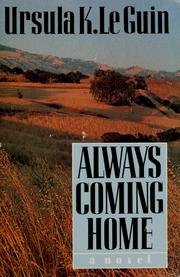
Always Coming Home is a 1985 science fiction novel by American writer Ursula K. Le Guin. It is in parts narrative, pseudo-textbook and pseudo-anthropologist's record. It describes the life and society of the Kesh people, a cultural group who live in the distant future long after modern society has collapsed. It is presented by Pandora, who seems to be an anthropologist or ethnographer from the readers' contemporary culture, or a culture very close to it. Pandora describes the book as a protest against contemporary civilization, which the Kesh call "the Sickness of Man".
Setting
The book's setting is a time so post-apocalyptic that no cultural source can remember the apocalypse, though a few folk tales refer to our time. The only signs of our civilization that have lasted into their time are indestructible artefacts such as styrofoam and a self-manufacturing, self-maintaining, solar-system-wide computer network. There has been a great sea level rise since our time, flooding much of northern California, where the story takes place.
The Kesh use technological inventions of civilization such as writing, steel, guns, electricity, trains, and a computer network (see below). However, unlike one of their neighboring societies – the Dayao or Condor People – they do nothing on an industrial scale, reject governance, have no non-laboring caste, do not expand their population or territory, consider disbelief in what we consider “supernatural” absurd, and deplore human domination of the natural environment. Their culture blends millennia of human economic culture by combining aspects of hunter-gatherer, agricultural, and industrial societies, but rejects cities (literal “civilization”). In fact, what they call “towns” would count as villages for the reader – a dozen or a few-dozen multi-family or large family homes. What they call “war” is a minor skirmish over hunting territories, and is considered a ridiculous pastime for youngsters, since an adult person should not throw his life away.
Pandora observes that a key difference between the Kesh and the readers' [her?] society is the size of their population: "There are not too many of them.". Their low population density means that they can feed themselves from their land. The Kesh maintain this low population without coercion, which would be antithetical to their loosely organized society. They carry a large accumulation of genetic damage, which leads to fewer successful pregnancies and higher infant mortality. They also have social taboos against multiple siblings and early pregnancies; a third child is considered shameful, and the Dayao's practice of large families is referred to as "incontinence". Abortions are practiced freely.
Summary
The book is divided into two parts: The first part consists mostly of Kesh texts and records of oral performances, interspersed with Pandora's commentary, accounts of a few aspects of Kesh life, and personal essays. The longest text is a personal history narrated by a woman called Stone Telling. Stone Telling's autobiography fills less than a third of the book, told in three sections with large gaps filled with other material. The second part, called "The Back of the Book", contains a few Kesh texts but consists mostly of Pandora's accounts of various aspects of Kesh life.
Stone Telling recounts how she spent her childhood with her mother's people in the Valley, as a very young woman lived several years with her father's people in The City, and escaped from it with her daughter, who was born there. The two societies are contrasted through her narrative: the Kesh are peaceable and self-organized, whereas the Condor people of The City are rigid, patriarchal, hierarchical, militaristic, and expansionist. During the lifetime of Stone Telling, both The City and the Valley change, and for a time one changes the other. There are traces of this arc in other parts of the book.
The next longest piece in the main part, in the section "Eight Life Stories", is the novelette "The Visionary", which was published as a stand-alone story in Omni in 1984. This part also includes history and legends, myths, plays, a chapter of a novel, and song lyrics and poetry. Some editions of the book were accompanied by a tape of Kesh music and poetry.
A number of these are attributed by Pandora to a Kesh woman named Little Bear Woman; these are:
Shahugoten. As told by Little Bear Woman of Sinshan to the Editor pp. 57–59 [a legend]
Coming Home to Up the Hill House. By Little Bear Woman p. 258 [a poem]
The Writer to the Morning in Up the Hill House in Sinshan. By Little Bear Woman p. 258 [a poem]
A Song to Up the Hill House in Sinshan. By Little Bear Woman p. 259 [a poem]
Some of the paths around Sinshan Creek. A Kesh map of the watershed of Sinshan Creek, given to the Editor by Little Bear Woman of Sinshan.
"The Back of the Book", about a fifth of the number of pages, presents cultural lore, with the format and attributions or annotations that an ethnographic fieldworker might make. It includes discussions of village layout and landscaping, family and professional guilds, recipes, medical care, yearly ritual dances, and language.
Analysis
In Ursula K. Le Guin: A Critical Companion, Bernardo and Murphy note that Always Coming Home underscores Le Guin's long-standing anthropological interests. The Valley of the Na [River] is modeled on the landscape of California's Napa Valley, where Le Guin spent her childhood when her family was not in Berkeley.
以上文字摘自英文维基百科「Always Coming Home」(有删节,去掉了参考文献等尾部小节),按 CC BY-SA 4.0 使用,作者为维基百科的各位编者。
资料卡
- 原题
- Always Coming Home
- 原作语言
- 美国英语、英语
- 首次出版
- 1985 年 10 月
- 作品形式
- 长篇小说
- 体裁
- 科学幻想
- 首版出版社
- 哈珀与罗出版公司
- 故事发生地
- 加利福尼亚州
- 获奖
- 20世纪百大英文小说
资料卡来自 Wikidata Q4677090(CC0),众包数据,个别字段可能不全。