 书单
百科
这个词条暂时没有中文维基百科条目,下面是英文维基百科的内容(英文原文):
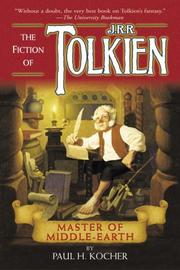
Master of Middle-earth: The Fiction of J. R. R. Tolkien, alternatively subtitled The Achievement of J.R.R. Tolkien, is a 1972 book of literary criticism of J. R. R. Tolkien's Middle-earth fantasy writings, written by Paul H. Kocher, and one of the few to be published in Tolkien's lifetime. It focuses especially on The Lord of the Rings and The Hobbit, and also covers some of his minor works such as "Leaf by Niggle" and "Smith of Wootton Major".
At a time when scholars were largely critical of Tolkien and his prose style, it both praised his writing and, in the absence of either The Silmarillion or Christopher Tolkien's The History of Middle-earth on the process of creation of Tolkien's fiction, it correctly inferred many of his major themes. It was one of the earliest book-length analyses of Tolkien's work, winning Kocher the 1973 Mythopoeic Society's Scholarship in Inkling Studies Award.
Context
J. R. R. Tolkien (1892–1973) was a scholar of English literature, a philologist and medievalist interested in language and poetry from the Middle Ages, especially that of Anglo-Saxon England and Northern Europe. His professional knowledge of Beowulf, telling of a pagan world but with a Christian narrator, helped to shape his fictional world of Middle-earth. His intention to create what has been called "a mythology for England" led him to construct not only stories but a fully-formed world, Middle-earth, with invented languages, peoples, cultures, and history. Among his many influences were his own Roman Catholic faith, and medieval languages and literature. He is best known as the author of the high fantasy works The Hobbit (1937), The Lord of the Rings (1954–1955), and The Silmarillion (1977), all set in Middle-earth.
The early literary reception of The Lord of the Rings was divided between enthusiastic support by figures such as W. H. Auden and C. S. Lewis, and outright rejection by critics such as Edmund Wilson.
Paul H. Kocher was a scholar of English literature. The book was published before The Silmarillion appeared to confirm several of Kocher's inferences about the mythical history of Middle-earth.
Book
Publication history
The book was first published in hardback by Houghton Mifflin in the United States in October 1972. The first British edition was brought out by Thames & Hudson in hardback in 1973, with the title Master of Middle-earth: The Achievement of J.R.R. Tolkien. Paperback editions followed: by Penguin Books in 1974, Ballantine Books in 1977, Pimlico in 2002, and Del Rey in 2003. The book has been translated into Dutch, French, German, Italian, Polish, and Swedish. The book was reprinted several times, such as in New York: Ballantine Books, 1977; New York: Del Rey, 1982; and London: Pimlico, 2002.
Translations include:
into French by Jean Markale as Le royaume de la terre du milieu: Les clés de l'oeuvre de J.R.R. Tolkien. Paris: Retz, 1981.
into Italian, Il maestro della Terra di Mezzo, Rome: Bompiani, 2011.
into Swedish by Åke Ohlmarks, Tolkiens sagovärld: En vägledning. Stockholm: AWE/Geber, 1989; and Stockholm: Geber, 1973.
into Dutch by Max Schuchart, Tolkien: Meester van midden-aarde: Zijn romans en verhalen. The Hague: Bert Bakker, 1973.
into Polish by Radosław Kot as Mistrz Śródziemia. Warsaw: Amber, 1998.
Synopsis
The book has seven chapters, a "Bibliographical Note" on Tolkien's publications, academic notes, and a full index. The chapters cover:
"Middle-earth: An Imaginary World" – how Tolkien blends fantasy and reality to create his world. Kocher quotes Tolkien's statement about creating secondary worlds, that they have to command a kind of belief, and while they may contain dwarfs, trolls, and dragons, these have to be set in a world with realistic features of sea and sky and earth. He notes that Middle-earth is "our earth as it was long ago".
"The Hobbit" – on the quality of Tolkien's children's book. Kocher suggests that the key is to think of Tolkien sitting by the fireside telling the story to a group of children: in the text, he addresses the reader directly. "Jocular interjections" help to maintain "a playful intimacy", while the text "is full of sound effects". All the same, the intended readership is vague, as some passages, like Bard's claim to Smaug's treasure, are more for adults. He notes, too, the change in the "true story" of how Bilbo got the One Ring in the 1966 prologue to The Lord of the Rings, helping to smooth the transition between the two novels.
"Cosmic Order" – on the cosmology of Middle-earth, from the role of Wizards to the godlike Valar. Kocher discerns a "moral dynamism in the universe to which each [protagonist] freely contributes, without exactly knowing how"; in his view the thoughtful characters say enough to imply clearly "the order in which they believe" and the unseen "planner operating through it". He considers, too, the nature of death and immortality for elves and men.
"Sauron and the Nature of Evil" – on the questions of evil and the addictive nature of the temptation of the Ring, including other evil figures like Saruman and Shelob. Kocher discusses how Tolkien deals with the different theories of evil in Christianity, including the Manichean view (evil is as powerful as good), and the question of how Orcs were made evil if "the Shadow that bred them can only mock, it cannot make".
"The Free Peoples" – on how Tolkien portrays different peoples, cultures, and languages by varying his prose. Kocher argues that far from using stereotyped characters or merely telling an adventure story, Tolkien explores both the individuals and the nature of their races, including Elves, Hobbits, Dwarves, Men, and Ents. In his view, "Tolkien's real mastery ... consists in his power to establish for each individual race a personality that is unmistakably its own."
以上文字摘自英文维基百科「Master of Middle-Earth」(有删节,去掉了参考文献等尾部小节),按 CC BY-SA 4.0 使用,作者为维基百科的各位编者。
资料卡
- 原题
- Master of Middle-Earth
- 原作语言
- 英语
- 体裁
- 文学批评
- 主题
- J·R·R·托尔金、传说故事集
资料卡来自 Wikidata Q110722791(CC0),众包数据,个别字段可能不全。