 书单
百科
这个词条暂时没有中文维基百科条目,下面是英文维基百科的内容(英文原文):
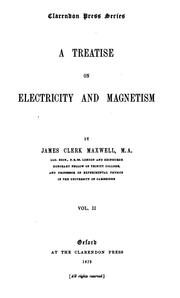
A Treatise on Electricity and Magnetism is a two-volume treatise on electromagnetism written by James Clerk Maxwell in 1873. The work is described as both "celebrated" and "rambling and difficult", while admired as a pioneering mathematical source to understand electromagnetic theory. The four famous Maxwell's Equations were derived from its content in the next decade. Maxwell was revising the Treatise for a second edition when he died in 1879. The revision was completed by William Davidson Niven for publication in 1881. A third edition was prepared by J. J. Thomson for publication in 1892.
The treatise is said to be notoriously hard to read, containing plenty of ideas but lacking both the clear focus and orderliness that may have allowed it catch on more easily. It was noted by one historian of science that Maxwell's attempt at a comprehensive treatise on all of electrical science tended to bury the important results of his work under "long accounts of miscellaneous phenomena discussed from several points of view". He goes on to say that, outside the treatment of the Faraday effect, Maxwell failed to expound on his earlier work, especially the generation of electromagnetic waves and the derivation of the laws governing reflection and refraction.
Maxwell introduced the use of vector fields, and his labels have been perpetuated:
A (vector potential), B (magnetic induction), C (electric current), D (displacement), E (electric field – Maxwell's electromotive intensity), F (mechanical force), H (magnetic field – Maxwell's magnetic force).
Maxwell's work is considered an exemplar of rhetoric of science:
Lagrange's equations appear in the Treatise as the culmination of a long series of rhetorical moves, including (among others) Green's theorem, Gauss's potential theory and Faraday's lines of force – all of which have prepared the reader for the Lagrangian vision of a natural world that is whole and connected: a veritable sea change from Newton's vision.
Contents
Preliminary. On the Measurement of Quantities.
Part I. Electrostatics.
Description of Phenomena.
Elementary Mathematical Theory of Electricity.
On Electrical Work and Energy in a System of Conductors.
General Theorems.
Mechanical Action Between Two Electrical Systems.
Points and Lines of Equilibrium.
Forms of Equipotential Surfaces and Lines of Flow.
Simple Cases of Electrification.
Spherical Harmonics.
Confocal Surfaces of the Second Degree.
Theory of Electric Images.
Conjugate Functions in Two Dimensions.
Electrostatic Instruments.
Part II. Electrokinematics.
The Electric Current.
Conduction and Resistance.
Electromotive Force Between Bodies in Contact.
Electrolysis.
Electrolytic Polarization.
Mathematical Theory of the Distribution of Electric Currents.
Conduction in Three Dimensions.
Resistance and Conductivity in Three Dimensions.
Conduction through Heterogeneous Media.
Conduction in Dielectrics.
Measurement of the Electric Resistance of Conductors.
Electric Resistance of Substances.
Part III. Magnetism
Elementary Theory of Magnetism.
Magnetic Force and Magnetic Induction.
Particular Forms of Magnets.
Induced Magnetization.
Magnetic Problems.
Weber's Theory of Magnetic Induction.
Magnetic Measurements.
Terrestrial Magnetism.
Part IV. Electromagnetism.
Electromagnetic Force.
Mutual Action of Electric Currents.
Induction of Electric Currents.
Induction of a Current on Itself.
General Equations of Dynamics.
Application of Dynamics to Electromagnetism.
Electrokinetics.
Exploration of the Field by means of the Secondary Circuit.
General Equations.
Dimensions of Electric Units.
Energy and Stress.
Current-Sheets.
Parallel Currents.
Circular Currents.
Electromagnetic Instruments.
Electromagnetic Observations.
Electrical Measurement of Coefficients of Induction.
Determination of Resistance in Electromagnetic Measure.
Comparison of Electrostatic With Electromagnetic Units.
Electromagnetic Theory of Light.
Magnetic Action on Light.
Electric Theory of Magnetism.
Theories of Action at a distance.
Reception
Reviews
On April 24, 1873, Nature announced the publication with an extensive description and much praise. When the second edition was published in 1881, George Chrystal wrote the review for Nature.
Pierre Duhem published a critical essay outlining mistakes he found in Maxwell's Treatise. Duhem's book was reviewed in Nature.
Comments
Hermann von Helmholtz (1881): "Now that the mathematical interpretations of Faraday's conceptions regarding the nature of electric and magnetic force has been given by Clerk Maxwell, we see how great a degree of exactness and precision was really hidden behind Faraday's words...it is astonishing in the highest to see what a large number of general theories, the mechanical deduction of which requires the highest powers of mathematical analysis, he has found by a kind of intuition, with the security of instinct, without the help of a single mathematical formula."
Oliver Heaviside (1893):”What is Maxwell's theory? The first approximation is to say: There is Maxwell's book as he wrote it; there is his text, and there are his equations: together they make his theory. But when we come to examine it closely, we find that this answer is unsatisfactory. To begin with, it is sufficient to refer to papers by physicists, written say during the first twelve years following the first publication of Maxwell's treatise to see that there may be much difference of opinion as to what his theory is. It may be, and has been, differently interpreted by different men, which is a sign that is not set forth in a perfectly clear and unmistakable form. There are many obscurities and some inconsistencies. Speaking for myself, it was only by changing its form of presentation that I was able to see it clearly, and so as to avoid the inconsistencies. Now there is no finality in a growing science. It is, therefore, impossible to adhere strictly to Maxwell's theory as he gave it to the world, if only on account of its inconvenient form.
以上文字摘自英文维基百科「A Treatise on Electricity and Magnetism」(有删节,去掉了参考文献等尾部小节),按 CC BY-SA 4.0 使用,作者为维基百科的各位编者。
资料卡
- 原题
- A Treatise on Electricity and Magnetism
- 原作语言
- 英语
- 首次出版
- 1873 年
- 体裁
- 教科书
- 主题
- 经典电磁学、麦克斯韦方程
资料卡来自 Wikidata Q4660281(CC0),众包数据,个别字段可能不全。