书单
百科
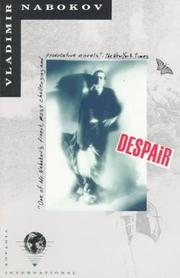
《绝望》(俄语:Отчаяние,英语:Despair)是弗拉基米尔·纳博科夫的一部小说,出版于1969年。最初用俄文写作,1934年在巴黎流亡白俄的文学期刊《当代》(Sovremennye zapiski)上连载。1936年全书出版,1937年被作者翻译成英文。1937年的英文版本在第二次世界大战期间大部分毁于德军空袭,存世仅数本。1965年,纳博科夫出版了第二本英文译本,这是目前在发行的唯一的英文译本。
情节
故事的叙述者和主人公赫尔曼·卡洛维奇,是一个德国血统的俄罗斯人,一家巧克力工厂的老板。他在布拉格遇到一个无家可归的人。赫尔曼认为此人是自己的分身。尽管所谓的分身费利克斯似乎并不认为他们二人有何相似,但赫尔曼还是坚持认为,他们两人之间是惊人的相似。赫尔曼的妻子是莉迪雅,根据赫尔曼的说法,她有时愚蠢而又健忘。她有一个表妹,叫阿尔达利翁。莉迪雅和阿尔达利翁两人其实是一对恋人,虽然赫尔曼一直强调说,莉迪雅非常爱他。有一次,赫尔曼赤身裸体地走近那对情侣,但他似乎完全忘记了,也许是故意的。过了一段时间,赫尔曼与费利克斯制定了一个计划,让费利克斯假扮成赫尔曼一段时间。但在费利克斯伪装成赫尔曼后,赫尔曼杀死了费利克斯,以便在3月9日领取赫尔曼的保险金。赫尔曼认为,这次谋杀阴谋是一件完美的艺术品,而不是赚钱的阴谋。但事实证明,这两人之间没有任何相似之处,谋杀并非"完美",很快,凶手就在一家法国小旅馆的藏身之处被警方抓获。
以上文字摘自维基百科「绝望 (小说)」(去掉了参考文献等尾部小节),按 CC BY-SA 4.0 使用,作者为维基百科的各位编者。
中文维基百科的条目比较短,下面附上英文维基百科的内容(英文原文):
Despair (Russian: Отчаяние, or Otchayanie) is the seventh novel by Vladimir Nabokov, originally published in Russian, serially in the politicized literary journal Sovremennye zapiski during 1934. It was then published as a book in 1936, and translated to English by the author in 1937. Most copies of the 1937 English edition were destroyed by German bombs during World War II; only a few copies remain. Nabokov published a second English translation in 1965; this is now the only English translation in print.
Plot summary
The narrator and protagonist of the story, Hermann Karlovich, a Russian of German descent and owner of a chocolate factory, meets a homeless man in the city of Prague, whom he believes to be his doppelgänger. Even though Felix, the supposed doppelgänger, is seemingly unaware of their resemblance, Hermann insists that their likeness is most striking. Hermann is married to Lydia, a sometimes silly and forgetful wife (according to Hermann) who has a cousin named Ardalion. It is heavily hinted that Lydia and Ardalion are, in fact, lovers, although Hermann continually stresses how much Lydia loves him. On one occasion Hermann actually walks in on the pair, naked, but Hermann appears to be completely oblivious of the situation, perhaps deliberately so. After some time, Hermann shares with Felix a plan for both of them to profit off their shared likeness by having Felix briefly pretend to be Hermann. But after Felix is disguised as Hermann, Hermann kills Felix in order to have Lydia collect his own life insurance. He then intends to re-marry her under his new identity as Felix. Hermann considers the presumably perfect murder plot to be a work of art rather than a scheme to gain money. But as it turns out, there is no resemblance whatsoever between the two men, the murder is not 'perfect', and the murderer is about to be captured by the police in a small hotel in France, where he is hiding. Hermann, the narrator, switches to a diary mode at the very end just before his capture; the last entry is on April 1.
Background
Publication history
Nabokov began to compose Despair while he was living in Berlin beginning in July 1932 and managed to complete the first draft on September 10 of the same year. The year in which Nabokov was writing Despair was a turbulent one for Germany. In June 1932, the Reichstag had collapsed. Incumbent President Paul von Hindenburg called for elections, leading to violence between the Nazis and Communists. The Nazi party was becoming more prominent; Hitler would be appointed chancellor in 1933. This would only fuel Nabokov's hatred for totalitarian governments, and this disdain was incorporated somewhat into Despair (Hermann is pro-Communist) and more prominently later on in Invitation to a Beheading (1936), Nabokov's next novel.
By 1935, Nabokov had become increasingly intrigued with the English language, and he elected to translate his two most recently written novels at the time, Laughter in the Dark (1932) (first translated as Camera Obscura) and Despair. Nabokov remarked that translating Despair was his "first serious attempt ... to use English for what may loosely termed an artistic purpose". The translation was finished on December 29 of that year. Nabokov sent the manuscript to Hutchinson & Co. in April 1936; the company had initial reservations, but eventually agreed to publish the book. The translation was checked by a Molly Carpenter-Lee, a student of Nabokov's friend Gleb Struve. The book was a complete flop commercially and Nabokov only earned €40, a minuscule amount even in the 1930s. The issue was that Hutchinson's only published cheap, "popular" novels, which Despair was not, and thus it was distributed to the wrong audience. Nabokov would later lament that Despair was "a rhinoceros in a world of hummingbirds".
以上文字摘自英文维基百科「Despair (novel)」(有删节,去掉了参考文献等尾部小节),按 CC BY-SA 4.0 使用,作者为维基百科的各位编者。
资料卡
- 原题
- Отчаяние
- 译者
- 弗拉基米尔·纳博科夫
- 原作语言
- 俄语
- 首次出版
- 1934 年
- 作品形式
- 长篇小说
- 体裁
- 现实主义
- 首发于
- Sovremennye zapiski
- 主题
- 完美犯罪
资料卡来自 Wikidata Q2494608(CC0),众包数据,个别字段可能不全。
改编作品
电影1
- 《绝望》Despair
名单来自 Wikidata(CC0):只列条目里写明「改编自 / 取材于」这本书的作品,不按名字猜;众包数据,可能不全。