书单
百科
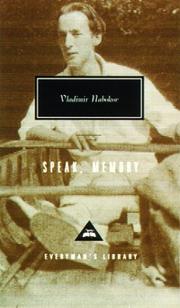
《说吧,记忆》(Speak, Memory)是是作家弗拉基米尔·纳博科夫的一部自传回忆录。这本书的内容曾在1936年至1951年间陆续发表,在1951年合集出版。纳博科夫的修订版和扩展版于1966年出版。
这本书是献给他的妻子薇拉,涵盖他的大半生,从1903年的幼年起,直到1940年移民美国。前十二章,都是纳博科夫在缅怀他青少年时代的贵族生活,1917年十月革命前,他家住圣彼得堡以及西弗斯卡亚附近的乡村庄园 Vyra。剩下的三章,回忆他在剑桥大学读书,以及生活在柏林和巴黎的白俄移民社区的岁月。通过记忆,纳博科夫能够拥有过去。
以上文字摘自维基百科「说吧,记忆」(去掉了参考文献等尾部小节),按 CC BY-SA 4.0 使用,作者为维基百科的各位编者。
中文维基百科的条目比较短,下面附上英文维基百科的内容(英文原文):
Speak, Memory is a memoir by writer Vladimir Nabokov. The book includes individual essays published between 1936 and 1951 to create the first edition in 1951. Nabokov's revised and extended edition appeared in 1966.
Nabokov writes in the text that he was dissuaded from titling the book Speak, Mnemosyne by his publisher, who feared that readers would not buy a "book whose title they could not pronounce". It was first published in a single volume in 1951 as Speak, Memory in the United Kingdom and as Conclusive Evidence in the United States. The Russian version was published in 1954 and called Drugie berega (Other Shores). An extended edition including several photographs was published in 1966 as Speak, Memory: An Autobiography Revisited. In 1999 Alfred A. Knopf issued a new edition with the addition of a previously unpublished section titled "Chapter 16".
Scope
The book is dedicated to his wife, Véra, and covers his life from 1903 until his emigration to America in 1940. The first twelve chapters describe Nabokov's remembrance of his youth in an aristocratic family living in pre-revolutionary Saint Petersburg and at their country estate Vyra, near Siverskaya. The three remaining chapters recall his years at Cambridge and as part of the Russian émigré community in Berlin and Paris. Through memory Nabokov is able to possess the past.
Nabokov published "Mademoiselle O", which became Chapter Five of the book, in French in 1936, and in English in The Atlantic Monthly in 1943, without indicating that it was non-fiction. Subsequent pieces of the autobiography were published as individual or collected stories, with each chapter able to stand on its own. Andrew Field observed that while Nabokov evoked the past through "puppets of memory" (in the characterizations of his educators, Colette, or Tamara, for example), his intimate family life with Véra and Dmitri remained "untouched". Field indicated that the chapter on butterflies is an interesting example of how the author deploys the fictional with the factual. It recounts, for example, how his first butterfly escapes at Vyra, in Russia, and is "overtaken and captured" forty years later on a butterfly hunt in Colorado.
The book's opening line, "The cradle rocks above an abyss, and common sense tells us that our existence is but a brief crack of light between two eternities of darkness," is arguably a paraphrase of Thomas Carlyle's "One Life; a little gleam of Time between two Eternities," found in Carlyle's 1840 lecture "The Hero as Man of Letters", published in On Heroes, Hero-Worship, and The Heroic in History in 1841. There is also a similar concept expressed in On the nature of things by the Roman Poet Lucretius. The line is parodied at the start of Little Wilson and Big God, the autobiography of the English writer Anthony Burgess. "If you require a sententious opening, here it is. Wedged as we are between two eternities of idleness, there is no excuse for being idle now."
There are variations between the individually published chapters, the two English versions, and the Russian version. Nabokov, having lost his belongings in 1917, wrote from memory, and explains that certain reported details needed corrections; thus the individual chapters as published in magazines and the book versions differ. Also, the memoirs were adjusted to either the English- or Russian-speaking audience. It has been proposed that the ever-shifting text of his autobiography suggests that "reality" cannot be "possessed" by the reader, the "esteemed visitor", but only by Nabokov himself.
Nabokov had planned a sequel under the title Speak on, Memory or Speak, America. He wrote, however, a fictional autobiographic memoir of a double persona, Look at the Harlequins!, apparently being upset by a real biography published by Andrew Field.
Chapters
The chapters were individually published as follows—in the New Yorker, unless otherwise indicated:
以上文字摘自英文维基百科「Speak, Memory」(有删节,去掉了参考文献等尾部小节),按 CC BY-SA 4.0 使用,作者为维基百科的各位编者。
资料卡
- 原题
- Speak, Memory
- 原作语言
- 英语
- 体裁
- 自传
- 首版出版社
- 维克多·格兰茨
资料卡来自 Wikidata Q1952312(CC0),众包数据,个别字段可能不全。