 书单
百科
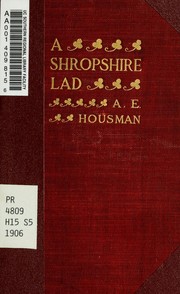
什罗普郡少年(A Shropshire Lad)是英国诗人阿尔弗雷德·爱德华·豪斯曼1896年出版的一部诗集,包含63首诗。它起初销量不佳,但不到十年后就迅速出名,开始被谱成音乐流传于后世。
历史
据说这本书最开始的名字是《The Poems of Terence Hearsay》,但作者在大英博物馆的一位同事的建议下将书名改为现名。但也有人认为其实名字从来就没改过。
起初这本书销量不好。最初印刷了500本,其中约160本售往美国,直到1898年才卖完。第二次布尔战争期间,其销量增加。第一次世界大战期间,许多年轻人带着它走上战场。最初他不收版税,以压低价格促进销量。1911年,其年平均销量为13,500册,到其发行50周年时,在英国和美国这部作品已经有近百个版本。
评价
豪斯曼的目标群体是年轻男性。威斯坦·休·奥登等许多作家受其影响。据乔治·奥威尔回忆,他伊顿公学的同学“常常在一种狂喜中一遍又一遍地给自己背诵这些诗歌”。
虽然标题是《什罗普郡少年》,但其实据作者本人所说:“我出生在伍斯特郡,而不是什罗普郡,我从未在那里呆过太多时间”。他说:“我对什罗普郡有一种感伤,因为它的山就在我们西方的地平线上。”所以作品中出现的一些地名位置与现实并不相符。
以上文字摘自维基百科「什罗普郡少年」(去掉了参考文献等尾部小节),按 CC BY-SA 4.0 使用,作者为维基百科的各位编者。
中文维基百科的条目比较短,下面附上英文维基百科的内容(英文原文):
A Shropshire Lad is a collection of 63 poems by the English poet A. E. Housman, published in 1896. Selling slowly at first, it then rapidly grew in popularity, particularly among young readers. Composers began setting the poems to music less than ten years after their first appearance, and many parodists have satirised Housman's themes and poetic style.
A Shropshire rhapsody
Housman is said originally to have titled his book The Poems of Terence Hearsay, referring to a character there, but changed the title to A Shropshire Lad at the suggestion of a colleague in the British Museum. A friend of his remembered otherwise, however, and claimed that A Shropshire Lad was always Housman's choice of title. He had more than a year to think about it, since most of the poems he chose to include in his collection were written in 1895, while he was living at Byron Cottage in Highgate. The book was published the following year, partly at the author's expense, after it had already been rejected by one publisher.
At first the book sold slowly; the initial printing of 500 copies, some 160 of which were sent to the United States, did not clear until 1898. Sales revived during the Second Boer War (1899–1902), due in part to the prominence of military themes and of dying young. Its popularity increased thereafter, especially during World War I, when the book accompanied many young men into the trenches but it also benefited from the accessibility that Housman encouraged himself. Initially he declined royalty payments, so as to keep the price down, and also encouraged small, cheap pocket (and even waistcoat pocket) editions. By 1911 sales were at an annual average of 13,500 copies, and by its fiftieth anniversary there had been approaching a hundred UK and US editions.
Housman later repeated the claim made in the final poem of the sequence (LXIII) to have had a young male readership in mind. For W. H. Auden and his generation "no other poet seemed so perfectly to express the sensibility of a male adolescent"; and George Orwell remembered that, among his generation at Eton College in the wake of World War I, "these were the poems which I and my contemporaries used to recite to ourselves, over and over, in a kind of ecstasy". They responded to Housman's lament for the transience of love, idealism and youth in what was in essence a half-imaginary pastoral countryside in a county only visited by him after he had begun writing the poems. "I was born in Worcestershire, not Shropshire, where I have never spent much time," he admitted later in a letter to Maurice Pollet dated 5 February 1933. "I had a sentimental feeling for Shropshire because its hills were on our Western horizon." Thus the "blue remembered hills" of his "land of lost content" in Poem XL are mostly a literary construct. Though the names there can be found on the map, their topographical details are admittedly not factual.
Indeed, Housman confessed in his letter to Pollett that "I know Ludlow and Wenlock, but my topographical details – Hughley, Abdon under Clee – are sometimes quite wrong". He did, however, have one source to guide him, echoes from which are to be found in the poems. This was Murray's Handbook for Shropshire, Cheshire and Lancashire (originally published in 1870), in which is to be found the jingle with which poem L opens,
Shrewsbury is described in the book as "encircled by the Severn on all sides but the North, and locally termed 'the Island'", which Housman condenses to "Islanded in Severn stream" in his poem XXVIII. Murray also mentions that the last fair of the year at Church Stretton is called 'Dead Man's Fair', the event with which "In midnights of November" begins. Written about the same time as the others, this poem was held over until it was incorporated in Last Poems (1922).
以上文字摘自英文维基百科「A Shropshire Lad」(有删节,去掉了参考文献等尾部小节),按 CC BY-SA 4.0 使用,作者为维基百科的各位编者。
资料卡
- 插图
- William Hyde
- 原作语言
- 英语
- 首次出版
- 1896 年
- 体裁
- 诗歌
- 续作
- Last Poems
资料卡来自 Wikidata Q4659502(CC0),众包数据,个别字段可能不全。
改编作品
音乐1
名单来自 Wikidata(CC0):只列条目里写明「改编自 / 取材于」这本书的作品,不按名字猜;众包数据,可能不全。