书单
百科
这个词条暂时没有中文维基百科条目,下面是英文维基百科的内容(英文原文):
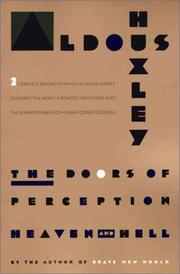
The Doors of Perception is an autobiographical book written by Aldous Huxley. Published in 1954, it elaborates on his psychedelic experience under the influence of mescaline in May 1953. Huxley recalls the insights he experienced, ranging from the "purely aesthetic" to "sacramental vision", and reflects on their philosophical and psychological implications. In 1956, he published Heaven and Hell, another essay which elaborates these reflections further. The two works have since often been published together as one book; the titles of both come from William Blake's 1793 book The Marriage of Heaven and Hell.
The Doors of Perception provoked strong reactions for its evaluation of psychedelic drugs as facilitators of mystical insight with great potential benefits for science, art, and religion. While many found the argument compelling, others including German writer Thomas Mann, Vedantic monk Swami Prabhavananda, Jewish philosopher Martin Buber, and Orientalist scholar Robert Charles Zaehner countered that the effects of mescaline are subjective and should not be conflated with objective religious mysticism. Huxley himself continued to take psychedelics for the rest of his life, and the alleged understanding he gained from them influenced his final novel Island, published in 1962.
Background
William Blake
William Blake (1757–1827), who inspired the book's title and writing style, was an influential English artist most notable for his paintings and poetry. The "doors of perception" was originally a metaphor written by Blake in his 1790 book, The Marriage of Heaven and Hell. The metaphor was used to represent Blake's feelings about mankind's limited perception of the reality around them:
If the doors of perception were cleansed every thing would appear to man as it is, Infinite. For man has closed himself up, till he sees all things thro' narrow chinks of his cavern.
Mescaline
Mescaline is the principal active psychedelic agent of the peyote cactus, which has been used in Native American religious ceremonies for thousands of years. A German pharmacologist, Arthur Heffter, isolated the alkaloids in the peyote cactus in 1897. These included mescaline, which he showed through a combination of animal and self-experiments was the compound responsible for the psychoactive properties of the plant. In 1919, Ernst Späth, an Austrian chemist, synthesised the drug. Although personal accounts of taking the cactus had been written by psychologists such as Weir Mitchell in the US and Havelock Ellis in the UK during the 1890s, the German-American Heinrich Klüver was the first to systematically study its psychological effects in a small book called Mescal: The 'Divine' Plant and Its Psychological Effects published in 1928. The book stated that the drug could be used to research the unconscious mind.
In the 1930s, American anthropologist Weston La Barre published The Peyote Cult, the first study of the ritual use of peyote as an entheogen drug amongst the Huichol people of western Mexico. La Barre noted that the Native American users of the cactus took it to obtain visions for prophecy, healing and inner strength. Most psychiatric research projects into the drug in the 1930s and early 1940s tended to look at the role of the drug in mimicking psychosis. In 1947 however, the US Navy undertook Project Chatter, which examined the potential for the drug as a truth revealing agent. In the early 1950s, when Huxley wrote his book, mescaline was still regarded as a research chemical rather than a drug and was listed in the Parke-Davis catalogue with no controls. Mescaline also played a paramount part in influencing the beat generation of poets and writers of the later 1940s to the early 1960s. Most notable in this regard were William S. Burroughs, Jack Kerouac, and Allen Ginsberg, all of whom were respected contemporary beat artists of their generation. Theirs and many other contemporary artists' works were heavily influenced by over-the-counter forms of mescaline during this time, due to its potency and attainability.
Huxley had been interested in spiritual matters and had used alternative therapies for some time. In 1936 he told TS Eliot that he was starting to meditate, and he used other therapies too; the Alexander Technique and the Bates method of seeing had particular importance in guiding him through personal crises. In the late 1930s he had become interested in the spiritual teaching of Vedanta and in 1945 he published The Perennial Philosophy, which set out a philosophy that he believed was found amongst mystics of all religions. He had known for some time of visionary experience achieved by taking drugs in certain religions.
Research by Humphry Osmond
Huxley had first heard of peyote use in ceremonies of the Native American Church in New Mexico, soon after coming to the United States in 1937. He first became aware of the cactus's active ingredient, mescaline, after reading an academic paper written by Humphry Osmond, a British psychiatrist working at Weyburn Mental Hospital, Saskatchewan, in early 1952. Osmond's paper set out results from his research into schizophrenia, using mescaline that he had been undertaking with colleagues, doctors Abram Hoffer and John Smythies. In the epilogue to his novel The Devils of Loudun, published earlier that year, Huxley had written that drugs were "toxic short cuts to self-transcendence". For the Canadian writer George Woodcock, Huxley had changed his opinion because mescaline was not addictive and appeared to be without unpleasant physical or mental side-effects. Further, he had found that hypnosis, autohypnosis and meditation had apparently failed to produce the results he wanted.
以上文字摘自英文维基百科「The Doors of Perception」(有删节,去掉了参考文献等尾部小节),按 CC BY-SA 4.0 使用,作者为维基百科的各位编者。
资料卡
- 原题
- The Doors of Perception
- 原作语言
- 英语
- 首次出版
- 1954 年
- 体裁
- 随笔
- 主题
- 哲学
资料卡来自 Wikidata Q1215450(CC0),众包数据,个别字段可能不全。