书单
百科
这个词条暂时没有中文维基百科条目,下面是英文维基百科的内容(英文原文):
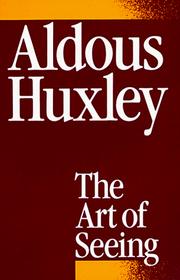
The Art of Seeing: An Adventure in Re-education is a 1942 book by Aldous Huxley, which details his experience with and views on the discredited Bates method, which according to Huxley improved his eyesight.
Huxley's own sight
In the preface to the book, Huxley describes how, at the age of sixteen, he had a violent attack of keratitis punctata which made him almost totally blind for eighteen months, and left him thereafter with severely impaired sight. Strong spectacles were of help, but reading, in particular, was a great strain. In 1939 his ability to read became increasingly degraded, and he sought the help of Margaret Corbett, who taught the Bates method. He found this immensely helpful, and in 1942 wrote “At the present time, my vision, though very far from normal, is about twice as good as it used to be when I wore spectacles, and before I had learned the art of seeing”.
The book is not an autobiography, however. Although his own history fuelled his interest in vision, and there are references in passing throughout the book to his own case, it is written as a general study of vision as he came to understand it.
His aim in writing
Huxley writes that his aim in writing the book was
… to correlate the methods of visual education with the findings of modern psychology and critical philosophy. My purpose in making this correlation is to demonstrate the essential reasonableness of a method, which turns out to be nothing more or less than the practical application to the problems of vision of certain theoretical principles, universally accepted as true.
Unlike many other texts on the Bates method, Huxley's book contains no diagrams of the eye, and very little description of its physiology.
The supposed incurability of visual defect
According to Huxley, the prevailing medical view is that
...the organs of vision are incapable of curing themselves … then the eyes must be totally different in kind from other parts of the body. Given favourable conditions, all other organs tend to free themselves from their defects. Not so the eyes. … it is a waste of time even to try to discover a treatment which will assist nature in its normal task of healing. …
He quotes Matthew Luckiesh, Director of General Electric’s Lighting Research Laboratory who wrote:
Suppose that crippled eyes could be transformed into crippled legs. What a heart-rending parade we would witness on a busy street! Nearly every other person would go limping by. Many would be on crutches and some on wheel chairs.
Huxley goes on to stress that when legs are imperfect, every effort is made to get the patient walking again, and without crutches if at all possible. "Why should it not be possible to do something analogous for defective eyes?"
The orthodox theory is, on the face of it, so implausible, so intrinsically unlikely to be true, that one can only be astonished that it should be so generally and so unquestioningly accepted. … At the present time it is rejected only by those who have personal reasons for knowing it to be untrue … It is therefore no longer possible for me to accept the currently orthodox theory, with its hopelessly pessimistic practical consequences.
Sensing+Selecting+Perceiving=Seeing
He goes on to analyse the whole process of visual perception, using ideas and vocabulary taken from the philosopher C. D. Broad. He sums the analysis up as follows:
Sensing is not the same as seeing.
The eyes and the nervous system do the sensing, the mind does the perceiving.
The faculty of perceiving is related to the individual’s accumulated experiences, in other words, to memory.
Clear seeing is the product of accurate sensing and correct perceiving.
Any improvement in the power of perceiving tends to be accompanied by an improvement in the power of sensing and of the product of sensing and perceiving which is seeing.
Variability
The most characteristic fact about the functioning of the total organism, or any part of the organism, is that it is not constant, but highly variable. … People with unimpaired eyes and good habits of using them possess, so to speak, a wide margin of visual safety. Even when their seeing organs are functioning badly, they still see well enough for most practical purposes. Consequently they are not so acutely conscious of variations in visual functioning as are those with bad seeing habits and impaired eyes. These last have little or no margin of safety; consequently any diminution in seeing power produces noticeable and often distressing results.
Huxley goes on to discuss the factors which bring about variation – general health or lack of it, tiredness, boredom, emotional states. But whereas these are in general transitory, glasses, if worn, are to a fixed prescription.It will thus be seen that the wearing of spectacles confines the eyes to a state of rigid and unvarying structural immobility. In this respect artificial lenses resemble, not the crutches to which Dr. Luckiesh has compared them, but splints, iron braces and plaster casts.
以上文字摘自英文维基百科「The Art of Seeing」(有删节,去掉了参考文献等尾部小节),按 CC BY-SA 4.0 使用,作者为维基百科的各位编者。
资料卡
- 原题
- The Art of Seeing
- 原作语言
- 英语
- 首次出版
- 1942 年
- 首版出版社
- 哈珀与罗出版公司
- 主题
- 贝茨疗法
资料卡来自 Wikidata Q581600(CC0),众包数据,个别字段可能不全。